Home
Class 12
PHYSICS
In the given circuit switch S(2) is Kept...

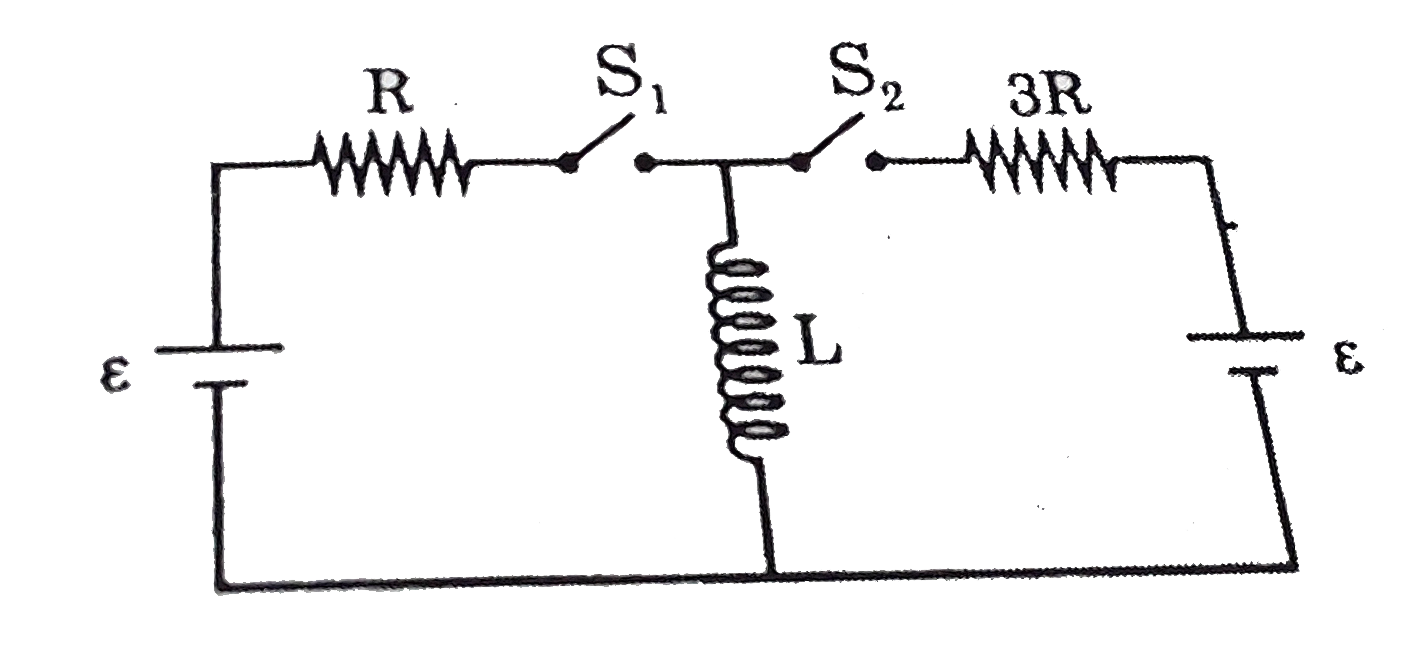
In the given circuit switch `S_(2)` is Kept closed and `S_(1)` is kept open for a very long time such that the system is in steady- state . Now `S_(1)` is also slosed keeping `S_(2)` closed.

Current passing through R just after `S_(1)` is closed , is :

A

`(epsilon)/(R)`

B

`(epsilon)/(3R)`

C

`4(epsilon)/(3R)`

D

`(epsilon)/(2R)`

Text Solution

Verified by Experts

The correct Answer is:

C
Promotional Banner

Topper's Solved these Questions

  • TEST PAPERS

    ALLEN |Exercise MATHS|1 Videos
  • TEST PAPERS

    ALLEN |Exercise part-2 physic|48 Videos
  • TEST PAPER 4

    ALLEN |Exercise PHYSICS|45 Videos
  • UNIT & DIMENSIONS, BASIC MATHS AND VECTOR

    ALLEN |Exercise Exercise (J-A)|7 Videos

Similar Questions

Explore conceptually related problems

In the given circuit switch S_(2) is Kept closed and S_(1) is kept open for a very long time such that the system is in steady- state . Now S_(1) is also slosed keeping S_(2) closed. Current passing through inductor L time after S_(1) is closed , is :

In given circuit initially switch S_(w_(1)) is closed and S_(w_(2)) is open, Now S_(w_(1)) is opened and S_(w_(2)) is closed, what is the heat liberated in resistance R?

What is the current in the 40 resistor when switch S_(1) is open and switch S_(2) is closed in the given circuit ?

An inductor (L = 0.03 H) and a resistor (R = 0.15 kOmega ) are connected in series to a battery of 15 V EMF in a circuit shown below The key K_1 has been kept closed for a long time. Then at t = 0, K_1 is opened and key K_2 is closed simultaneously. At t = 1 ms, the current in the circuit will be : (e^5 cong 150)

A conducting sphere S_1 of radius r is attached to an insulating handle. Another conduction sphere S_2 of radius R is mounted on an insulating stand. S_2 is initially uncharged. S_1 is given a charge Q brought into contact with S_2 and removed. S_1 is recharge such that the charge on it is again Q and it is again brought into contact with S_2 and removed. This procedure is repeated n times. a. Find the electrostatic energy of S_2 after n such contacts with S_1 . b. What is the limiting value of this energy as nrarroo ?

Sounds from two identical sources S_(1) and S_(2) reach a point P . When the sounds reach directly, and in the same phase, the intensity at P is I_(0) . The power of S_(1) is now reduced by 64% and the phase difference between S_(1) and S_(2) is varied continuously. The maximum and minimum intensities recorded at P are now I_("max") and I_("min")

A vessel ABCD of 10 cm width has two small slits S_(1) and S_(2) sealed with idebtical glass plates of equal thickness. The distance between the slits is 0.8 mm . POQ is the line perpendicular to the plane AB and passing through O, the middle point of S_(1) and S_(2) . A monochromatic light source is kept at S, 40 cm below P and 2 m from the vessel, to illuminate the slits as shown in the figure. Calculate the position of the central bright fringe on the other wall CD with respect of the line OQ . Now, a liquid is poured into the vessel and filled up to OQ . The central bright fringe is fiund to be at Q. Calculate the refractive index of the liquid.

Figure shows two coherent sources S_(1) and S_(2) which emit sound of wavelength lambda in phase. The separation between the sources is lambda. A circular wire of large radius is placed in such a way that S_(1)S_(2) lies in its plane and the middle point of S_(1)S_(2) is at the centre of the wire. Find the angular positions theta, on the wire for which constructive interference takes place.
