Home
Class 12
PHYSICS
A ball is hit by a batsman at an angle o...

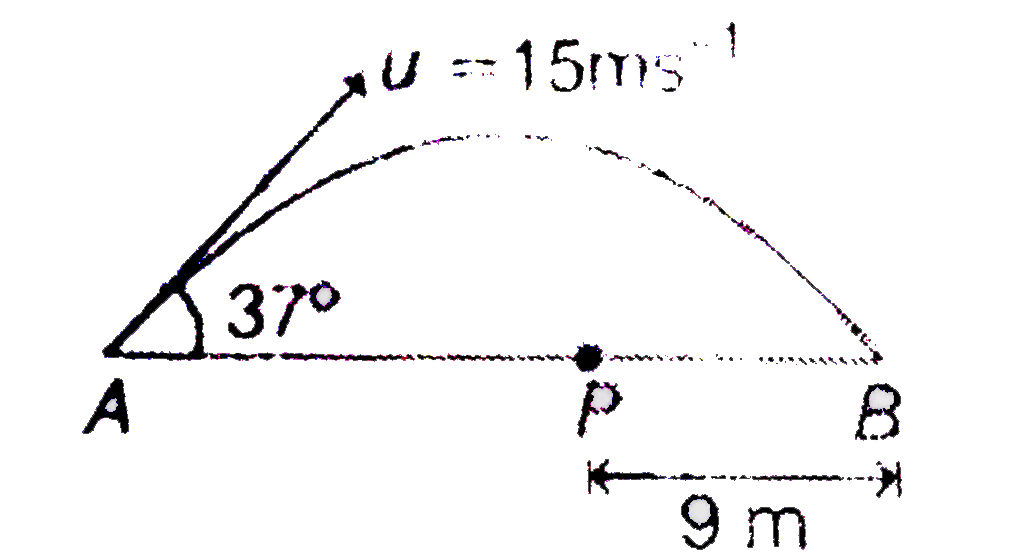
A ball is hit by a batsman at an angle of `37^(@)` as shown in figure. The man standing at `P` should run at what minimum velocity so that he catches the ball before it strikes the ground. Assume that height of man is negligible in comparison to maximum height of projectile.

A

3 m/s

B

5 m/s

C

9 m/s

D

12 m/s

Text Solution

Verified by Experts

The correct Answer is:

B
Promotional Banner

Topper's Solved these Questions

  • KINEMATICS-2D

    ALLEN |Exercise Exercise (O-2)|47 Videos
  • KINEMATICS-2D

    ALLEN |Exercise Exercise (S-2)|14 Videos
  • GRAVITATION

    ALLEN |Exercise EXERCISE 4|9 Videos
  • MOTION IN A PALNE

    ALLEN |Exercise SOLVED EXAMPLE|28 Videos

Similar Questions

Explore conceptually related problems

A ball was thrown by a boy a at angle 60^(@) with horizontal at height 1 m from ground. Boy B is running in the plane of motion of ball and catches the ball at height 1 m from ground. He finds the ball falling vertically. If the boy is running at a speed 20 km/hr. Then the velocity of projection of ball is-

A car P is moving with a uniform speed 5sqrt3 m//s towards a carriage of mass 9 kg at rest kept on the rails at a point B as shown in figure. The height AC is 120 m. Cannon balls of 1 kg are fired from the car with an initial velocity 100m//s at an angle 30^@ with the horizontal. The first cannon hall hits the stationary carriage after a time t_0 and sticks to it. Determine t_0 . At t_0 , the second cannon ball is fired. Assume that the resistive force between the rails and the carriage is constant and ignore the vertical motion of the carriage throughout. If the second ball also hits and sticks to the carriage, what will be the horizontal velocity of the carriage just after the second impact?

A circus wishes to develop a new clown act. Fig. (1) shows a diagram of the proposed setup. A clown will be shot out of a cannot with velocity v_(0) at a trajectory that makes an angle theta=45^(@) with the ground. At this angile, the clown will travell a maximum horizontal distance. The cannot will accelerate the clown by applying a constant force of 10, 000N over a very short time of 0.24s . The height above the ground at which the clown begins his trajectory is 10m . A large hoop is to be suspended from the celling by a massless cable at just the right place so that the clown will be able to dive through it when he reaches a maximum height above the ground. After passing through the hoop he will then continue on his trajectory until arriving at the safety net. Fig (2) shows a graph of the vertical component of the clown's velocity as a function of time between the cannon and the hoop. Since the velocity depends on the mass of the particular clown performing the act, the graph shows data for serveral different masses. If a clown holds on to hoop instead of passing through it, what is the position of the cable so that he doesn't hit his head on the ceiling as he swings upward?

A circus wishes to develop a new clown act. Fig. (1) shows a diagram of the proposed setup. A clown will be shot out of a cannot with velocity v_(0) at a trajectory that makes an angle theta=45^(@) with the ground. At this angile, the clown will travell a maximum horizontal distance. The cannot will accelerate the clown by applying a constant force of 10, 000N over a very short time of 0.24s . The height above the ground at which the clown begins his trajectory is 10m . A large hoop is to be suspended from the celling by a massless cable at just the right place so that the clown will be able to dive through it when he reaches a maximum height above the ground. After passing through the hoop he will then continue on his trajectory until arriving at the safety net. Fig (2) shows a graph of the vertical component of the clown's velocity as a function of time between the cannon and the hoop. Since the velocity depends on the mass of the particular clown performing the act, the graph shows data for serveral different masses. From figure 2, approximately how much time will it take for clown with a mass of 60 kg to reach the safety net located 10 m below the height of the cannot?

A circus wishes to develop a new clown act. Fig. (1) shows a diagram of the proposed setup. A clown will be shot out of a cannot with velocity v_(0) at a trajectory that makes an angle theta=45^(@) with the ground. At this angile, the clown will travell a maximum horizontal distance. The cannot will accelerate the clown by applying a constant force of 10, 000N over a very short time of 0.24s . The height above the ground at which the clown begins his trajectory is 10m . A large hoop is to be suspended from the celling by a massless cable at just the right place so that the clown will be able to dive through it when he reaches a maximum height above the ground. After passing through the hoop he will then continue on his trajectory until arriving at the safety net. Fig (2) shows a graph of the vertical component of the clown's velocity as a function of time between the cannon and the hoop. Since the velocity depends on the mass of the particular clown performing the act, the graph shows data for serveral different masses. If the clown's mass is 80 kg , what initial velocity v_(0) will have as he leaves the cannot?

A circus wishes to develop a new clown act. Fig. (1) shows a diagram of the proposed setup. A clown will be shot out of a cannot with velocity v_(0) at a trajectory that makes an angle theta=45^(@) with the ground. At this angile, the clown will travell a maximum horizontal distance. The cannot will accelerate the clown by applying a constant force of 10, 000N over a very short time of 0.24s . The height above the ground at which the clown begins his trajectory is 10m . A large hoop is to be suspended from the celling by a massless cable at just the right place so that the clown will be able to dive through it when he reaches a maximum height above the ground. After passing through the hoop he will then continue on his trajectory until arriving at the safety net. Fig (2) shows a graph of the vertical component of the clown's velocity as a function of time between the cannon and the hoop. Since the velocity depends on the mass of the particular clown performing the act, the graph shows data for serveral different masses. The slope of the line segments plotted in figure 2 is a figure constant. Which one of the following physical quantities does this slope represent?

A ball is thrown at an angle theta up to the top of a cliff of height L, from a point at a distance. L from the base, as shown in figure. Assuming that one of the following quantities is the initial speed required to make the ball hit right at the edge of the cliff, which one is it :-

Two very small balls A and B of masses 4.0kg and 5.0kg are affixed to the ends of a light inextensible cord that passes through a frictionless ring of radius negligible compared to the length of the cord. The ring is fixed at some height above the ground . Ball A is pulled aside and given a horizontal velocity so that it stars moving on a circular path parallel to the ground, keeping ball B in euilibrium as shown. speed of the ball A is closest to

A point sources S emitting light of wavelength 600nm is placed at a very small height h above the flat reflecting surface AB (see figure).The intensity of the reflected light is 36% of the intensity.interference firnges are observed on a screen placed parallel to the reflecting surface a very large distance D from it. (A)What is the shape of the interference fringes on the screen? (B)Calculate the ratio of the minimum to the maximum to the maximum intensities in the interference fringes fromed near the point P (shown in the figure) (c) if the intenstities at point P corresponds to a maximum,calculate the minimum distance through which the reflecting surface AB should be shifted so that the intensity at P again becomes maximum.

in figure shown AB is a plane mirror of length 40cm placed at a height 40cm from ground . There is a light source S at a point on the ground ,Find the maximum and minimum height of a man(eye height)required to see the image of the source If he is standing at a point A on ground shown in figure.

ALLEN -KINEMATICS-2D-Exercise (O-1)
  1. A particle is projected from the ground with velocity u at angle theta...

    Text Solution

    |

  2. Suppose a player hits several baseballs. Which baseball will be in the...

    Text Solution

    |

  3. A ball is hit by a batsman at an angle of 37^(@) as shown in figure. T...

    Text Solution

    |

  4. A ball is projected horizontally. After 3s from projection its velocit...

    Text Solution

    |

  5. A particle P is projected from a point on the surface of smooth inclin...

    Text Solution

    |

  6. If time taken by the projectile to reach Q is T, than PQ =

    Text Solution

    |

  7. A particle is projected up the inclined such that its component of vel...

    Text Solution

    |

  8. A particle A is projected with speed v(A) from a point making an angle...

    Text Solution

    |

  9. Consider the motion of three bodies as shown for an observer on B. wha...

    Text Solution

    |

  10. A trolley is moving horizontally with a constant velocty of v m//s w.e...

    Text Solution

    |

  11. An elevator car (lift) is moving upward with uniform acceleration of 2...

    Text Solution

    |

  12. A flag is mounted on a car moving due North with velocity of 20 km//hr...

    Text Solution

    |

  13. Three ships A, B and C are in motion. The motion of A as seen by B is ...

    Text Solution

    |

  14. Wind is blowing in the north direction at speed of 2 m/s which causes ...

    Text Solution

    |

  15. A boat which has a speed of 5km per hour in still water crosses a rive...

    Text Solution

    |

  16. A man is crossing a river flowing with velocity of 5m//s. He reaches a...

    Text Solution

    |

  17. A motor boat is to reach at a point 30^@ upstream on the outer side of...

    Text Solution

    |

  18. A ball is thrown from the top of 36m high tower with velocity 5m//ss a...

    Text Solution

    |

  19. A particle moves in the xy plane and at time t is at the point vec r= ...

    Text Solution

    |

  20. A particle moves in the xy plane with a constant acceleration 'g' in t...

    Text Solution

    |
