Home
Class 11
PHYSICS
Two forces of magnitudes 3N and 4N are a...

Two forces of magnitudes `3N` and `4N` are acted on a body. The ratio of magnitude of minimum and maximum resultant force on the body is

Text Solution

Verified by Experts
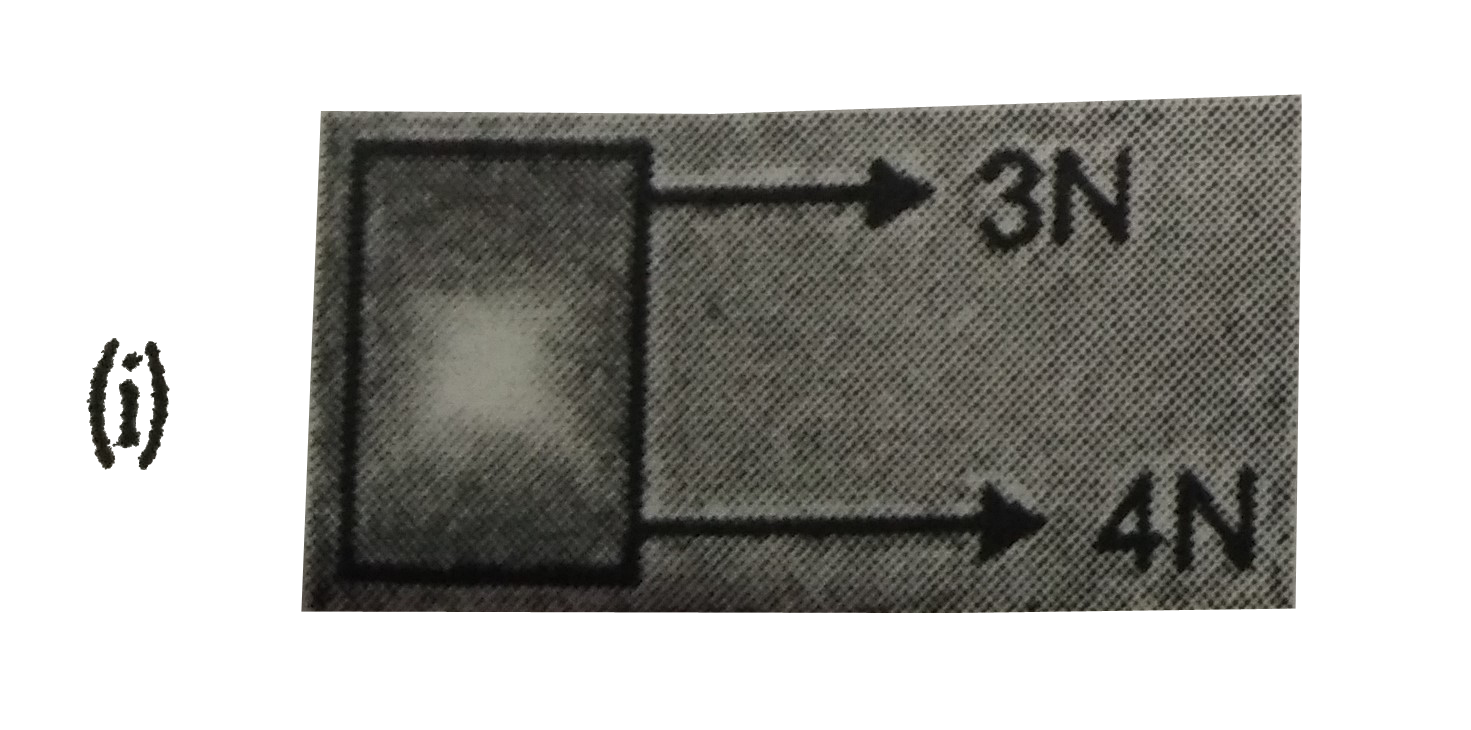
(i)
`theta = 0^(@)`, both the forcees are parallel, R= A+B
`therefore` Net force or resultant force R = 3+4= 7N
`" "` Diretion of resultant is along both the forces

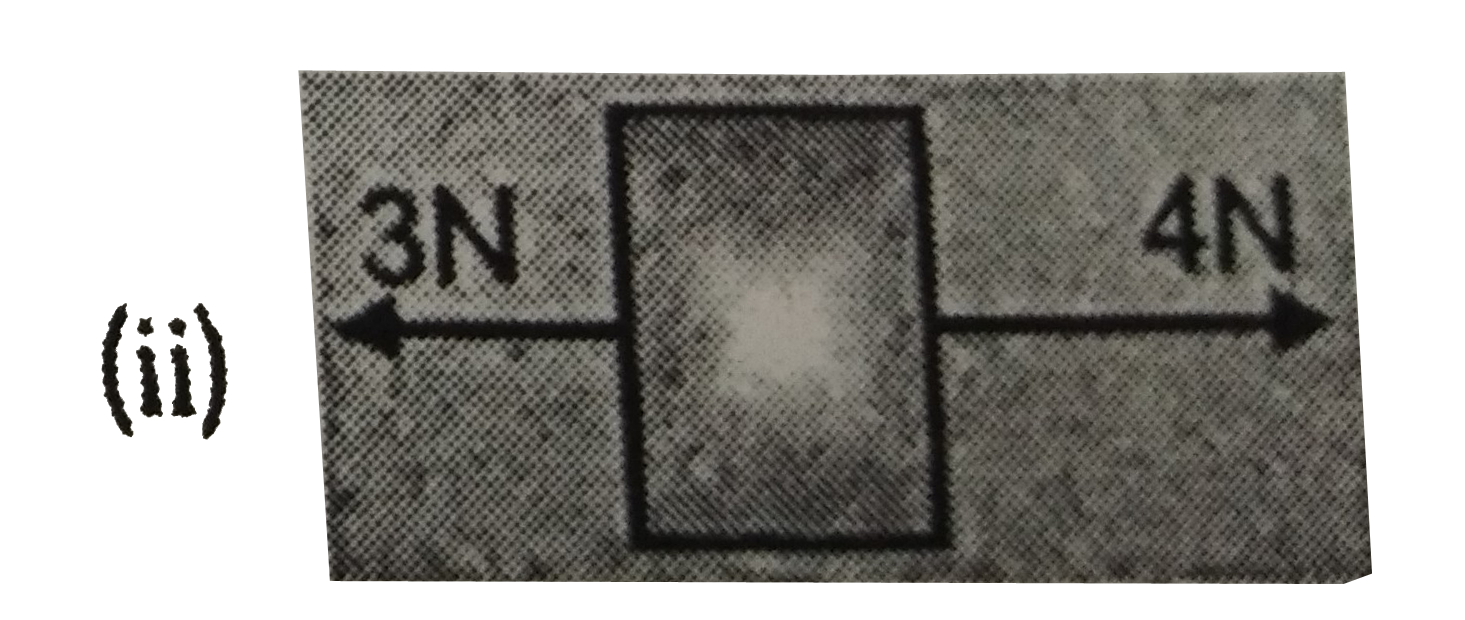
`theta= 180^(@)`, both the forces are antiparallel, R = A`~`B
`therefore ` Net force or resultant force R= 4-3 = 1N
Direction of net force is along larger force i.e. along 4N.
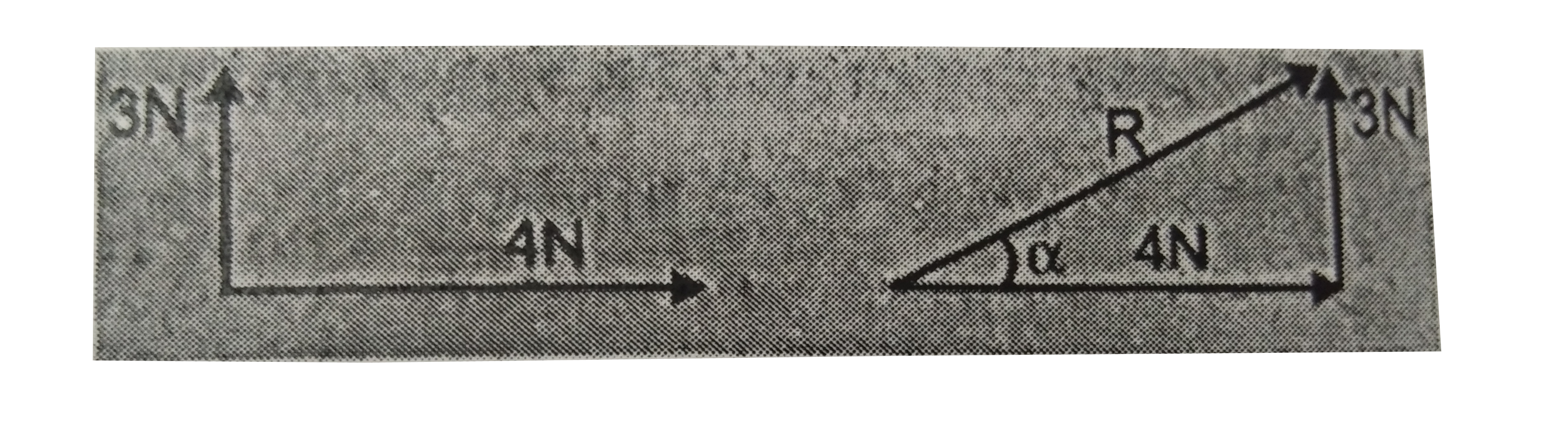
(iii) `theta= 90^(@)`, both the forces are perpendicular

then `R= sqrt (A^(2) + B^(2) + 2AB cos 90^(@))=sqrt (A^(2) + B^(2)) = sqrt(3^(2) + 4^(2))= 5N, tan alpha = (3)/(4) rArr alpha = tan^(-1) ((3)/(4))= 37^(@)`
Magnitude of resultant is 5N which is acting at an angle of `37^(@)` from 4N force.
Promotional Banner

Topper's Solved these Questions

  • BASIC MATHEMATICS USED IN PHYSICS &VECTORS

    ALLEN |Exercise BEGINNER S BOX 1|2 Videos
  • BASIC MATHEMATICS USED IN PHYSICS &VECTORS

    ALLEN |Exercise BEGINNER S BOX 2|3 Videos
  • CENTRE OF MASS

    ALLEN |Exercise EXERCISE-V B|19 Videos

Similar Questions

Explore conceptually related problems

Two forces of magnitudes 3N and 4N respectively are acting on a body. Calculate the resultant force if the angle between them is : (i) 0^(@) (ii) 180^(@) (iii) 90^(@)

Three forces of magnitudes 2N, 3N and 6N act at corners of a cube along three sides as shown in figure. Find the resultant of these forces in N.

ABC is an isosceles triangle right angled at A. forces of magnitude 2sqrt(2),5 and 6 act along BC, CA and AB respectively. The magnitude of their resultant force is

Three ant P,Q and R are pulling a grain with forces of magnitude 6N,3sqrt(3) N " and " 3sqrt(2)N as shown in the figure. Find the magnitude of resultant force (in N ) acting on the grain .

Which force act on body first action or reaction

A block is applied two forces of magnitude 5N each. One force is acting towards East and the other acting along 60^(@) North of East. The resultant of the two forces (in N) is of magnitude :-

Assertion :- when two non parallel forces F_(1) and F_(2) act on a body. The magnitude of the resultant force acting on the is less than the "sum" of F_(1) and F_(2) Reason :- In a triangle, any side is less then the "sum" of the other two sides.

Two displacement vectors of same magnitude are arranged in the folllowing manner. Magnitude of resultant is maximum for

Three forces acting on a body are shown in figure. To have the resultant force only along the y-directon, the magnitude of the minimum additional force needed along OX is

Two forces, each of magnitude F have a resultant of the same magnitude F. The angle between the two forces is