Home
Class 11
PHYSICS
Three girls skating on a circular ice gr...

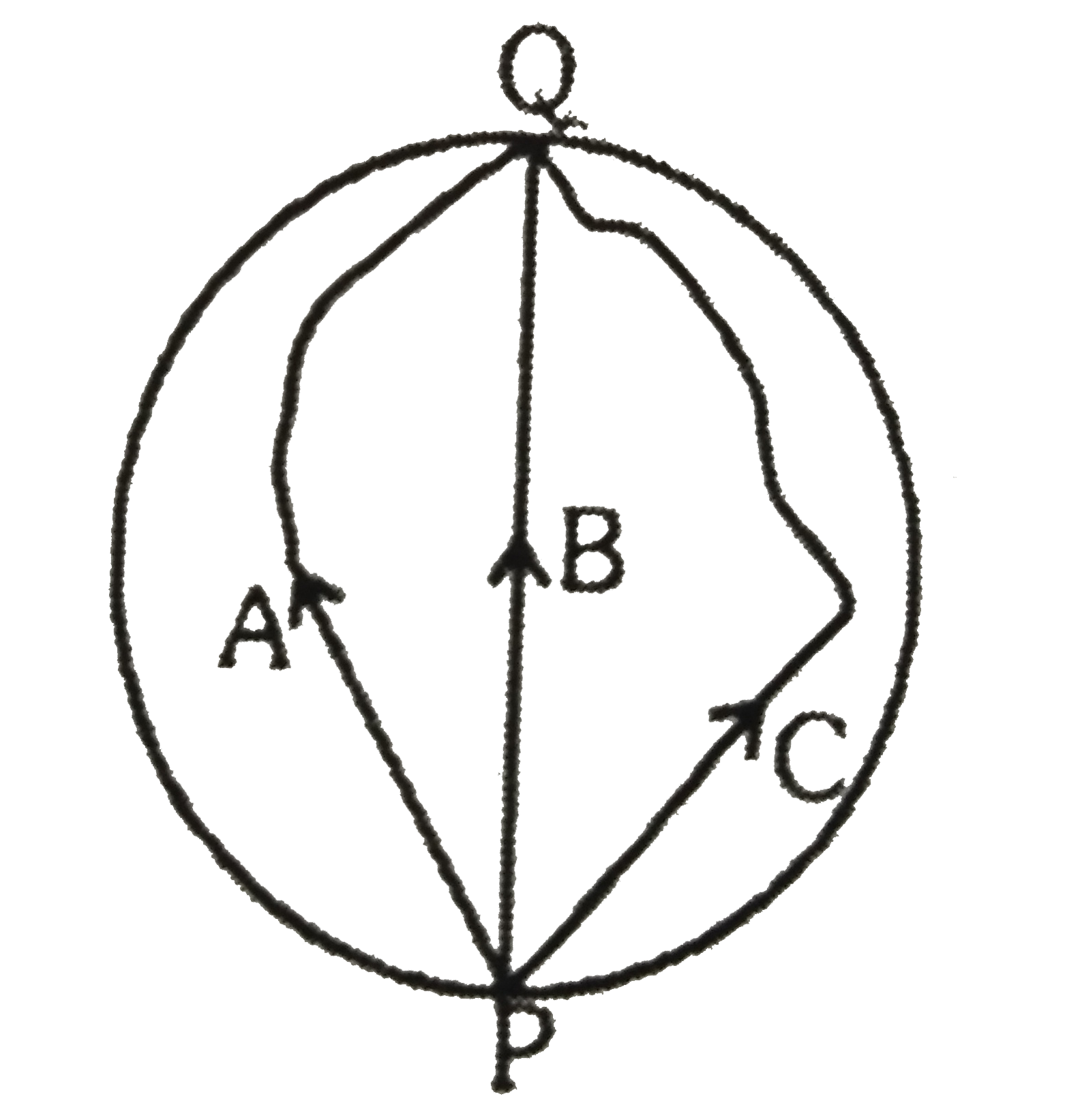
Three girls skating on a circular ice ground of radius 200 m start from a point P on the edge of the ground and a point Q diametrically opposite to P following different paths as shown in figure. What is the magnitude of the placement for each ? For which girl is this equal to the actual to the actual length of path skate ?

Text Solution

Verified by Experts

Since displacement is independent of path, the displacement is the shortest distance between initial position & final position. So the displacement for each girl will be 400 m. For girl 'B' the displacement will be equal to actual path length
Promotional Banner

Topper's Solved these Questions

  • KINEMATICS (MOTION ALONG A STRAIGHT LINE AND MOTION IN A PLANE)

    ALLEN |Exercise BEGINNER S BOX-2|7 Videos
  • KINEMATICS (MOTION ALONG A STRAIGHT LINE AND MOTION IN A PLANE)

    ALLEN |Exercise BEGINNER S BOX-3|2 Videos
  • KINEMATICS (MOTION ALONG A STRAIGHT LINE AND MOTION IN A PLANE)

    ALLEN |Exercise BEGINNER S BOX-7|8 Videos
  • KINEMATICS

    ALLEN |Exercise EXERCISE-2|89 Videos
  • MISCELLANEOUS

    ALLEN |Exercise Question|1 Videos

Similar Questions

Explore conceptually related problems

Three particles P, Q and R are situated at point A on the circular path of radius 10m. All three particles move along different path and reach at point B shown in figure. Then the ratio of distance traversed by particle P and Q is:-

On an open ground , a motorist follows a track that turns to his left by an angle of 60^(@) after every 500 m. Starting from a given turn , specify the displacement of of the motorist at the third , sixth and eighth turn . Compare the magnitude of the displacement with the total path length covered by the motorist in each case.

A small ball of mass m and charge q is attached to the bottom end of a piece of negligible mass thread of length l, whose top end is fixed. The system formed by the thread and ball is in vertical plane and is in uniform horizontal magnetic field B, which is perpendicular to the plane of figure and points into the paper The ball is started with a velocity v_(0) from lower most point of circle in a direction perpendicular both to the magnetic induction and to direction of thread. The ball moves along a circular path such that thread remains tight during the whole motion. Neglect any loss of enery. By what factor is the force acting on the thread (tension in thread) at point A is greater than at point C, when speed of the ball is the above stated one?

A point p moves in counter - clockwise direction on a circular path as shown in the figure . The movement of 'p' is such that it sweeps out in the figure . The movement of 'p' is such that it sweeps out a length s = t^(3) + 5 , where s is in metres and t is in seconds . The radius of the path is 20 m . The acceleration of 'P' when t = 2 s is nearly .

A ray of light travelling with a speed c leaves point 1 shown in figure and is reflected to point 2. The ray strikes the reflecting surface at a distance x from point 1. According to Fermat's principle of least time, among all possible paths between two points , the one actually taken by a ray of light is that for which the time taken is the least (In fact there are some cases in which the time taken by a ray is maximum rather than a minimum). Which of the following statement is in accordance with Fermat's principle

A ray of light travelling with a speed c leaves point 1 shown in figure and is reflected to point 2. The ray strikes the reflecting surface at a distance x from point 1. According to Fermat's principle of least time, among all possible paths between two points , the one actually taken by a ray of light is that for which the time taken is the least (In fact there are some cases in which the time taken by a ray is maximum rather than a minimum). Under what condition is time taken least?

A small ball of mass m and charge q is attached to the bottom end of a piece of negligible mass thread of length l, whose top end is fixed. The system formed by the thread and ball is in vertical plane and is in uniform horizontal magnetic field B, which is perpendicular to the plane of figure and points into the paper The ball is started with a velocity v_(0) from lower most point of circle in a direction perpendicular both to the magnetic induction and to direction of thread. The ball moves along a circular path such that thread remains tight during the whole motion. Neglect any loss of enery. What is the magnitude of magnetic induction B, if the minimum initial speed at which the described motion of ball (complete vertical circular motion) occurs is V_(0)=(1)/(2)sqrt(17gL)

An accelration produces a narrow beam of protons, each having an initial speed of v_(0) . The beam is directed towards an initially uncharges distant metal sphere of radius R and centered at point O. The initial path of the beam is parallel to the axis of the sphere at a distance of (R//2) from the axis, as indicated in the diagram. The protons in the beam that collide with the sphere will cause it to becomes charged. The subsequentpotential field at the accelerator due to the sphere can be neglected. The angular momentum of a particle is defined in a similar way to the moment of a force. It is defined as the moment of its linear momentum, linear replacing the force. We may assume the angular momentum of a proton about point O to be conserved. Assume the mass of the proton as m_(P) and the charge on it as e. Given that the potential of the sphere increases with time and eventually reaches a constant velue. The total energy (E) of a proton in the beam travelling with seed v at a distance of r (r ge R) from point O. Assuming that the sphere has acquired an electrostatic charge Q is

An object A is kept fixed at the point x= 3 m and y = 1.25 m on a plank p raised above the ground . At time t = 0 the plank starts moving along the +x direction with an acceleration 1.5 m//s^(2) . At the same instant a stone is projected from the origin with a velocity vec(u) as shown . A stationary person on the ground observes the stone hitting the object during its downward motion at an angle 45(@) to the horizontal . All the motions are in the X -Y plane . Find vec(u) and the time after which the stone hits the object . Take g = 10 m//s

A small ball of mass m and charge q is attached to the bottom end of a piece of negligible mass thread of length l, whose top end is fixed. The system formed by the thread and ball is in vertical plane and is in uniform horizontal magnetic field B, which is perpendicular to the plane of figure and points into the paper The ball is started with a velocity v_(0) from lower most point of circle in a direction perpendicular both to the magnetic induction and to direction of thread. The ball moves along a circular path such that thread remains tight during the whole motion. Neglect any loss of enery. Choose CORRECT statement
