A
B
C
D
Text Solution
Verified by Experts



Topper's Solved these Questions
Similar Questions
Explore conceptually related problems
ALLEN -TEST PAPERS-MATHEMATICS
- If f(x) is a polynomial of degree 5 with leading co-fficient 1 such t...
Text Solution
|
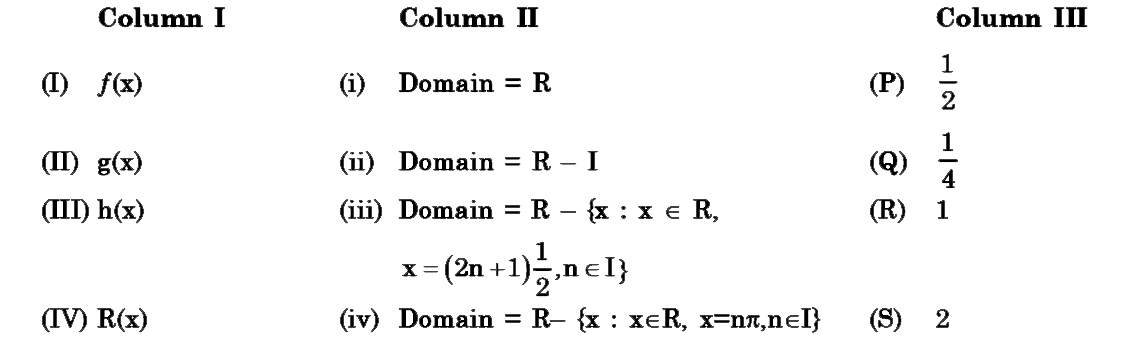
- Let f(x),g(x),h(x) and R(x) be four functions f(x)=e^({2x}) where {....
Text Solution
|
- Let f(x),g(x),h(x) and R(x) be four functions f(x)=e^({2x}) where {....
Text Solution
|
- Let f(x),g(x),h(x) and R(x) be four functions f(x)=e^({2x}) where {....
Text Solution
|
- Column I : Contains information about f(x) Column II: Contains range...
Text Solution
|
- Column I : Contains information about f(x) Column II: Contains range...
Text Solution
|
- Column I : Contains information about f(x) Column II: Contains range...
Text Solution
|
- If x!=(npi)/2 (where n is an integer) and the vale of (1+cotxcosecx)xx...
Text Solution
|
- Let AP (a,d) denote the set of all the terms of an infinite ariothmeti...
Text Solution
|
- If number of distinct real roots of the equation (log(sqrt(3))(tanx))s...
Text Solution
|
- If alpha and beta are the roots of x^(2)+4x+6=0 and N=1/((alpha)/(beta...
Text Solution
|
- If roots of 2(x-a)(x+b)+c=0 are alpha and beta roots of (x-alpha)(x-be...
Text Solution
|
- The number of solution of the equation 2(tanx-sinx)+3(cotx-cosx)+5=0x ...
Text Solution
|
- If n^(th) term (T(n)) of the sequece is given by the relation T(n+1)=T...
Text Solution
|
- If lamda(1) is the product of values of x satisfy the equation (x)^(lo...
Text Solution
|
- If 2tan^(2)theta(1)tan^(2)theta(2)theta(3)+tan^(2)theta(1)tan^(2)theta...
Text Solution
|
- Let f:(4,8)to(3,4) be a function defined by f(x)={x/4}+3 ({.} denotes ...
Text Solution
|
- Value of "sin"^(6)(pi)/16+"sin"^(6)(3pi)/16+"sin"^(5pi)/16+"sin"^(6)(7...
Text Solution
|
- Number of solution of the equation sin^(2)x+(sin^(2)3x)/4=sinx sin 3x,...
Text Solution
|
- If x and y are real and satisfy the equation x^(2)+16y^(2)-3x+2=0 then...
Text Solution
|