Home
Class 12
PHYSICS
Two stationary particles of masses M(1) ...

Two stationary particles of masses `M_(1)` and `M_(2)` are at a distance d apart. A third particle, lying on the line joining the particles experiences no resultant gravitational forces. What is the distance of this particle from `M_(1)`.

Text Solution

Verified by Experts
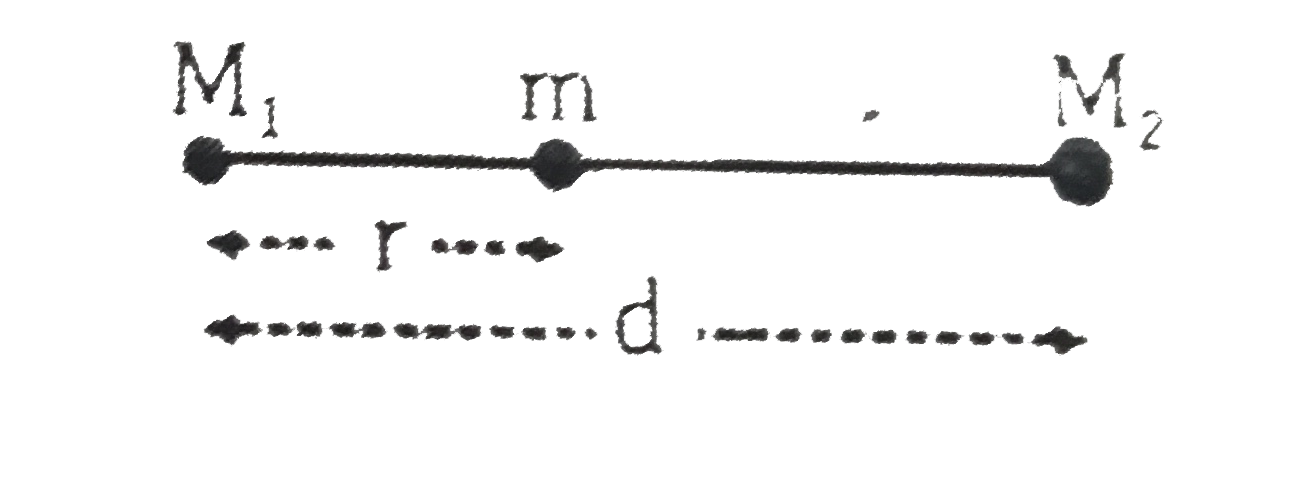
Let m be the mass of the third particle
Force on m towards `M_(1)` is `F_(1)=(GM_(1)m)/r^(2)`
Force on m towards `M_(2)` is `F_(2)=(GM_(2)m)/((d-r)^(2))`
Since net force on m is zero `:. F_(1)=F_(2)`
`implies (GM_(1)m)/r^(2)=(GM_(2)m)/((d-r)^(2))implies ((d-r)/r)^(2)=M_(2)/M_(1)implies d/r-1=sqrt(M_(2))/sqrt(M_(1))implies r=d [sqrt(M_(1))/(sqrt(M_(1))+sqrt(M_(2)))]`
Promotional Banner

Topper's Solved these Questions

  • GRAVITATION

    ALLEN |Exercise BOX-1|3 Videos
  • GRAVITATION

    ALLEN |Exercise BOX-2|13 Videos
  • GRAVITATION

    ALLEN |Exercise Exercise 5 B (Previous Year Questions)|9 Videos
  • GEOMETRICAL OPTICS

    ALLEN |Exercise subjective|14 Videos
  • KINEMATICS-2D

    ALLEN |Exercise Exercise (O-2)|47 Videos

Similar Questions

Explore conceptually related problems

Two bodies of masses m and 4m are placed at a distance r. The gravitational potential at a point on the line joining them where the gravitational field is zero is:

Two particles of masses 1.0 kg and 2.0 kg are placed at a separation of 50 cm. Assuming that the only forces acting on the particles are their mutual gravitation find the initial acceleration of the two particles.

Two bodies of mass 10^(2) kg and 10^(3) kg are lying 1 m apart . The gravitational potential at the mid-point of the line joining them is

Two particles A and B having equal charges are placed at distance d apart. A third charged particle placed on the perpendicular bisector at a distance x will experience the maximum Coulomb’s force when :

Two bodies of masses M_(1) and M_(2) are kept separeated by a distance d. The potential at the point where the gravitational field produced by them is zero, is :-

Two bodies of masses m and M are placed at distance d apart. The gravitational potential (V) at the position where the gravitational field due to them is zero V is

Two particles of equal mass m and charge t are placed at a distance 16 cm. They do no experience any force. The value of q/m is……..

A particle of mass m is placed at each vertices of equilateral triangle. If the particle of 5 kg is placed at the centroid of triangle, then find the gravitational force on it. The distance between centroid to vertice is 2 m.

A particle of mass M is at a distance a from surface of a thin spherical shell of equal mass and having radius a .

Three particles, each of the mass m are situated at the vertices of an equilateral triangle of side a . The only forces acting on the particles are their mutual gravitational forces. It is desired that each particle moves in a circle while maintaining the original mutual separation a . Find the initial velocity that should be given to each particle and also the time period of the circular motion. (F=(Gm_(1)m_(2))/(r^(2)))

ALLEN -GRAVITATION-Illustration
  1. Two spherical balls of mass 10 kg each are placed 100 m apart. Find th...

    Text Solution

    |

  2. The particles of mases 1kg and 2 kg are placed at a separation of 50 c...

    Text Solution

    |

  3. Two stationary particles of masses M(1) and M(2) are at a distance d a...

    Text Solution

    |

  4. Three masses, each equal to M, are placed at the three corners of a sq...

    Text Solution

    |

  5. Two paricles of equal mass m go round a circle of radius R under the a...

    Text Solution

    |

  6. Three particles, each of the mass m are situated at the vertices of an...

    Text Solution

    |

  7. Two solid sphere of same size of a metal are placed in contact by touc...

    Text Solution

    |

  8. A mass (M) is split into two part (mO and (M-m) which are then separat...

    Text Solution

    |

  9. Infinite particles each of mass 'M' are placed at positions x=1 m, x=2...

    Text Solution

    |

  10. At which depth from earth surface acceleration due to gravity is decre...

    Text Solution

    |

  11. Which of the following statement are true about acceleration due to gr...

    Text Solution

    |

  12. At what height above the earth's surface the acceleration due to gravi...

    Text Solution

    |

  13. Determine the speed with which the earth would have to rotate on its a...

    Text Solution

    |

  14. Draw a rough sketch of the variation in weight of a spacecraft which m...

    Text Solution

    |

  15. A solid sphere of uniform density and radius R applies a gravitational...

    Text Solution

    |

  16. The maximum vertical distance through which an astronaut can jump on t...

    Text Solution

    |

  17. Three solid sphere of mass M and radius R are placed in contact as sho...

    Text Solution

    |

  18. Four bodies each of mass m are placed at the different corners of a sq...

    Text Solution

    |

  19. A body of mass m is placed on the surface of earth. Find work required...

    Text Solution

    |

  20. if velocity given to an object from the surface of the earth is n time...

    Text Solution

    |

