Home
Class 12
PHYSICS
Two composite rods made by A & B and C &...

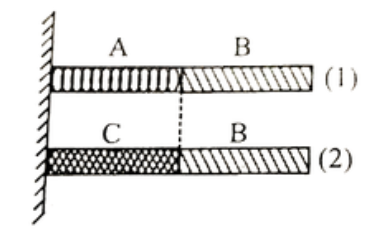
Two composite rods made by A & B and C & B materials as shown. When we increase the temperature `DeltaT`, relation between final lengths of rod becomes `L_(1)ltL_(2)`. Find the relation between `alpha_(A)` and `alpha_(C)`.

A

`alpha_(A)gtalpha_(C)`

B

`alpha_(A)=alpha_(C)`

C

`alpha_(A)ltalpha_(C)`

D

`alpha_(A)+alpha_(C)=alpha_(B)`

Text Solution

Verified by Experts

The correct Answer is:

C
Promotional Banner

Topper's Solved these Questions

  • RACE

    ALLEN |Exercise Basic Maths (Thermal Physics) (Calorimetry)|14 Videos
  • RACE

    ALLEN |Exercise Basic Maths (Thermal Physics) (Mode of Heat Transfer)|15 Videos
  • RACE

    ALLEN |Exercise Basic Maths (Properties of Matter & Fluid Mechanics)(Surface Tension)|26 Videos
  • NEWTONS LAWS OF MOTION

    ALLEN |Exercise EXERCISE-III|28 Videos
  • SIMPLE HARMONIC MOTION

    ALLEN |Exercise Example|1 Videos

Similar Questions

Explore conceptually related problems

A cube of coefficient of linear expansion alpha is floating in a bath containing a liquid of coefficient of volume expansion gamma_(l) . When the temperature is raised by DeltaT , the depth upto which the cube is submerged in the liquid remains the same. Find relation between alpha and gamma_(l)

A rod of length L with sides fully insulated is made of a material whose thermal conductivity K varies with temperature as K=(alpha)/(T) where alpha is constant. The ends of rod are at temperature T_(1) and T_(2)(T_(2)gtT_(1)) Find the rate of heat flow per unit area of rod .

Solids and liquids both expands on heating. The density of substance decreases on expanding according to the relation rho_(2) = (rho_(1))/(1 + gamma(T_(2)- T_(1))) , where , rho_(1) rarr "density at" T_(1) , rho_(2) rarr "density at" T_(2) , gamma rarr coefficient of volume expansion of substances. When a solid is submerged in a liquid , liquid exerts an upward force on solid which is equal to the weight of liquid displaced by submerged part of solid. Solid will float or sink depends on relative densities of solid and liquid . A cubical block of solid floats in a liquid with half of its volume submerged in liquid as shown in figure (at temperature T ) alpha_(S) rarr Coefficient of linear expansion of solid gamma_(L) rarr "Coefficient of volume expansion of liquid" rho_(S) rarr "Density of solid at temperature" T rho_(L) rarr" Density of liquid at temperature" T Imagine fraction submerged does not change on increasing temperature the relation between gamma_(L) and alpha_(S) is

Two metal rods of the same length and area of cross-section are fixed end to end between rigid supports. The materials of the rods have Young module Y_(1) and Y_(2) , and coefficient of linear expansion alpha_(1) and alpha_(2) . The junction between the rod does not shift and the rods are cooled

Two rods A and B are of equal lengths. Their ends are kept at the same temperature difference and their area of cross - sections are A_(1) and A_(2) and thermal conductivities k_(1) and k_(2) . The rate of heat transmission in two rods will be equal, if . . . .. . .

An equilateral triangle ABC is formed by two copper rods AB and BC and one is aluminium rod which heated in such a way that temperature of each rod increases by DeltaT. Find change in the angle angleABC. (Coefficient of linear expansion for copper is alpha _(1). and for aluminium is alpha2 .).

The variation of lengths of two moles rods A and B with change in temperature is shown in figure . The ratio of (alpha_(a))/(alpha_(B)) is :-

A copper rod of 88cm and an aluminimum rod of unknown length have their increase in length independent of increase in temperature. The length of aluminium rod is: (alpha_(Cu) =1.7 xx 10^(-5) K^(-1) and alpha_(Al)= 2.2 xx 10^(-5) K^(-1))

Two rods, one of aluminium and other made of steel, having initial lengths l_(1) and l_(2) are connected together to form a single rod of length (l_(1)+l_(2)) . The coefficient of linear expansions for aluminium and steel are alpha_(a) and alpha_(s) respectively. If length of each rod increases by same amount when their tempertures are raised by t^(@)C , then find the ratio l_(1) / (l_(1)+l_(2)) .
