Home
Class 12
PHYSICS
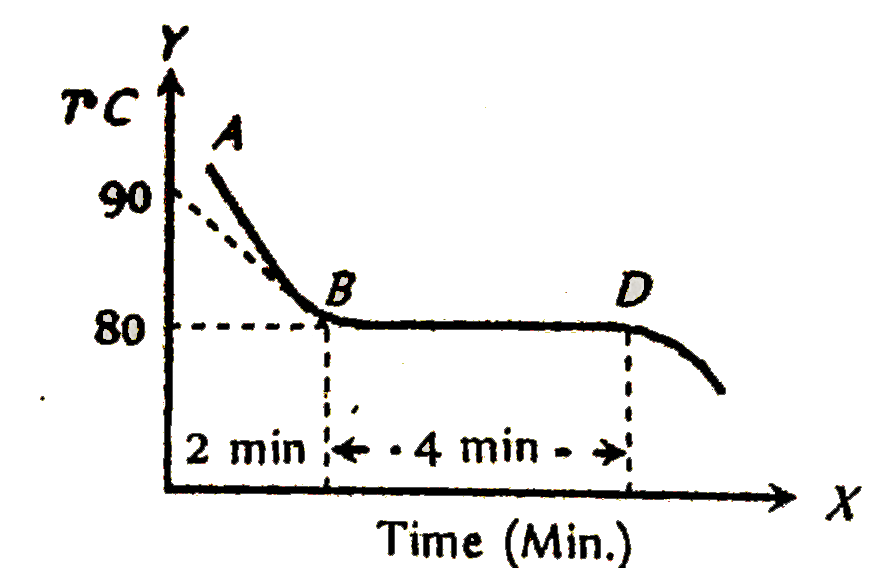
The figure given below shows the cooling...

The figure given below shows the cooling curve of pure wax material after heating. It cools from A to B and solidifies along BD . If L and C are respective values of latent heat and the specific heat of the liquid wax, the ratio L / C is

A

40

B

80

C

100

D

20

Text Solution

Verified by Experts

The correct Answer is:

D
Promotional Banner

Topper's Solved these Questions

  • RACE

    ALLEN |Exercise Basic Maths (Thermal Physics) (Mode of Heat Transfer)|15 Videos
  • RACE

    ALLEN |Exercise Basic Maths (Thermal Physics) (Kinetic theory of gasess)|14 Videos
  • RACE

    ALLEN |Exercise Basic Maths (Thermal Physics) (Temperature scales & thermal expansion)|14 Videos
  • NEWTONS LAWS OF MOTION

    ALLEN |Exercise EXERCISE-III|28 Videos
  • SIMPLE HARMONIC MOTION

    ALLEN |Exercise Example|1 Videos

Similar Questions

Explore conceptually related problems

250 g of water and equal volume of alcohol of mass 200 g are replaced successively in the same calorimeter and cool from 60^@C to 55^@C in 130 s and 67 s, respectively. If the water equivalent of the calorimeter is 10 g, then the specific heat of alcohol in cal//g^@C is

A water cooler of storages capacity 120 liters can cool water at a constant rate of P watts. In a closed circulation system (as shown schematically in the figure), the water from the cooler is used to cool an external device that generates constantly 3kW of heat (thermal load). The temperature of water fed into the device cannot exceed 30^@C and the entire stored 120 liters of water is initially cooled to 10^@C. The entire system is thermally insulated. The minimum value of P ( in watts) for which the device can be operated for 3hours is (Specific heat of water is 4.2kJkg^-1K^-1 and the density of water is 1000kgm^-3 )

Objects A and B that are initially separated from each other and well isolated from their surroundings are then brought into thermal contact. Initially T_(A) = 0^(@)C and T_(B) = 100^(@)C . The specific heat of A is less than the specific heat of B . After some time, the system comes to an equilibrium state. the final temperatures are:

(a) Estimate the speed with which electrons emitted from a heated emitter of an evacuated tube impinge on the collector maintained at a potential difference of 500 V with respect to the emitter. Ignore the small initial speeds of the electrons. The specific charge of the electron, i.e., its e/m is given to be 1.76 xx 10^(11) C kg^(-1) . (b) Use the same formula you employ in (a) to obtain electron speed for an collector potential of 10 MV. Do you see what is wrong ? In what way is the formula to be modified?

Each phase of a material can exits only in certain regions of pressure and temperature . P-T phase diagrams, in which pressure is plotted versus temperature, show the regions corresponding to various phases and phase transformations . P-V diagrams, on the other hand , can be used to study pressure volume relationship at a constant temperature. If the liquid and gaseous phases of a pure substances are heated together in a closed container, both the temperature and the vapor pressure will increase until a point is reached at which the two phases can no longer be distinguished from one another. The temperature and pressure at which this occurs are called the critical temperature and pressure. Exceeding either of these parameters, by itself ,will cause the "gas"//"liguid" phase transition to disappear. if the other variable is then changed as well, while the first variable is maintained above its critical point , a gradual transition will occur between the gaseous and liquid phases, with no clear boundary.(The liquid and solid phases, on the other hand , maintain a distinct boundary at all pressure above the triple point). Shown in figure is a combined P-T phase diagram for material A and B . If heat is added to solids A and B , each in a container that is open to the atmosphere :-

Each phase of a material can exits only in certain regions of pressure and temperature . P-T phase diagrams, in which pressure is plotted versus temperature, show the regions corresponding to various phases and phase transformations . P-V diagrams, on the other hand , can be used to study pressure volume relationship at a constant temperature. If the liquid and gaseous phases of a pure substances are heated together in a closed container, both the temperature and the vapor pressure will increase until a point is reached at which the two phases can no longer be distinguished from one another. The temperature and pressure at which this occurs are called the critical temperature and pressure. Exceeding either of these parameters, by itself ,will cause the "gas"//"liguid" phase transition to disappear. if the other variable is then changed as well, while the first variable is maintained above its critical point , a gradual transition will occur between the gaseous and liquid phases, with no clear boundary.(The liquid and solid phases, on the other hand , maintain a distinct boundary at all pressure above the triple point). Shown in figure is a combined P-T phase diagram for material A and B . Which is true about the substance in figure?

In figure , heat is added to a pure substance in a closed container rate. A graph of the temperature of the substance as a function of time is shown here , If L_(F) = heat of fusion and L_(V) = heat of vaporization . What is the value of the ratio L_(V)//L_(F) for this substance ?

The figure shows the cross-section of the outer wall of a house buit in a hill-resort to keep the house insulated from the freezing temperature of outside. The wall consists of teak wood of thickness L_(1) and brick of thickness (L_(2) = 5L_(1)) , sandwitching two layers of an unknown material with identical thermal conductivites and thickness. The thermal conductivity of teak wood is K_(1) and that of brick is (K_(2) = 5K) . Heat conducion through the wall has reached a steady state with the temperature of three surfaces being known. (T_(1) = 25^(@)C, T_(2) = 20^(@)C and T_(5) = - 20^(@)C) . Find the interface temperature T_(4) and T_(3) .
