Home
Class 12
PHYSICS
In a horizontal spring - mass system mas...

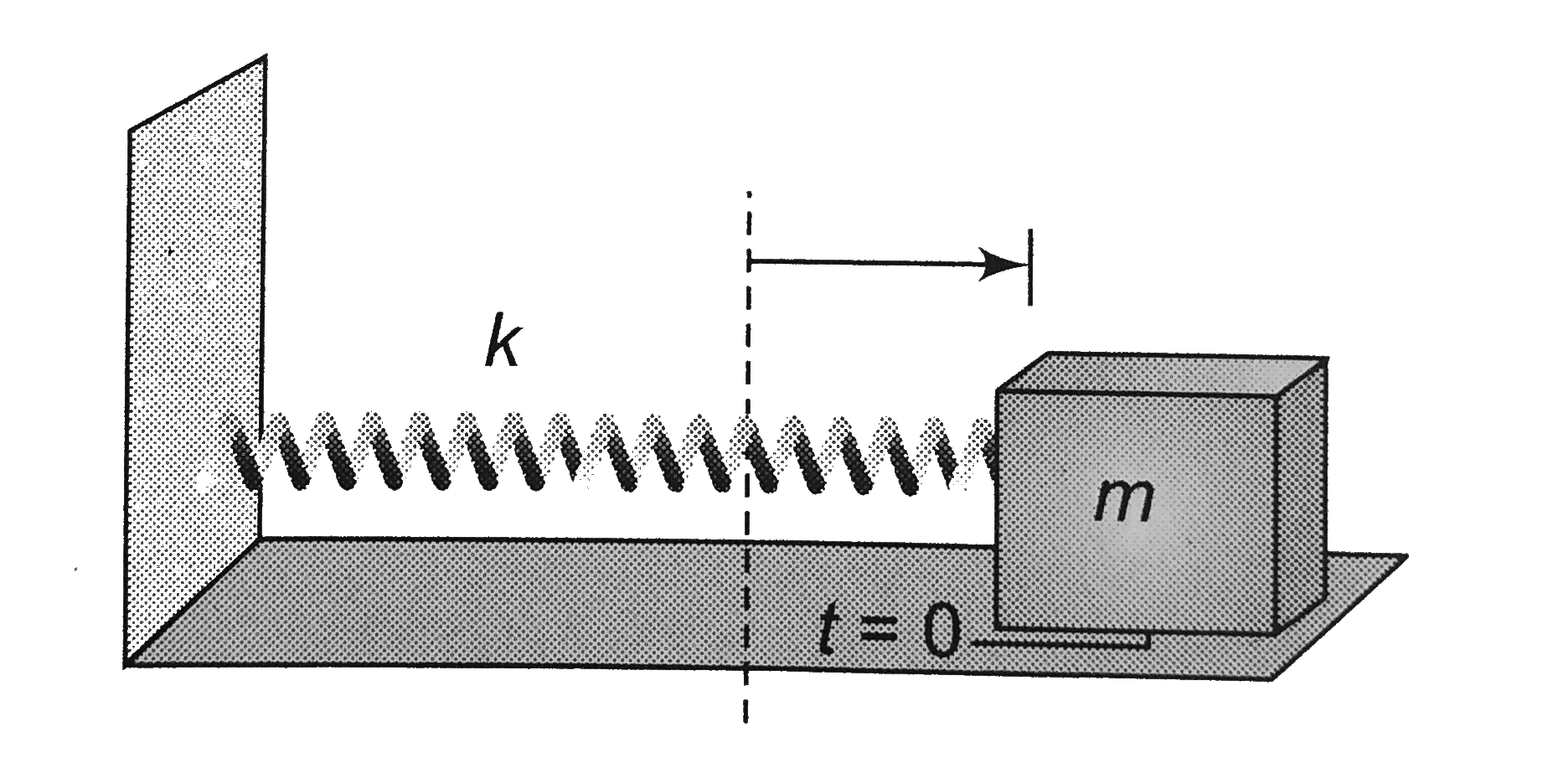
In a horizontal spring - mass system mass `m` is released after being displaced towards right by some distance `t = 0` on a friction-less surface. The phase angle of motion in radian when it is first time passing through equilibrium position is equal to

A

`pi//2`

B

`pi`

C

`3pi//2`

D

0

Text Solution

Verified by Experts

The correct Answer is:

B
Promotional Banner

Topper's Solved these Questions

  • RACE

    ALLEN |Exercise Basic Maths (Oscillations) (Simple pendulum and types of SHM)|17 Videos
  • RACE

    ALLEN |Exercise Basic Maths (Wave Motion & Dopplers Effect) (Fundamental)|24 Videos
  • RACE

    ALLEN |Exercise Basic Maths (Dscillations) (Kinematics of SHM)|20 Videos
  • NEWTONS LAWS OF MOTION

    ALLEN |Exercise EXERCISE-III|28 Videos
  • SIMPLE HARMONIC MOTION

    ALLEN |Exercise Example|1 Videos

Similar Questions

Explore conceptually related problems

A 100 g block is connected to a horizontal massless spring of force constant 25.6(N)/(m) As shown in Fig. the block is free to oscillate on a horizontal frictionless surface. The block is displaced 3 cm from the equilibrium position and , at t=0 , it is released from rest at x=0 It executes simple harmonic motion with the postive x-direction indecated in Fig. The position time (x-t) graph of motion of the block is as shown in Fig. Q. When the block is at position B on the graph its.

A particle of mass m is attached to one end of a mass-less spring of force constant k, lying on a frictionless horizontal plane. The other end of the spring is fixed. The particle starts moving horizontally from its equilibrium position at time t=0 with an initial velocity u_0 . when the speed of the particle is 0.5u_0 , it collides elastically with a rigid wall. After this collision

In space of horizontal EF (E = (mg)//q) exist as shown in figure and a mass m is released at the end of a light rod. If mass m is releases from the position shown in figure find the angular velocity of the rod when it passes through the bottom most position .

A 100g block is connected to a horizontal massless spring of force constant 25.6 N//m . The block is free to oscillate on a horizontal fricationless surface. The block is displced by 3 cm from the equilibrium position, and at t = 0 , it si released from rest at x = 0 , The position-time graph of motion of the block is shown in figure. When the block is at position A on the graph, its

A 100g block is connected to a horizontal massless spring of force constant 25.6 N//m . The block is free to oscillate on a horizontal fricationless surface. The block is displced by 3 cm from the equilibrium position, and at t = 0 , it si released from rest at x = 0 , The position-time graph of motion of the block is shown in figure. Let us now make a slight change to the initial conditions. At t = 0 , let the block be released from the same position with an initial velocity v_(1) = 64 cm//s . Position of the block as a function of time can be expressed as

A box of mass m is initially at rest on a horizontal surface. A constant horizontal force of mg/2 is applied to the box directed to the right. The coefficient of friction of the surface changes with the distance pushed as mu=mu_(0)x where x is the distance fr4om the initial location . For what distance is the box pushed until it comes to rest again?

A mass m is attached to a spring. The spring is stretched to x by a force F and refeased. After being released, the mass comes to rest at the initial equilibrium position. The coeffiecient of friction, mu_(k) , is :-

A uniform thin cylindrical disk of mass M and radius R is attaached to two identical massless springs of spring constatn k which are fixed to the wall as shown in the figure. The springs are attached to the axle of the disk symmetrically on either side at a distance d from its centre. The axle is massless and both the springs and the axle are in horizontal plane. the unstretched length of each spring is L. The disk is initially at its equilibrium position with its centre of mass (CM) at a distance L from the wall. The disk rolls without slipping with velocity vecV_0 = vacV_0hati. The coefficinet of friction is mu. The centre of mass of the disk undergoes simple harmonic motion with angular frequency omega equal to -

A small ring of mass m_(1) is connected by a string of length l to a small heavy bob of mass m_(2) . The ring os free to move (slide) along a fixed smooth horizontal wire. The bob is given a small displacement from its equilibrium position at right angles to string. Find period of small oscillations.

A uniform thin cylindrical disk of mass M and radius R is attaached to two identical massless springs of spring constatn k which are fixed to the wall as shown in the figure. The springs are attached to the axle of the disk symmetrically on either side at a distance d from its centre. The axle is massless and both the springs and the axle are in horizontal plane. the unstretched length of each spring is L. The disk is initially at its equilibrium position with its centre of mass (CM) at a distance L from the wall. The disk rolls without slipping with velocity vecV_0 = vacV_0hati. The coefficinet of friction is mu. The net external force acting on the disk when its centre of mass is at displacement x with respect to its equilibrium position is.

ALLEN -RACE-Basic Maths (Oscillations) (Energy & spring pendulum)
  1. If particle is excuting simple harmonic motion with time period T, the...

    Text Solution

    |

  2. A particle of mass 4kg moves simple harmonically such that its PE (U) ...

    Text Solution

    |

  3. When a mass m attached to a spring it oscillates with period 4s. When ...

    Text Solution

    |

  4. Assertion:- A spring of force constatn k is cut in to two piece having...

    Text Solution

    |

  5. F-x and x-t graph of a particle in SHM are as shown in figure match th...

    Text Solution

    |

  6. A linear harmonic oscillator of force constant 2 xx 10^(6)N//m and amp...

    Text Solution

    |

  7. A particle moving on x - axis has potential energy U = 2 - 20x + 5x^(2...

    Text Solution

    |

  8. The potential energy of a particle executing SHM change from maximum t...

    Text Solution

    |

  9. A particle of mass m performs SHM along a straight line with frequency...

    Text Solution

    |

  10. Which of the following is correct about a SHM, along a straight line?

    Text Solution

    |

  11. Two identical spring of constant K are connected in series and paralle...

    Text Solution

    |

  12. A force of 6.4 N stretches a vertical spring by 0.1m. Find the mass th...

    Text Solution

    |

  13. Four massless springs whose force constants are 2k, 2k, k and 2k respe...

    Text Solution

    |

  14. A system is shown in the figure. The time period for small oscillatio...

    Text Solution

    |

  15. In a horizontal spring - mass system mass m is released after being d...

    Text Solution

    |

  16. A mass M is suspended from a light spring. An additional mass m added ...

    Text Solution

    |

  17. A smooth inclined plane having angle of inclination 30^(@) with horizo...

    Text Solution

    |
