Home
Class 12
PHYSICS
Two plane mirror M(1) "and" M(2) are inc...

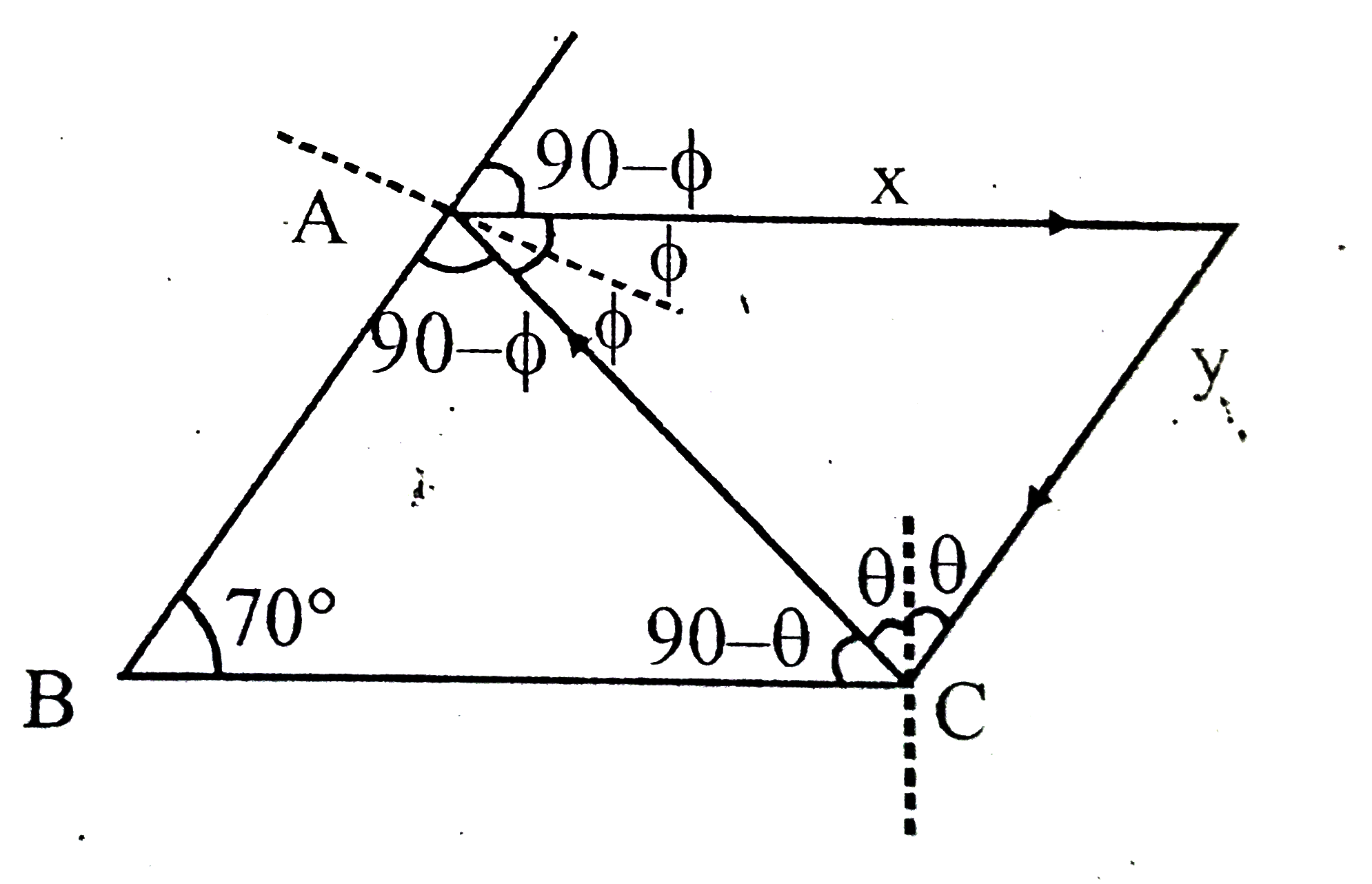
Two plane mirror `M_(1) "and" M_(2)` are inclined to each other at `70^(@)`. A ray incident on the mirror `M_(1)` at an angle `theta` fallls on `M_(2)` and is then reflected parallel to `M_(1)` for

A

` 50 ^@ `

B

`45^@ `

C

`30 ^@ `

D

` 55^@ `

Text Solution

Verified by Experts

The correct Answer is:
A


Reflected ray x is parallel to the base mirror BC.
In ` Delta ABC`, sum of the interior angles in 180.
` 90 - theta + 70 + 90 - phi = 180 ^@ `
` rArr theta + phi = 70 ^@......... ` (i)
Also ray x is `|| ` to the base mirror BC. so,
` 90 - phi = 70 ^@ `
` rArr phi = 20 ^@ ` ..... (ii)
From (i) & (ii) , ` theta = 50 ^@ `
Promotional Banner

Topper's Solved these Questions

Similar Questions

Explore conceptually related problems

Two plane mirrors at an angle such that a ray incident on a mirror undergoes a total deviation of 240^(@) after two reflections:

Two plane mirrors A and B are aligned parallel to each other, as shown in the figure. A light ray is incident at an angle '30degree' at a point just inside one end of A. The plane of incidence coincides with the plane of the figure. The maximum number of times the ray undergoes reflections (including the first one) before it emerges out is

A mirror is inclined at an angle of theta with the horizontal. If a ray light is incident at an angle theta as shown , then the angle made by reflected ray with the horizontal is

In the given figure, PQ and RS are two mirrors placed parallel to each other. An incident ray AB strikes the mirror PQ at B, reflected ray moves along the path BC and strikes the mirror RS at C and again reflects back along CD. Prove that AB||CD

Two mirrors are inclined at angle theta as shown in figure. Light rays are incident parallel to one of mirrors. Light will start retracing its path after the reflection if

The two masses m_(1) and m_(2) are joined by a spring as shown. The system is dropped to the ground from a height. The spring will be

Two concave mirrors each of radius of curvature 40cm are placed such that their principla axes are parallel to each other and at a distance of 1cm to each other. Both the mirrors are at a distance of 100cm to each other. Consider first reflection at M_(1) and then at M_(2) , find the coordinates of the image thus formed. Take location of object as the origin

Two blocks M_(1) and M_(2) having equal mass are free to move on a horizontal frictionless surface . M_(2) is attached to a massless spring as shown in figure .Intially M_(2) is at rest and M_(1) is moving toward M_(2) with speed v and collides head - on with M_(2) .

Two stationary particles of masses M_(1) and M_(2) are at a distance d apart. A third particle, lying on the line joining the particles experiences no resultant gravitational forces. What is the distance of this particle from M_(1) .

Two particles of mass m_(1) and m_(2) are projected from the top of a tower. The particle m_(1) is projected vertically downward with speed u and m_(2) is projected horizontally with same speed. Find acceleration of CM of system of particles by neglecting the effect of air resistance.

ALLEN -AIIMS 2019-PHYSICS
  1. An equi-convex lens of focal length 10 cm and refractive index (mug=1....

    Text Solution

    |

  2. A boy of height 1.5m with his eye level at 1.4m stands before a plane ...

    Text Solution

    |

  3. Two plane mirror M(1) "and" M(2) are inclined to each other at 70^(@)....

    Text Solution

    |

  4. A beam of diameter 'd' is incident on a glass hemisphere. If the radiu...

    Text Solution

    |

  5. Two lenses in contact made of materials with dispersive powers in the ...

    Text Solution

    |

  6. A beam of monochromatic light is incident at i= 50^(@) on one face of ...

    Text Solution

    |

  7. Find the height of image in the following diagram.

    Text Solution

    |

  8. A plane mirror is moving with velocity -2 hati - 3 hatj + 4hatk ....

    Text Solution

    |

  9. Find the lateral shift of a light ray while it passws through a paral...

    Text Solution

    |

  10. A thin convex lens from a real Image of a certain object 'p' times it ...

    Text Solution

    |

  11. The distance between the objective lens and the eye lens of an astrono...

    Text Solution

    |

  12. A far sighted person has a near point of 60"cm" . What power lens shou...

    Text Solution

    |

  13. If the potential at the center of a uniformly charged sphere of radius...

    Text Solution

    |

  14. A charge q is placed at the point P as shown in figure on the axis of ...

    Text Solution

    |

  15. A point charge Q is placed at the centre of a spherical conducting she...

    Text Solution

    |

  16. Two spherical, nonconducting, and very thin shells of uniformly distri...

    Text Solution

    |

  17. An infinite number of concentric rings carry a charge Q each alternate...

    Text Solution

    |

  18. If uniform electric field vec E = E 0 hati + 2 E 0 hatj ,...

    Text Solution

    |

  19. For an infinite line of charge having linear charge density lambda lyi...

    Text Solution

    |

  20. A particle of mass m and charge +q approaches from a very large distan...

    Text Solution

    |

