

Home
Class 12
PHYSICS
An infinite number of concentric rings c...

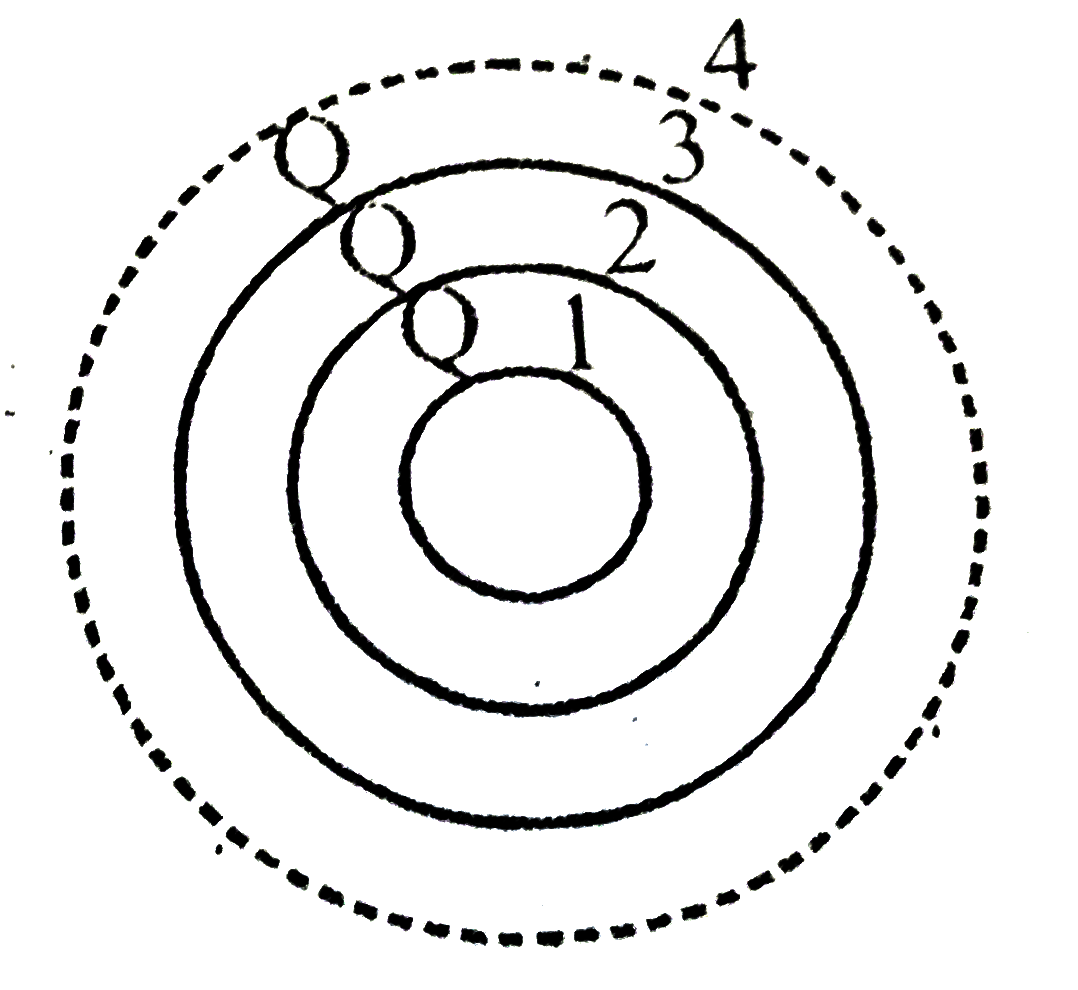
An infinite number of concentric rings carry a charge Q each alternately positive and negative.
Their radii are 1, 2, 4, 8..... meters in gometric progression as shown in the figure. The potential at the centre of the rings will be

A

zero

B

` ( Q) /( 12 pi epsi _ 0 ) `

C

` (Q ) / (8 pi epsi _ 0 ) `

D

` ( Q ) / ( 6pi epsi _ 0 ) `

Text Solution

Verified by Experts

The correct Answer is:
D

` V = (Q ) /( 4pi in _ 0 xx 1 ) - ( Q ) /( 4pi in _ 0 xx 2 ) + ( Q ) /( 4pi in _ 0 xx 2 ^ 2 )….oo `
` = ( Q ) /( 4 pi in _ 0 ) [ 1 - ( 1 ) /( 2 ) + ( 1 ) / ( 2 ^ 2 ) - ( 1 ) /( 2 ^ 3 ) + ….oo] `
` = ( Q ) / ( 4pi in _ 0 ) xx ( 1 ) /( 1 - (- 1//2 )) = ( Q ) /( 4pi in _ 0 ) xx ( 2 ) /( 3 ) = ( Q ) / ( 6 pi in _ 0 ) `
Promotional Banner

Topper's Solved these Questions

Similar Questions

Explore conceptually related problems

Positive and negative charges of 1 muC each are placed at two points as shown in the figure. Find the potential difference between A and B

Charges q, 2q,3q and 4q are placed at the corners A,B,C and D of a square as shown in the following figure. The directon of electric field at the centre of the square is along

An insulating solid sphere of radius R has a uniformaly positive charge density rho . As a result of this uniform charge distribution there is a finite value of electric potential at the centre of the sphere, at the surface of the sphere and also at a point out side the sphere. The electric potential at infinity is zero. Statement-1: Wgen a charge 'q' is taken from the centre to the surface of the sphere, its potential energy charges by (qrho)/(3 in_(0)) Statement-2 : The electric field at a distance r (r lt R) from the centre of the the sphere is (rho r)/(3in_(0))

Two spherical , nonconducting and very tin shells of uniformly distributed positive charge Q and radius d are located a distance 10d from each other . A positive point charge q is placed inside one of the shells at a distance d//2 from the center, on the line connecting the centers of the two shells , as shown in the figure, What is the net force on the charge q ? .

An infinite number of charges, each of magnitude q, are placed along x-axis at x = 1m, 2m, 4m, 8m, 16m and so on but the consecutive charges are of opposite sign starting with +q at x = 1m. A point charge q_0 , kept at the origin, experiences a force of magnitude :

The diagram show a small bead of mass m carrying charge q . The bead can freely move on the smooth fixed ring placed on a smooth horizontal plane . In the same pane a charge +Q has also been fixed as shown. The potential at the point P due to +Q is V . The velocity which the bead should projected from the point P so that it can complete a circle should be greater than .

Consider three charges q_(1),q_(2), q_(3) each equal to q at the vertices of an equilateral triangle of side l. What is the force on a charge Q (with the same sign as q) placed at the centroid of the triangle, as shown in figure ?

A spiral is made up of successive semicircles , with centres alternately at ' A and B , starting with centre at A , of radii 0.5 cm, 1.0 cm , 1.5 cm , 2.0 cm , ... as shown in the given figure . What is the total length of such a spiral made up to thirteen consecutive semicircles ? (Take pi= 22/7 )

An electric dipole is prepared by taking two electric charges of 2 xx 10^(-8) C separated by distance 2 mm. This dipole is kept near a line charge distribution having density 4 xx 10^(-4) C/m in such a way that the negative electric charge of the dipole is at a distance 2 cm from the wire as shown in the figure. Calculate the force acting on the dipole. [Take k=1/(4piepsilon_(0)) = 9 xx 10^(9) Nm^(2)C^(-2) ]

A spiral is made up of successive semicircles, with centres alternately at A and B, starting with centre at A, of radii 0.5 cm, 1.0 cm, 1.5 cm, 2.0 cm, ... as shown in Figure. What is the total length of such a spiral made up of thirteen consecutive semicircles? (Take pi= 22/7 ) [Hint : Length of successive semicircles is 11, 12, 13, 14, ... with centres at A, B, A, B, ..., respectively.]

ALLEN -AIIMS 2019-PHYSICS
  1. An equi-convex lens of focal length 10 cm and refractive index (mug=1....

    Text Solution

    |

  2. A boy of height 1.5m with his eye level at 1.4m stands before a plane ...

    Text Solution

    |

  3. Two plane mirror M(1) "and" M(2) are inclined to each other at 70^(@)....

    Text Solution

    |

  4. A beam of diameter 'd' is incident on a glass hemisphere. If the radiu...

    Text Solution

    |

  5. Two lenses in contact made of materials with dispersive powers in the ...

    Text Solution

    |

  6. A beam of monochromatic light is incident at i= 50^(@) on one face of ...

    Text Solution

    |

  7. Find the height of image in the following diagram.

    Text Solution

    |

  8. A plane mirror is moving with velocity -2 hati - 3 hatj + 4hatk ....

    Text Solution

    |

  9. Find the lateral shift of a light ray while it passws through a paral...

    Text Solution

    |

  10. A thin convex lens from a real Image of a certain object 'p' times it ...

    Text Solution

    |

  11. The distance between the objective lens and the eye lens of an astrono...

    Text Solution

    |

  12. A far sighted person has a near point of 60"cm" . What power lens shou...

    Text Solution

    |

  13. If the potential at the center of a uniformly charged sphere of radius...

    Text Solution

    |

  14. A charge q is placed at the point P as shown in figure on the axis of ...

    Text Solution

    |

  15. A point charge Q is placed at the centre of a spherical conducting she...

    Text Solution

    |

  16. Two spherical, nonconducting, and very thin shells of uniformly distri...

    Text Solution

    |

  17. An infinite number of concentric rings carry a charge Q each alternate...

    Text Solution

    |

  18. If uniform electric field vec E = E 0 hati + 2 E 0 hatj ,...

    Text Solution

    |

  19. For an infinite line of charge having linear charge density lambda lyi...

    Text Solution

    |

  20. A particle of mass m and charge +q approaches from a very large distan...

    Text Solution

    |