Home
Class 12
BIOLOGY
Assertion : Watson and Crick provided ex...

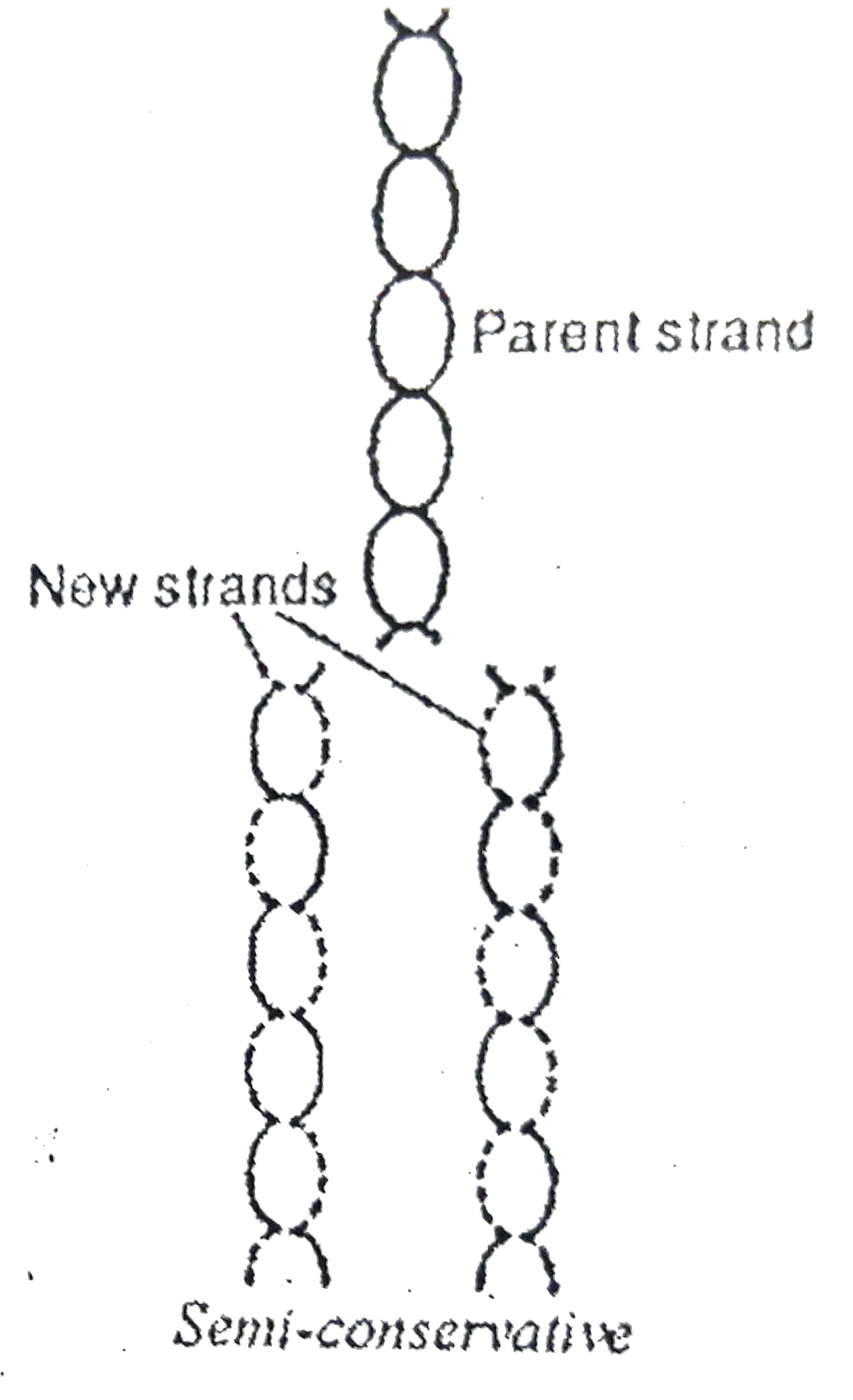
Assertion : Watson and Crick provided experimental proof of semiconservative nature of DNA replication.
Reason : Daughter strand will have one new strand and one parental strand.

A

If both A and R are true and R is the correct explanation of A.

B

If both A and R are true but R is not the correct explanation of A.

C

If A is true but R is false

D

A is false but R is true.

Text Solution

Verified by Experts

The correct Answer is:
D

Watson and Crick suggested that replication of DNA is semiconservative . Semiconervative. Nature of DNA replication wsa proved by Messelson and Stahl by using heavy isotope of nitrogen (15N).
DNA polymerase III establishes phosphodiester linkages between the adjacent deoxyribo-nucleoside phosphate in presence of ATP/GTP, TPP and `Mg^(2+)` . It produces a new strand of DNA. DNA polymerase binds nucleotides in 5'-3' direction.
Promotional Banner

Similar Questions

Explore conceptually related problems

Method of DNA replication in which two strands of DNA separates and synthesize new strands :-

Assertion :- Complementary base pairing confers a very unique property to the DNA chains. Reason : If sequence of one strand is known then sequence in other strand can be predicted.

Assertion : The mechanism of DNA replication is semi-conservative in nature. Reason : Each of the complementary strands of the parental double helix is conserved during the process.

When a DNA molecule undergoes replication the number of new strands formed is

In a DNA molecule adenine of one strand base pair with ………. on the other strand

Assertion: The stickiness of ends produced by restriction endonuclease faciliates the action of DNA polymerase Reason :It helps in joining the two DNA strands

Assertion: The two strands in double strand helix structure of DNA are complementary to each other Reason: Disulphide bonds are formed between SQPecific pairs of bases

A 3' ______________ 5' B C 5' _______________ 3'D AB and CD represent two strands of a DNA molecule. When this molecule undergoes replication, forming a replication fork between A and C in the above. (i) Name the template strands for replication. (ii) Using which strand as the template, will there be continuous synthesis of a complementary DNA strand? (iii) Complementary to which strand will Okazaki segments get synthesised and discontinuous synthesis will occur (iv) What are template strands and Okazaki pieces? (v) In which direction is a new strand synthesized?

Assertion :- The DNA strand which does not code for anything is referred to as coding strand. Reason :- Coding strand sequence are same as RNA and this strand contain uracil at the place of thymine.

