Home
Class 12
PHYSICS
Shown below are the black body radiation...

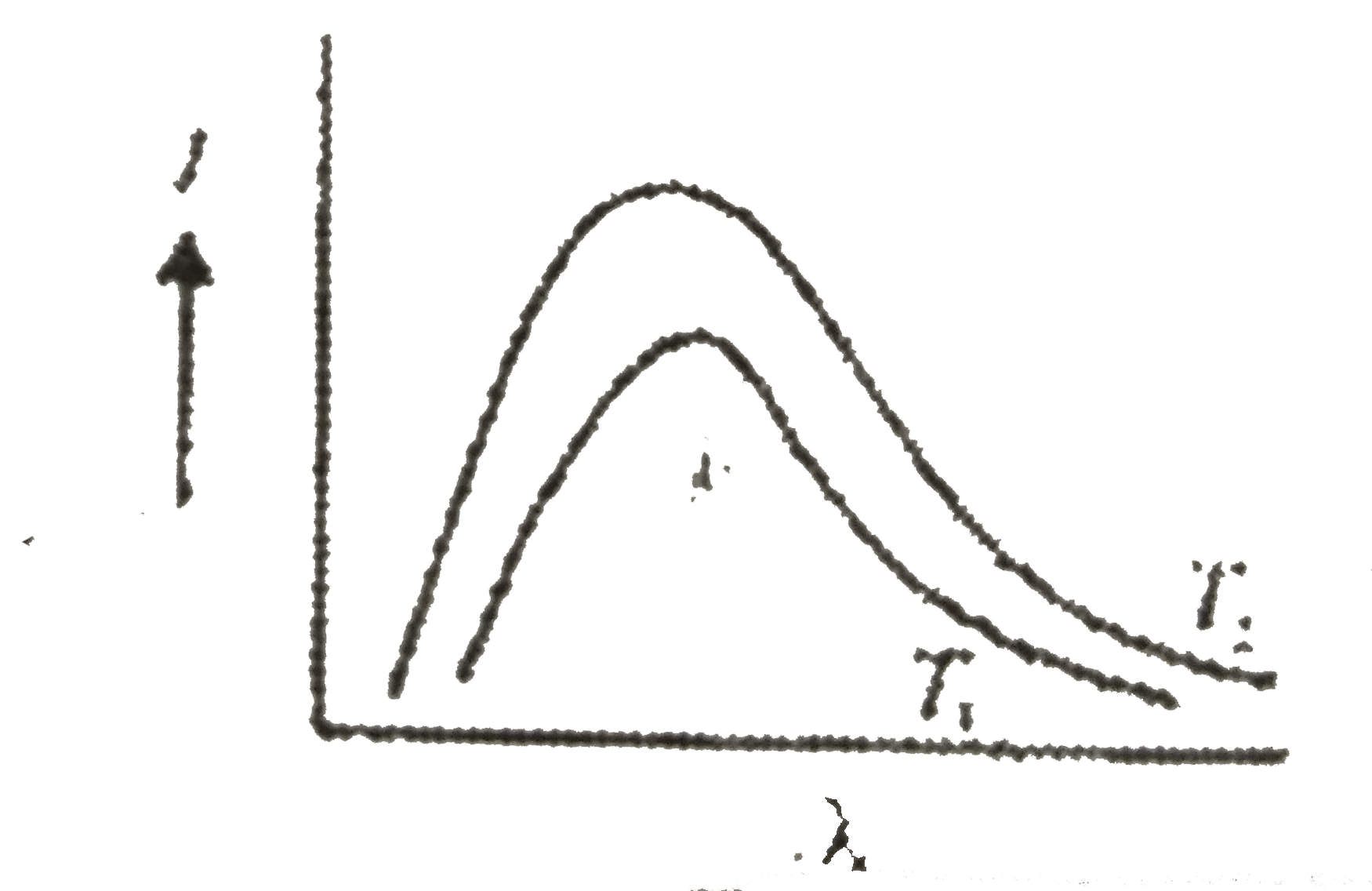
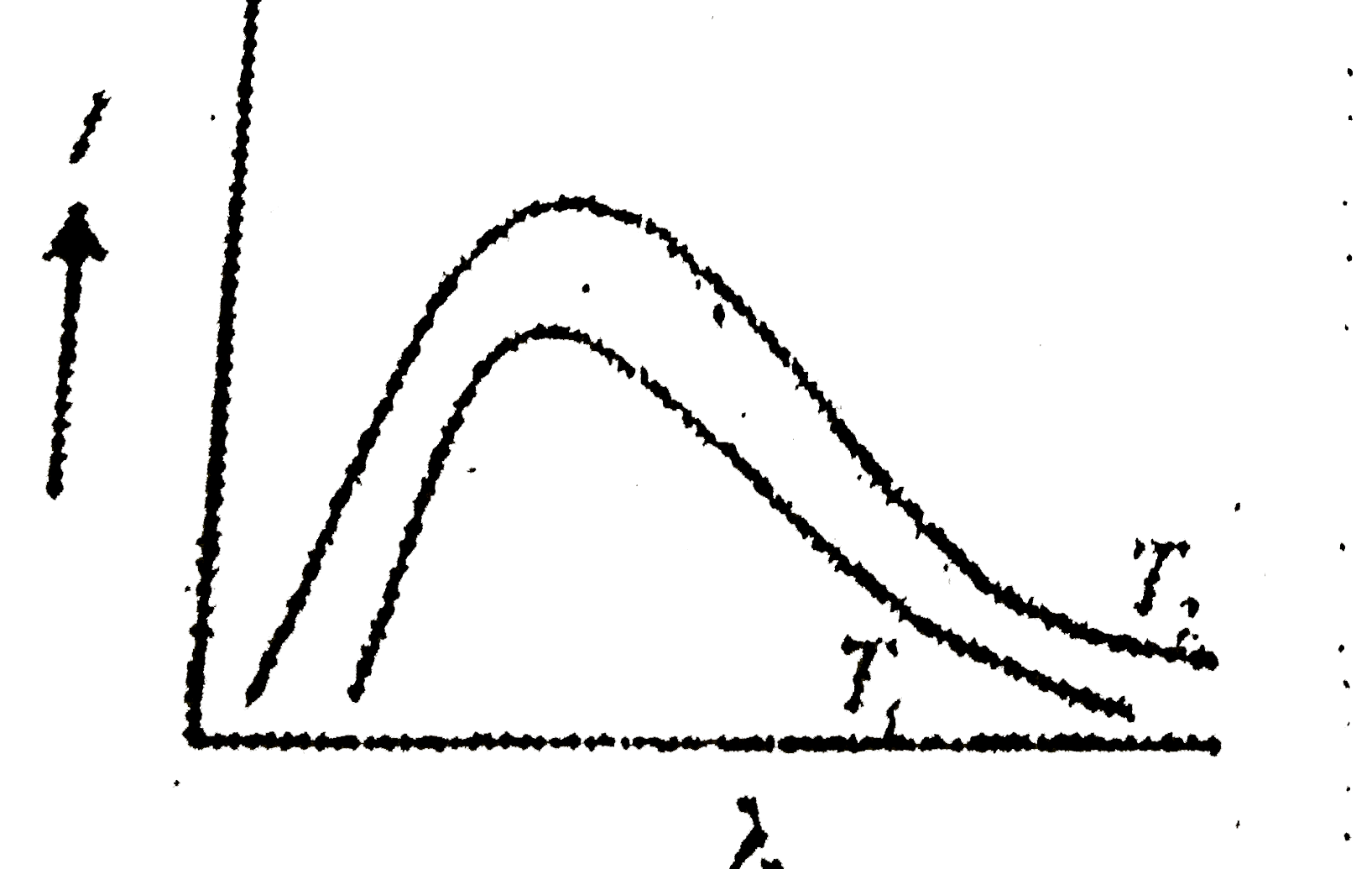
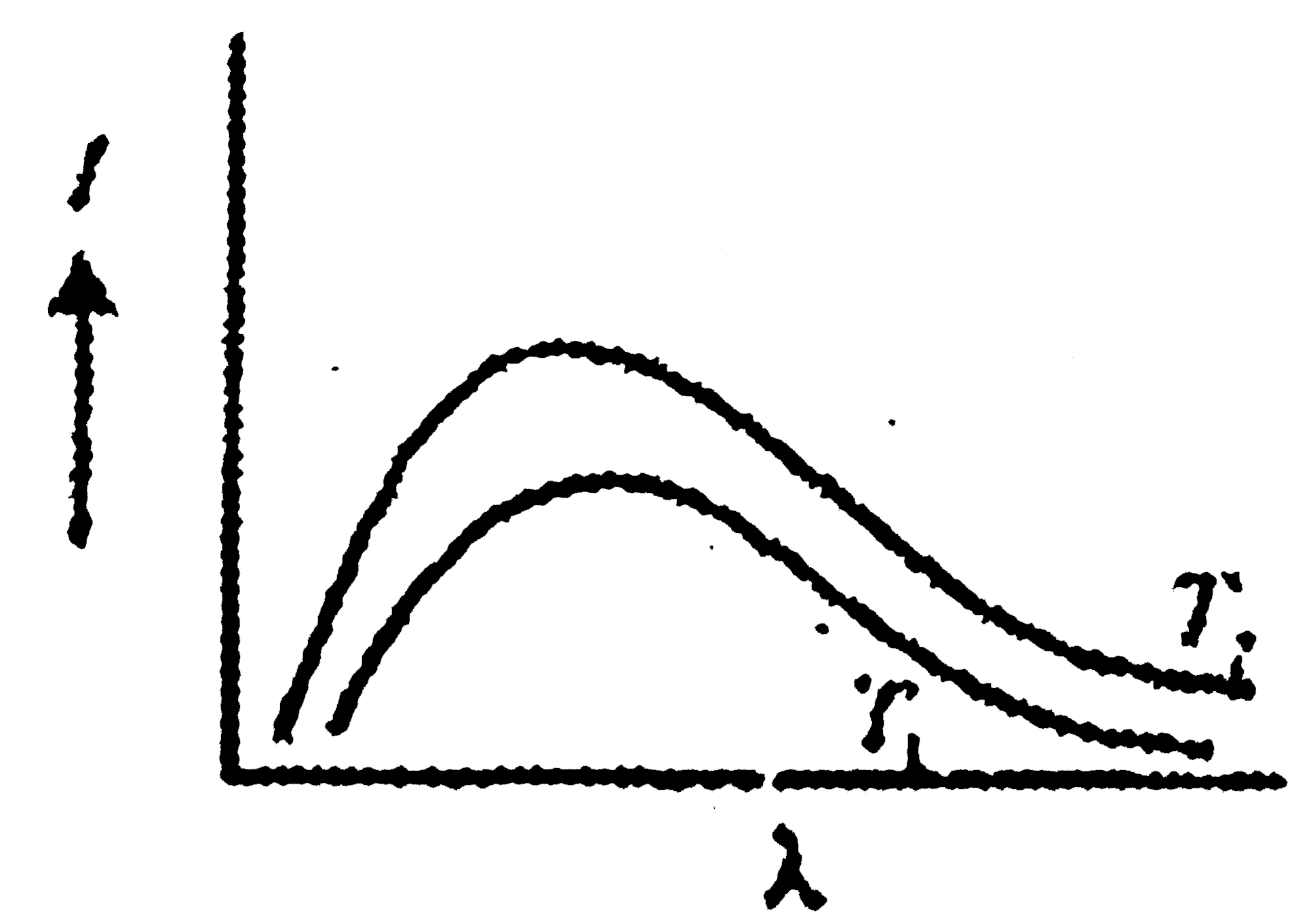
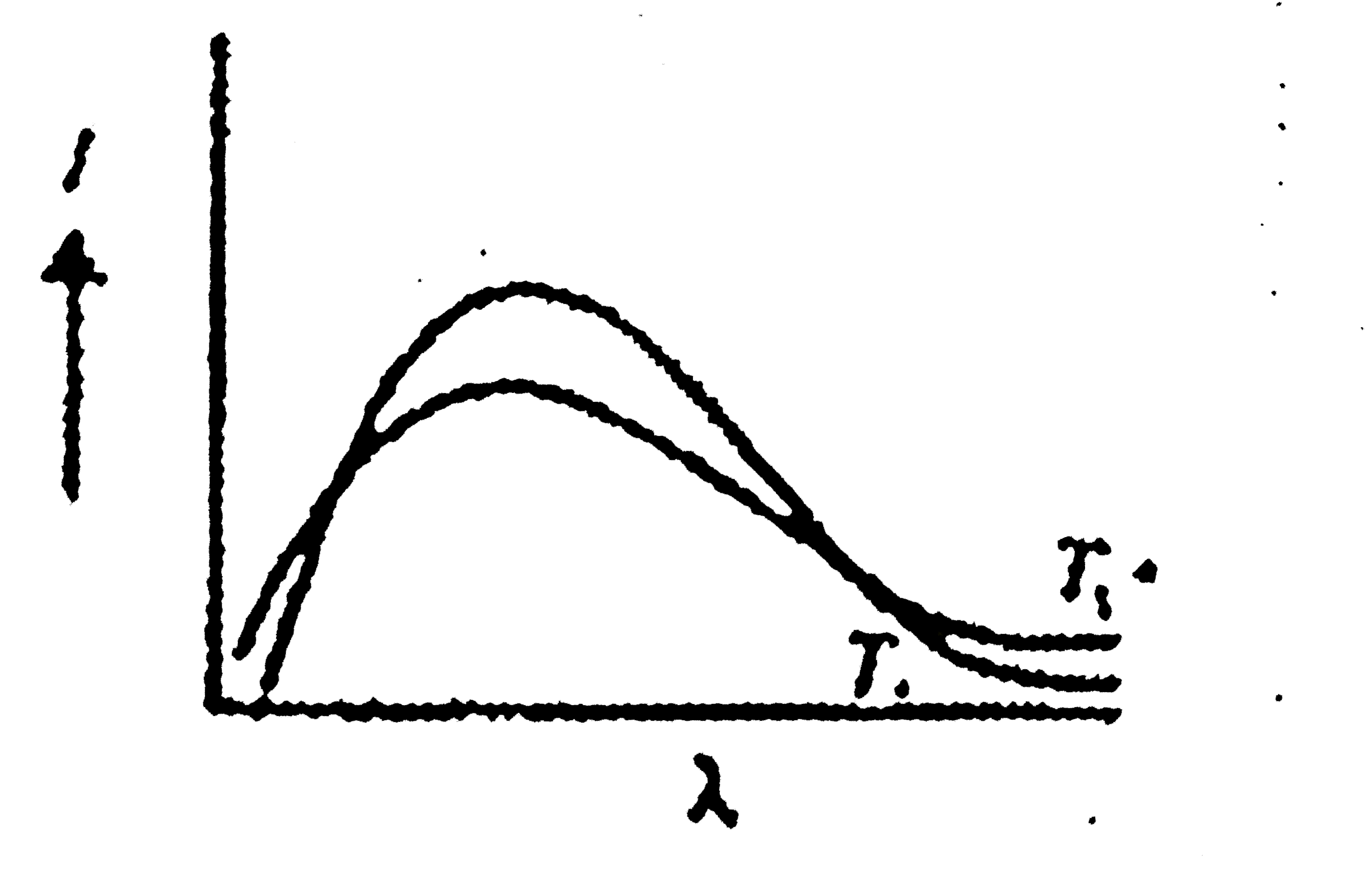
Shown below are the black body radiation curves at temperature `T_(1)` and `T_(2) (T_(2) gt T_(1))`. Which of the following plots is correct?

A

B

C

D

Text Solution

AI Generated Solution

The correct Answer is:

To solve the problem regarding the black body radiation curves at temperatures \( T_1 \) and \( T_2 \) (where \( T_2 > T_1 \)), we will use Wien's Displacement Law and the characteristics of black body radiation. ### Step-by-Step Solution: 1. **Understand Black Body Radiation**: Black body radiation refers to the electromagnetic radiation emitted by a perfect black body in thermal equilibrium. The intensity of radiation emitted varies with wavelength and temperature. 2. **Apply Wien's Displacement Law**: According to Wien's Displacement Law, the wavelength \( \lambda_m \) at which the intensity of radiation is maximum for a black body is inversely proportional to the temperature \( T \): \[ \lambda_m T = b \] where \( b \) is a constant (Wien's displacement constant). 3. **Analyze the Given Temperatures**: Since \( T_2 > T_1 \), it follows from Wien's Law that: \[ \lambda_{m2} T_2 = \lambda_{m1} T_1 \] This implies that \( \lambda_{m2} < \lambda_{m1} \) because \( T_2 > T_1 \). Therefore, the peak wavelength for the higher temperature \( T_2 \) will be shorter than that for the lower temperature \( T_1 \). 4. **Interpret the Curves**: In the black body radiation curves: - The curve for \( T_1 \) will peak at a longer wavelength (larger \( \lambda_{m1} \)). - The curve for \( T_2 \) will peak at a shorter wavelength (smaller \( \lambda_{m2} \)). 5. **Identify the Correct Plot**: Among the given options, the correct plot will show: - The curve corresponding to \( T_2 \) shifted to the left (indicating a shorter peak wavelength) compared to the curve for \( T_1 \). 6. **Conclusion**: Based on the analysis, the correct plot that represents the black body radiation curves at temperatures \( T_1 \) and \( T_2 \) (with \( T_2 > T_1 \)) is the one where the curve for \( T_2 \) is to the left of the curve for \( T_1 \).

To solve the problem regarding the black body radiation curves at temperatures \( T_1 \) and \( T_2 \) (where \( T_2 > T_1 \)), we will use Wien's Displacement Law and the characteristics of black body radiation. ### Step-by-Step Solution: 1. **Understand Black Body Radiation**: Black body radiation refers to the electromagnetic radiation emitted by a perfect black body in thermal equilibrium. The intensity of radiation emitted varies with wavelength and temperature. 2. **Apply Wien's Displacement Law**: According to Wien's Displacement Law, the wavelength \( \lambda_m \) at which the intensity of radiation is maximum for a black body is inversely proportional to the temperature \( T \): \[ ...
Promotional Banner

Similar Questions

Explore conceptually related problems

Following represents the Maxwell distribution curve for an ideal gas at two temperature T_(1) and T_(2) . Which of the following option(s) is/are true?

Figure shows graphs of pressure vs density for an ideal gas at two temperature T_(1) and T_(2) . Which of the following is correct?

A carbon resistor is used in a circuit, at different constant temperatures, T_(1) and T_(2)(T_(1) gt T_(2)) for different voltages. Which of the following graphs are correct ? [ i is the current through the resistor, V is the voltage applied across it]

The adjoining fgure shows graph of pressure and volume of a gas at two temperatures T_(1) and T_(2) Which one the following is correct

Calculate a, T_(1), T_(2), T_(1)' & T_(2)' .

Radius of a conductor increases uniformly from left end to right end as shown in fig. Material of the conductor is isotropic and its curved surface is thermally isolated from surrounding. Its ends are maintained at temperatures T_(1) and T_(2) ( T_(1) gt T_(2)) : If, in steady state, heat flow rate is equal to H , then which of the following graphs is correct

Radius of a conductor increases uniformly from left end to right end as shown in fig. Material of the conductor is isotropic and its curved surface is thermally isolated from surrounding. Its ends are maintained at temperatures T_(1) and T_(2) ( T_(1) gt T_(2)) : If, in steady state, heat flow rate is equal to H , then which of the following graphs is correct

V vs T curves at different pressures P_(1) and P_(2) for an ideal gas are shown below: Which one of the following is correct?

If K_(1)= Rate constant at temperature T_(1) and k_(2) rate constant at temperature T_(2) for a first order reaction, then which of the following relation is correct ?

A point moves with uniform acceleration and v_(1), v_(2) , and v_(3) denote the average velocities in the three successive intervals of time t_(1).t_(2) , and t_(3) Which of the following Relations is correct?.
