Home
Class 12
PHYSICS
A body starting from rest moves along a ...

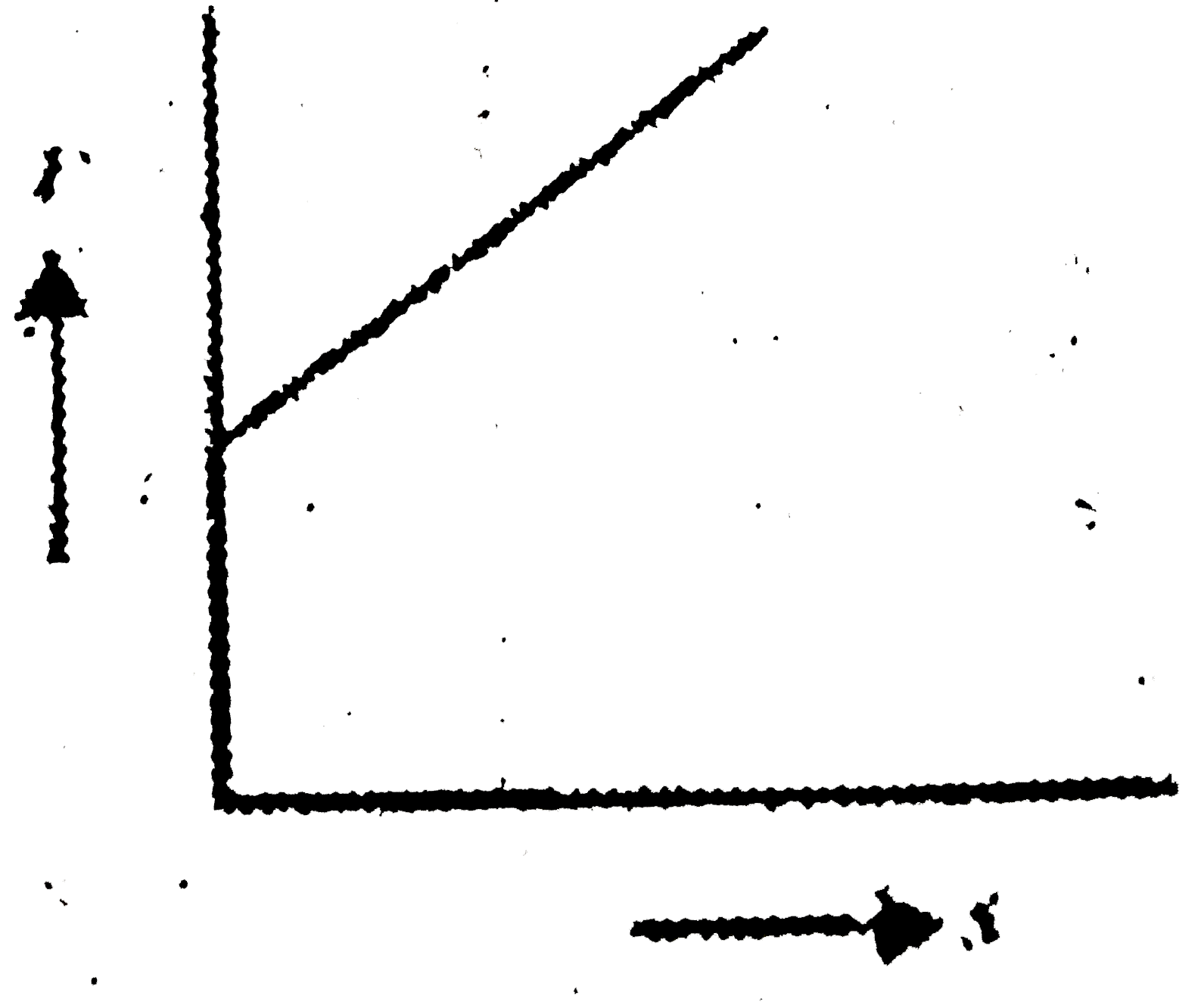
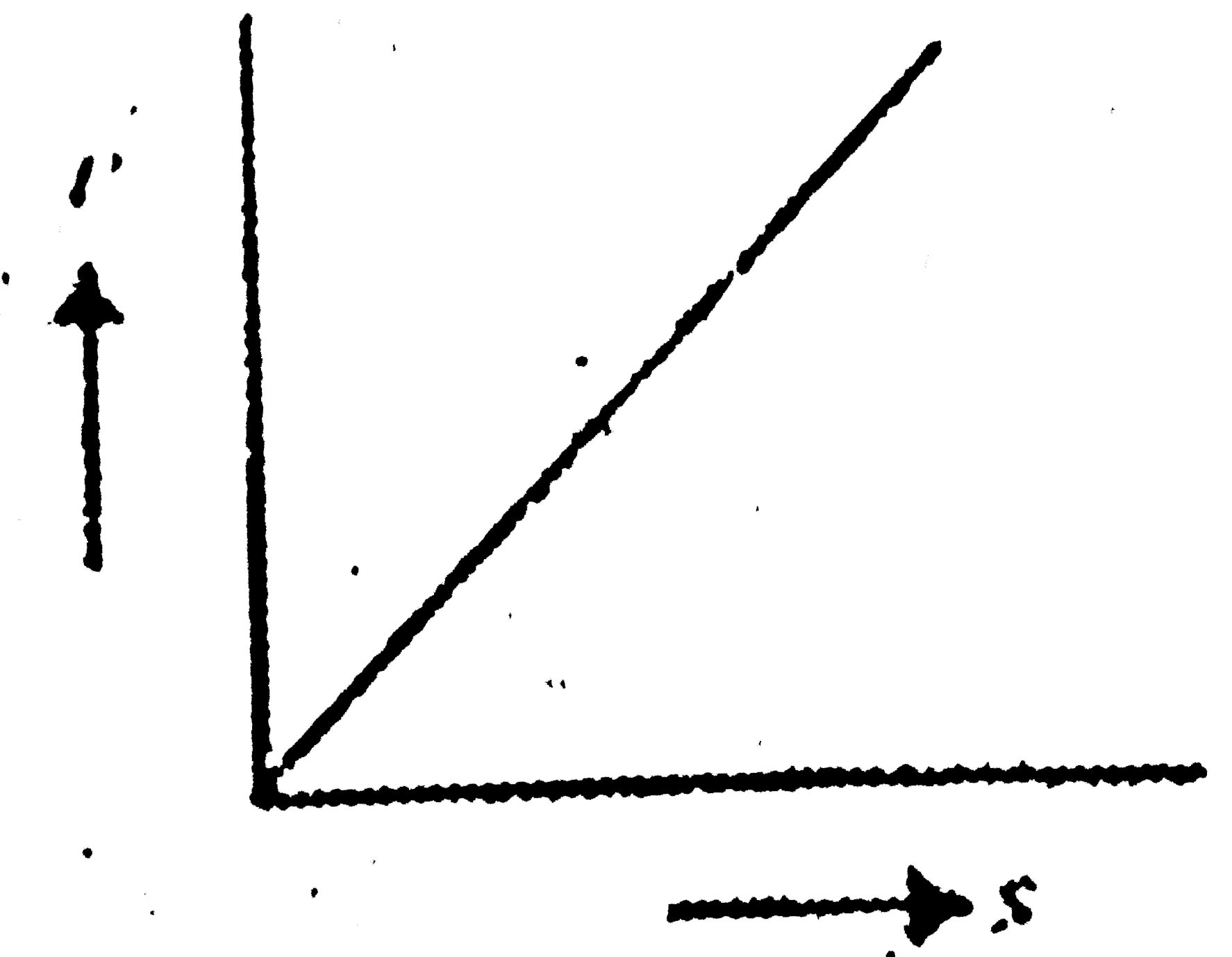
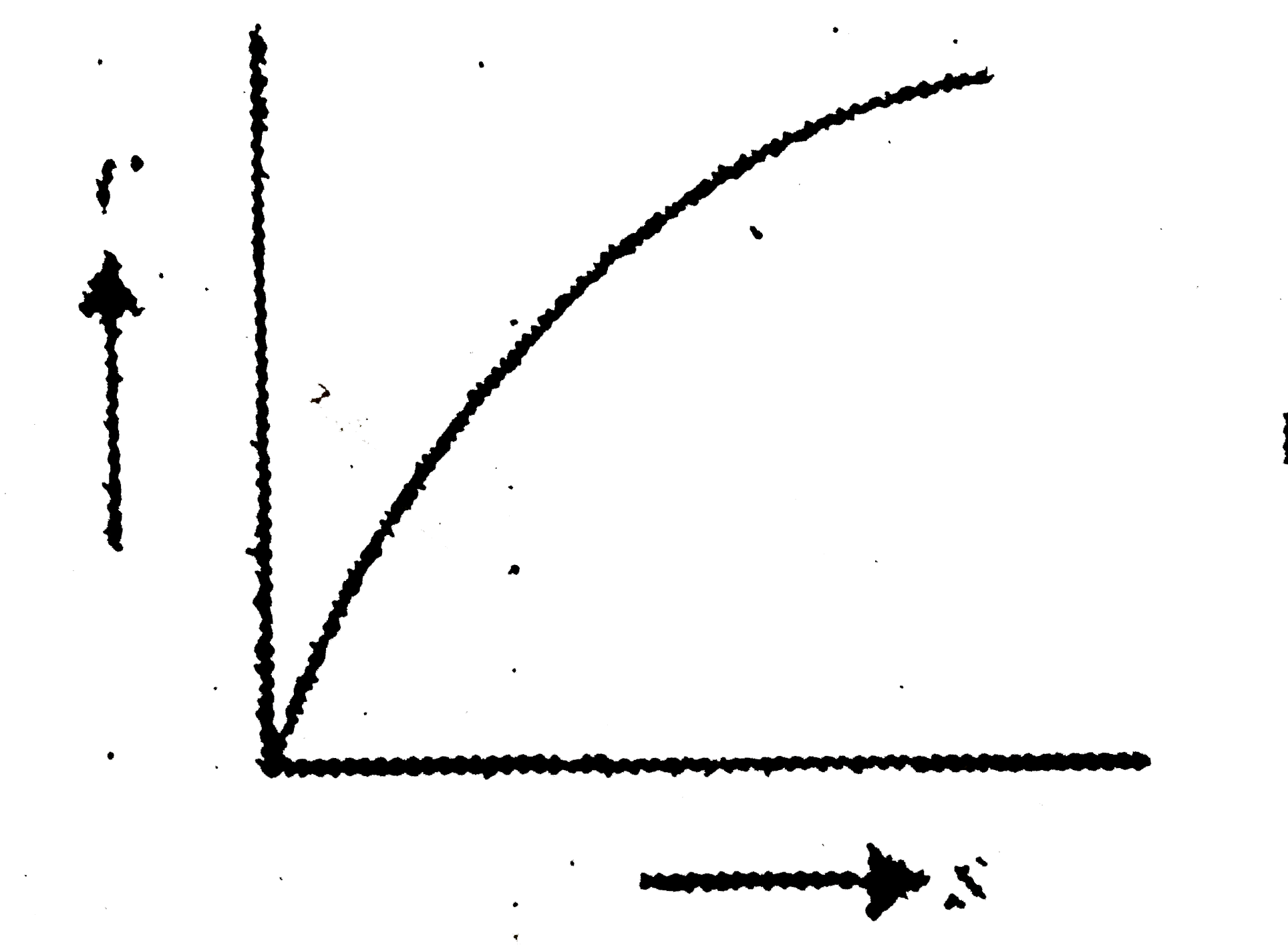
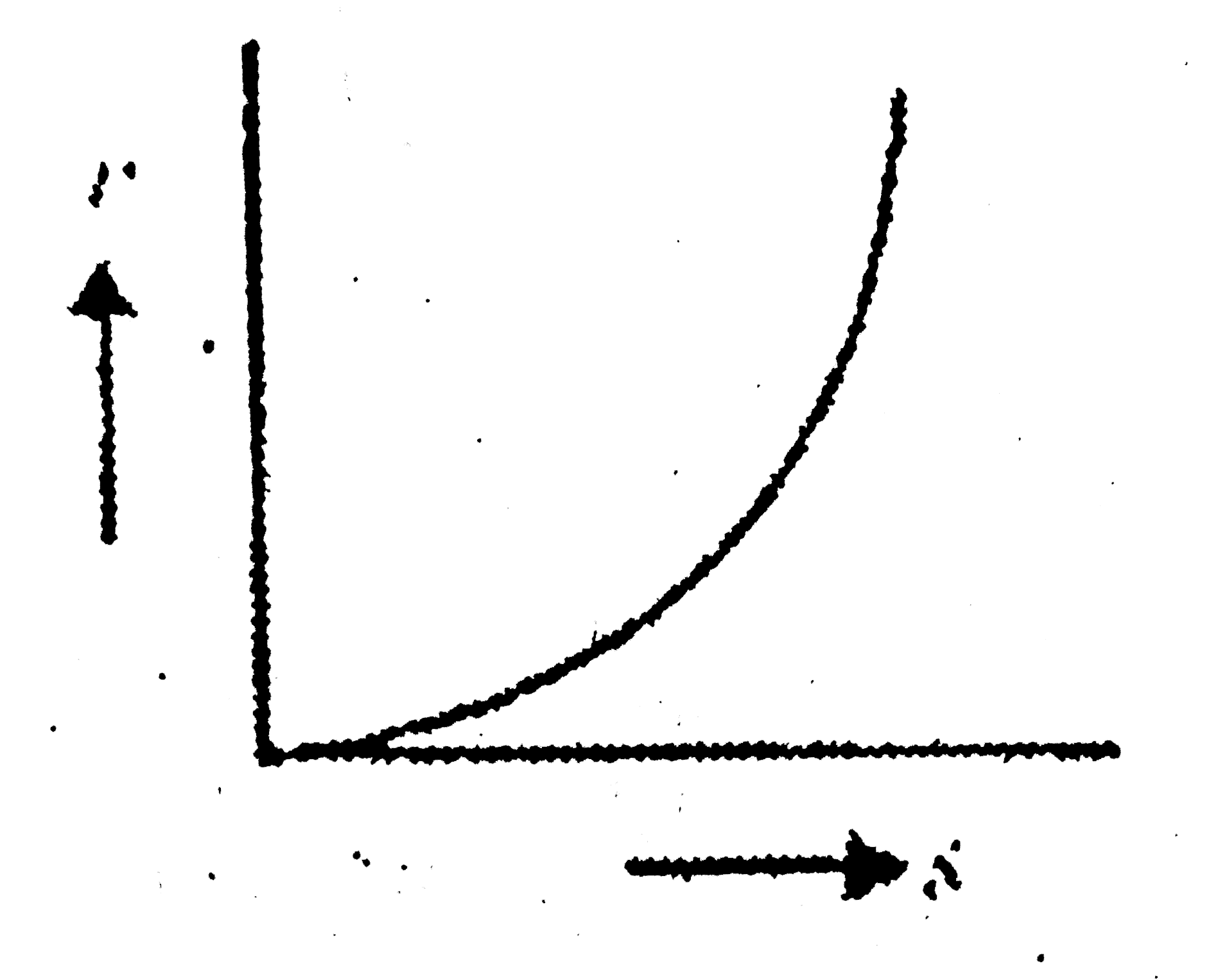
A body starting from rest moves along a straight line with a constant acceleration. The variation of speed (v) with distance (s) is represented by the graph:

A

B

C

D

Text Solution

AI Generated Solution

The correct Answer is:

To solve the problem, we need to analyze the motion of a body starting from rest and moving with constant acceleration. We will use the third equation of motion to relate speed (v) and distance (s). ### Step-by-Step Solution: 1. **Identify Initial Conditions**: The body starts from rest, which means the initial velocity \( u = 0 \). 2. **Use the Third Equation of Motion**: The third equation of motion states: \[ v^2 = u^2 + 2as \] Here, \( v \) is the final velocity, \( u \) is the initial velocity, \( a \) is the constant acceleration, and \( s \) is the distance traveled. 3. **Substitute Initial Velocity**: Since the body starts from rest, we substitute \( u = 0 \) into the equation: \[ v^2 = 0 + 2as \] This simplifies to: \[ v^2 = 2as \] 4. **Rearranging the Equation**: We can rearrange this equation to express \( v \) in terms of \( s \): \[ v = \sqrt{2as} \] 5. **Graphical Representation**: The equation \( v = \sqrt{2as} \) indicates that the relationship between \( v \) and \( s \) is a square root function. If we plot \( v \) against \( s \), the graph will be a curve that opens upwards, resembling a parabola. 6. **Conclusion**: Thus, the variation of speed \( v \) with distance \( s \) is represented by a graph that is symmetric to a parabola. The correct option corresponding to this relationship in the provided choices is option 3.

To solve the problem, we need to analyze the motion of a body starting from rest and moving with constant acceleration. We will use the third equation of motion to relate speed (v) and distance (s). ### Step-by-Step Solution: 1. **Identify Initial Conditions**: The body starts from rest, which means the initial velocity \( u = 0 \). 2. **Use the Third Equation of Motion**: ...
Promotional Banner

Similar Questions

Explore conceptually related problems

A particle starting from rest moves along a straight line with constant acceleration for this velocity displacement graph will have the form-

A particle starting from rest moves in a straight line with acceleration as shown in the a-t graph. Find the distance (in m) travelled by the particle in the first four seconds from start of its motion. Q

A car, starting from rest, moves in a straight line with constant acceleration . 4m//s^(2) After some time, it immediately starts retarding at constant rate 2m//s^(2) until it comes to rest. If the car moved for a total time 18 seconds, the total distance covered is

A particle starts from rest and moves with constant acceleration. Then velocity displacement curve is:

A body starts from rest and moves with constant acceleration. The ratio of distance covered by the body in nth second to that covered in n second is.

For a body moving with uniform acceleration along straight line, the variation of its velocity (v) with position (x) is best represented by

A particle at rest starts moving in a horizontal straight line with a uniform acceleration. The ratio of the distances covered during the fourth and third seconds is

A particle starts from rest at t=0 and moves in a straight line with an acceleration as shown below. The velocity of the particle at t=3 s is

A body with constant acceleration always moves along a straight line. A body with constant magnitude of acceleration may not speed up.

A particle starts motion from rest and moves along a straight line. Its acceleration-time graph is shown. Find out speed of particle at t=2s and at t=3s.
