Home
Class 12
PHYSICS
A monochromatic beams of light is used f...

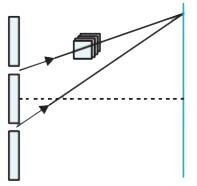
A monochromatic beams of light is used for the formation of fringes on the screen by illuminating the two slits in the Young’s double slit mica is interposed in the path of one of the interfering beams then:

A

The fringe width increases

B

The fringe width decreases

C

The fringe width remains he same but the pattern shifts

D

The fringe pattern disappeasrs.

Text Solution

Verified by Experts

The correct Answer is:

C

The presence of thin mica in the path of one of the interfering beams changes only the path difference between the beams due to which the pattern shifts upwards.But the fringe width remains the same.As mochromatic light is used,one cannot make out which is the central shift as all the fringes are having the same colour and intensity.
Promotional Banner

Similar Questions

Explore conceptually related problems

A monochromatic beam of light is used for the formation of fringes on a screen by illuminating the two slits in the Young,s double slit interference experiment. When a thin film of mic is interposed in the path of one of the interfering beams

In YDSE using monochromatic light, the fringe pattern shifts by a certain distance on the screen when a mica sheet of refractive index 1.5 and thickness 2 microns is introduced in the path of one of the interfering waves. The mica sheet is then removed and the distance between the plane of slits and the screen is doubled. It is found that the distance between successive maxima (or minima) now is the same as the observed fringe shift upon the introduction of the mica sheet. Calculate the wavelength of the light.

In a Young's double slit experiment using monochromatic light, the fringe pattern shifts by a certain distance on the screen when a mica sheet of refractive index 1.6 and thickness 1.964 microns is introduced in the path of one of the interfering waves. The mica sheet is then removed and the distance between the slits and screen is doubled. It is found that the distance between successive maxima now is the same as observed fringe shift upon the introduced of the mica sheet . Calculate the wavelength of the monochromatic light used in the experiment .

Light of wavelength 500nm is used to form interference pattern in Young's double slit experiment. A uniform glass plate of refractive index 1.5 and thickness 0.1mm is introduced in the path of one of the interfering beams. The number of fringes which will shift the cross wire due to this is

In the Young’s double slit experiment, for which colour the fringe width is least

In Young.s double slit experiment both the slits are similar. If width of one of the slits is doubled then

In a Young's double slit experiment using monochromatic light, the fringe pattern shifts by as certasin distance on the screen when a mica sheet of refractive inde 1.6 and thickness 1.964 micron (1 micron =10^-6m) is introduced in the path of one of the interfering waves. The mica sheet is then removed and the distance between the screen and the slits is doubled. It is found that the distance between the successive maxima now is the same as the observed frige-shift upon the introduction of the mica sheet. Calculate the wavelength of the monochromatic light used in the experiment.

If one of the two slits of Young's double-slit experiment is painted so that it transmits half the light intensity as the second slit, then

In Young's experiment, monochromatic light is used to illuminate the two slits A and B. Interference fringes are observed on a screen placed in front of the slits. Now if a thin glass plate is placed normally in the path of the beam coming from the slit

In Young's experiment, monochromatic light is used to illuminate the two slits A and B. Interference fringes are observed on a screen placed in front of the slits. Now if a thin glass plate is placed normally in the path of the beam coming from the slit
