Home
Class 12
PHYSICS
In the figure given below, the position ...

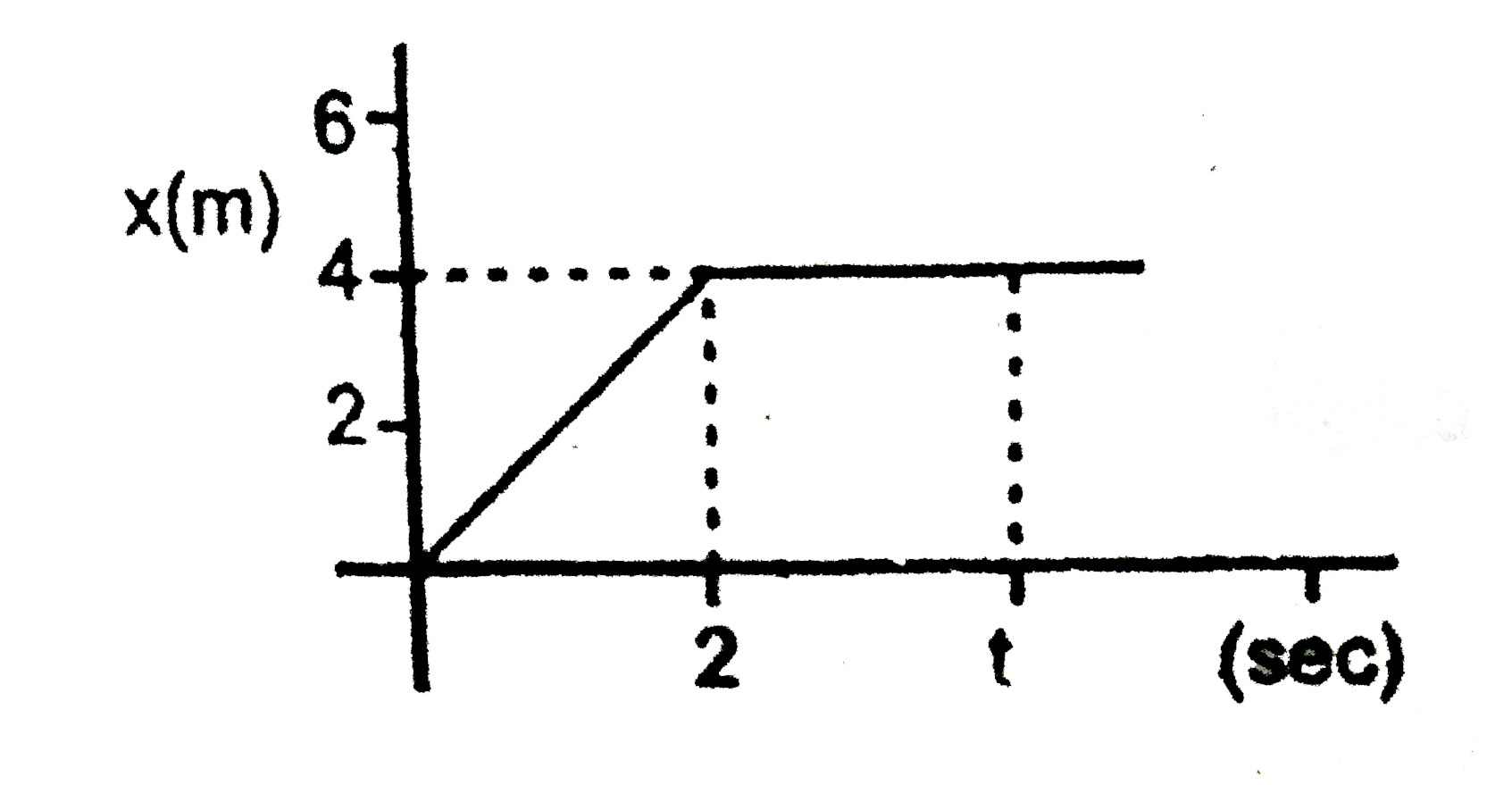
In the figure given below, the position time graph of a particle of mass 0.1kg is shown. The impulse at t=2 sec is

A

`"0.2 kg m sec"^(-1)`

B

`-0.2 kg m sec"^(-1)`

C

`"0.1 kg m sec"^(-1)`

D

`"-0.4 kg m sec"^(-1)`

Text Solution

Verified by Experts

The correct Answer is:

A

Impulse = change in momentum
`=m Delta V=(m Delta x)/(Delta t)=0.1xx(4-0)/(2-0)=0.2" kg m sec"^(-1)`
Promotional Banner

Similar Questions

Explore conceptually related problems

In the figure given below, the position-time graph of a particle of mass 0.1kg is shown. The impuslse at t=2 sec is

In the figure, the position time graph of a particle of mass 0.1 kg is shown. The impulse at t=2 second is :

The figure shows the position time graph of a particle of mass 40 kg. What is the force acting on the particle of 0lttlt4 s

The velocity - time graph of a particle is as shown in figure

The position - time graph for a particle is shown in fig. Then in the time interval of (0, 6sec)

The force versus position (F-x) graph of a particle of mass 2 kg is shown in the figure. If at x = 0 velocity of particle is 2 m/s then velocity of the particle at x = 8 m will be

Figure shows the position-time graph of a particle of mass 0.04kg . Suggest a suitable physical context for this motion. What is the time between two consecutive impulses received by the particle? What is the magnitude of each impulse?

Figure shows the position-time graph of a particle of mass 0.04kg . Suggest a suitable physical context for this motion. What is the time between two consecutive impulses received by the particle? What is the magnitude of each impluse?

Fig. shows the position-time graph of a particle of mass 4 kg. What is the (i) force acting on the particle for t lt 0, t lt 4 s, 0 lt t lt 4 s ? (ii) impulse at t = 0 and t = 4 s? Assume that the motion is one dimensional.

In the figure the variation of components of acceleration of a particle of mass is 1 kg is shown w.r.t. time. The initial velocity of the particle is vec u=(- 3i + 4j) m//s . The total work done by the resultant force on the particle in time from t = 0 to t = 4 seconds is : .
