Home
Class 12
PHYSICS
A total reflecting equilateral prism can...

A total reflecting equilateral prism can be used to deviate a ray of light through :

A

If both assertion and reason are true and reason is the correct explanation of assertion

B

If both assertion and reason are true but reason is not the correct explanation of assertion

C

If assertion is true but reason is false

D

If both assertion and reason are false.

Text Solution

Verified by Experts

The correct Answer is:
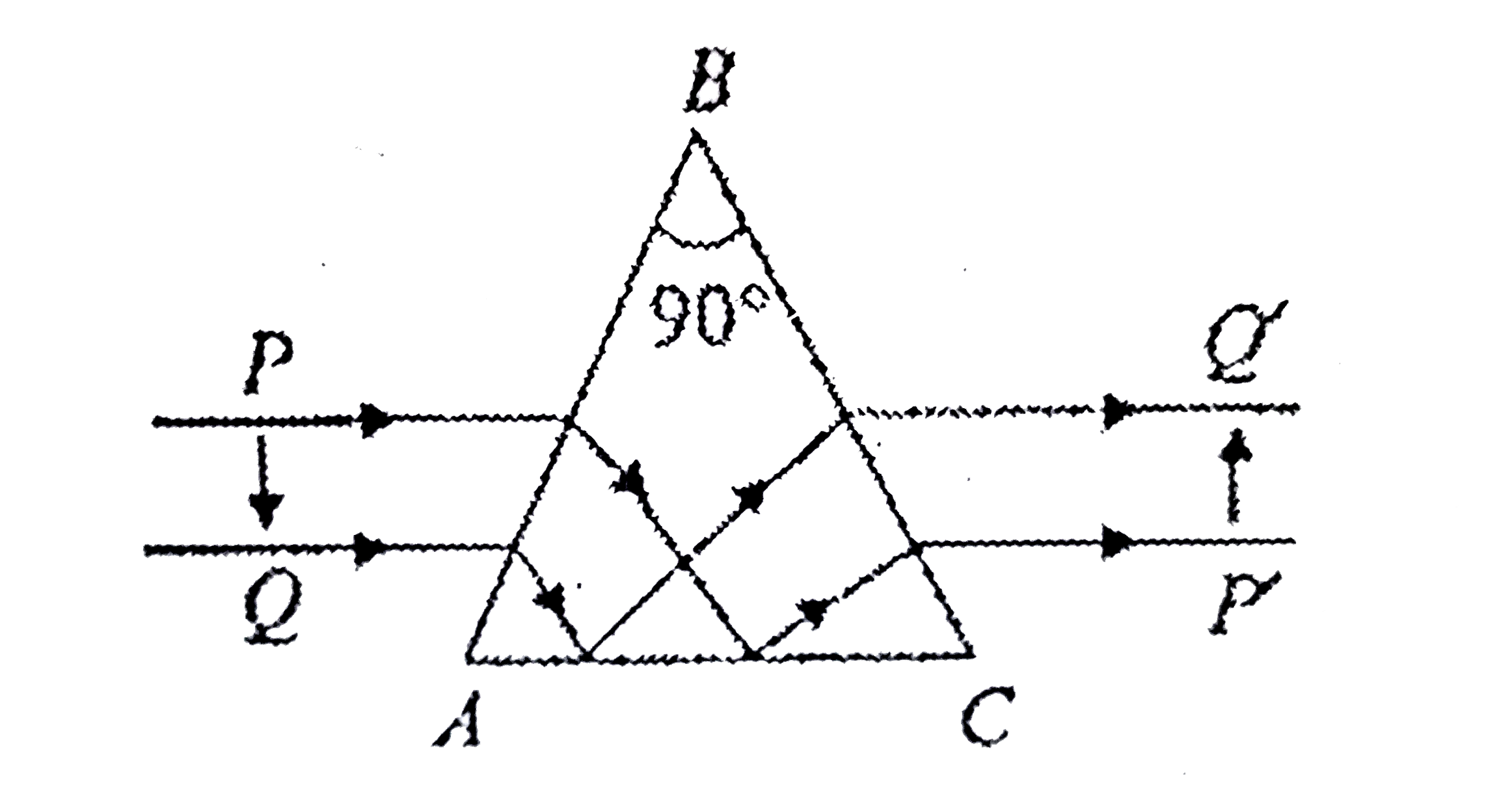
A


Beam of light incident on face AB, suffers refraction from air to glass and strikes the face AC suffering total intenal reflection. The beam now strikes the face BC of the prism at an angle of incidence less than the critical angle hence it suffers refraction from glass to air and bends away from the normal. The beam emerges out parallel to the base. As a result of refraction, on emergence the rays are inverted.
Promotional Banner

Similar Questions

Explore conceptually related problems

A total reflecting right angled isosceles prism can be used to deviate a ray of light through :

Show with the help of a diagram how a total reflecting prism can be used to turn a ray of light through 90^(@) . Name one instrument in which such a prism is used.

Write a relation between the angle of incidence (i), angle of emergence (e), angle of prism (A) and angle of deviation (d) for a ray of light passing through an equilateral prism.

Write a relation for the angle of deviation (delta) for a ray of light passing through an equilateral prism in terms of the angle of incidence (i_(1)) , angle of emergence (i_(2)) ang angle of prism (A).

The path of a ray of light passing through an equilateral glass prism ABC is shown in figure. The ray of light is incident on face BC at the critical angle for just total internal reflection. The total internal reflection. The total angle of deviation after the refraction at face AC is 108^@ . Calculate the refractive index of the glass.

If two prisms are combined , as shown in figure, find the total angular dispersion and angle of deviation suffered by a white ray of light incident on the combination.

A ray of light suffers refraction through an equilateral prism. The deviation produced by the prism does not depend on the:

A light ray is normally incident onone face of equilateral glass prism of refractive index sqrt(2) . The deviation of light ray is

When a ray of light is incident normally on one refracting surface of an equilateral prism (Refractive index of the material of the prism =1.5

When a ray of light is incident normally on one refracting surface of an equilateral prism (Refractive index of the material of the prism =1.5 )

