
Home
Class 12
PHYSICS
During SHM, a paricle has displacement x...

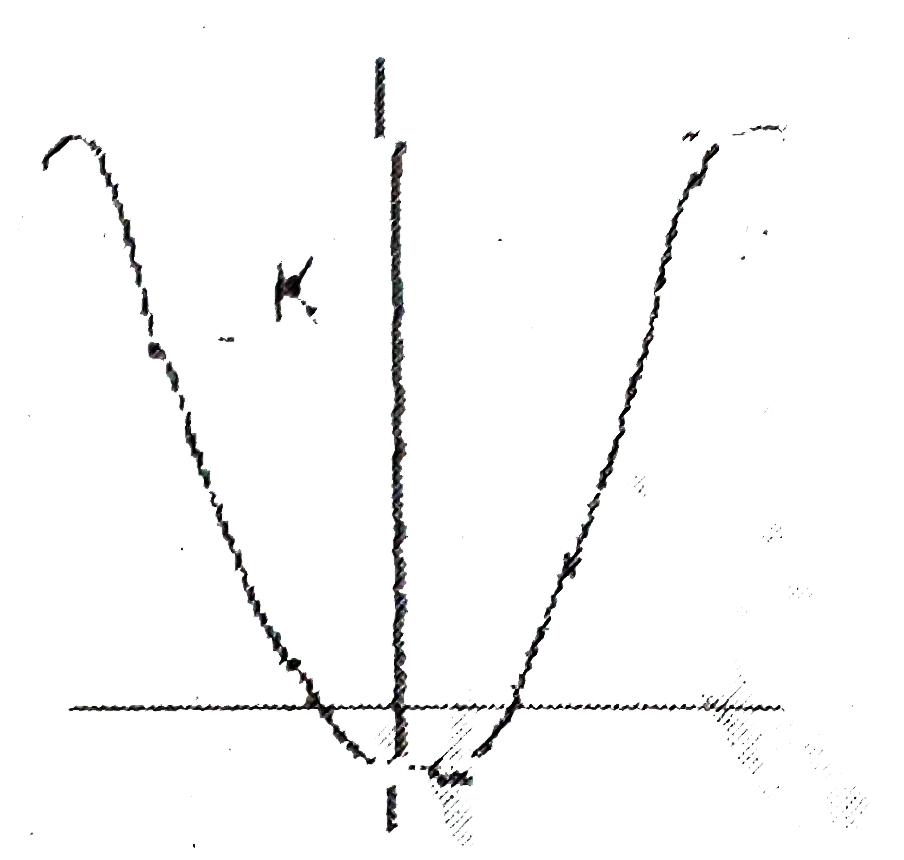
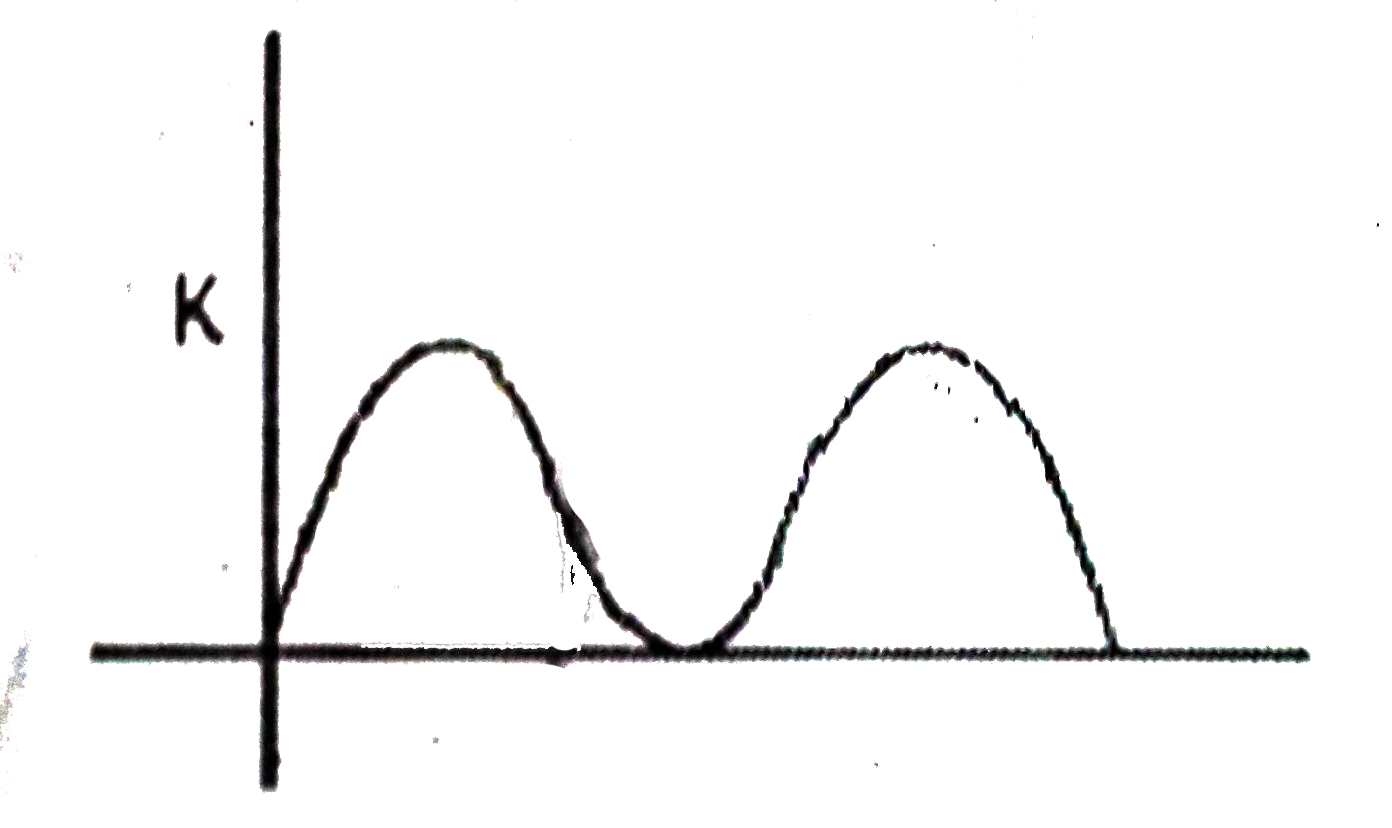
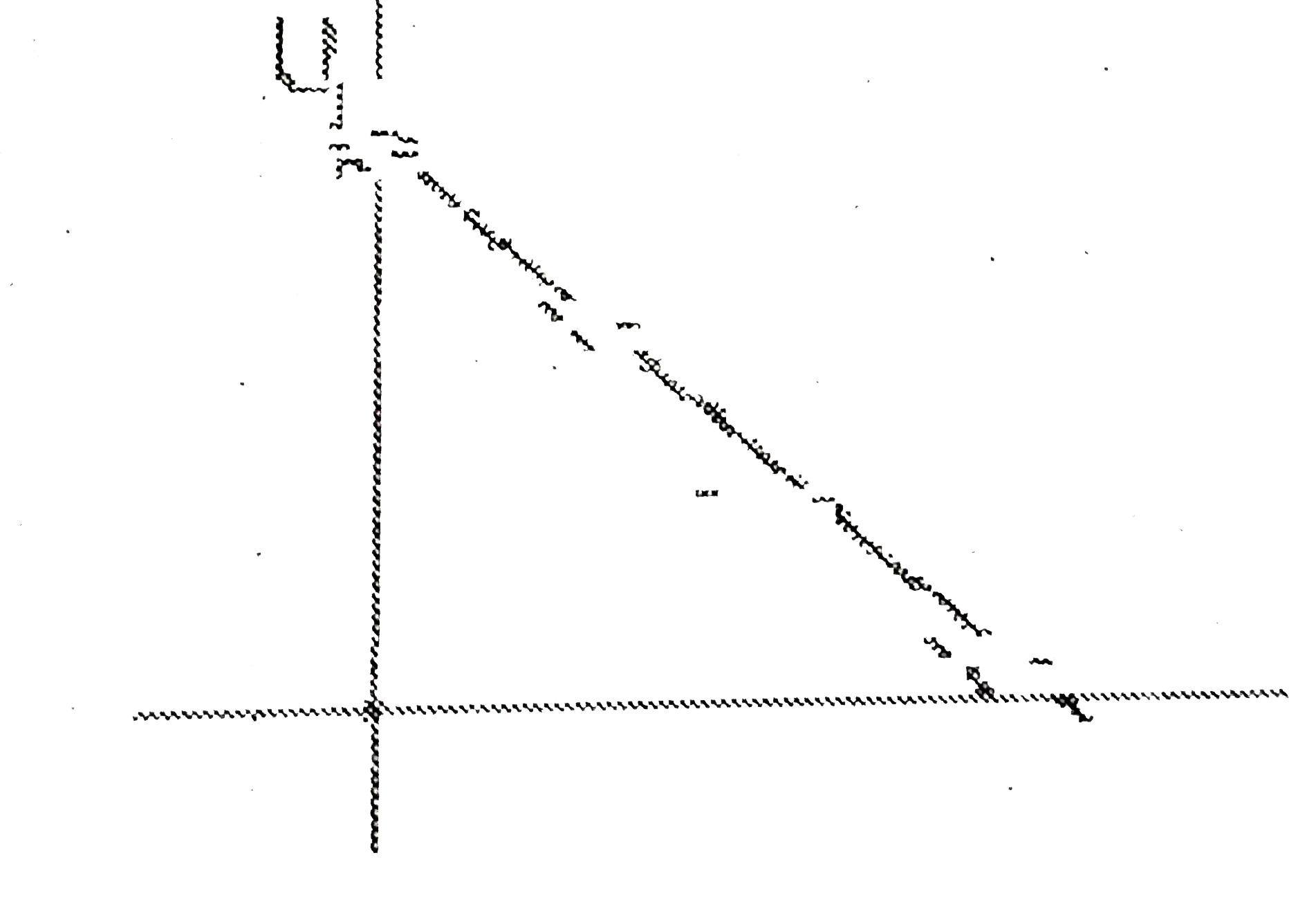
During SHM, a paricle has displacement x form mean position. If accreleration. Kinetic energy and potential energy are represented by a K and U respectively, the choose the appropriate graph

A

B

C

D

Text Solution

AI Generated Solution

The correct Answer is:

To solve the question regarding the graphs of kinetic energy (K), potential energy (U), and acceleration (A) during Simple Harmonic Motion (SHM), we can follow these steps: ### Step-by-Step Solution: 1. **Understand the Motion**: In SHM, the displacement \( x \) of the particle from the mean position varies sinusoidally with time. The equations governing SHM are: \[ x(t) = A \sin(\omega t) \] where \( A \) is the amplitude and \( \omega \) is the angular frequency. 2. **Find Velocity**: The velocity \( v \) is the derivative of displacement with respect to time: \[ v(t) = \frac{dx}{dt} = A \omega \cos(\omega t) \] 3. **Find Acceleration**: The acceleration \( a \) is the derivative of velocity: \[ a(t) = \frac{dv}{dt} = -A \omega^2 \sin(\omega t) \] This indicates that acceleration is maximum when the displacement is maximum and vice versa. 4. **Kinetic Energy (K)**: The kinetic energy of the particle is given by: \[ K = \frac{1}{2} m v^2 = \frac{1}{2} m (A \omega \cos(\omega t))^2 = \frac{1}{2} m A^2 \omega^2 \cos^2(\omega t) \] 5. **Potential Energy (U)**: The potential energy in SHM is given by: \[ U = \frac{1}{2} k x^2 = \frac{1}{2} m \omega^2 (A \sin(\omega t))^2 = \frac{1}{2} m A^2 \omega^2 \sin^2(\omega t) \] 6. **Total Energy**: The total mechanical energy \( E \) in SHM is constant and is the sum of kinetic and potential energy: \[ E = K + U = \frac{1}{2} m A^2 \omega^2 \] 7. **Graphing the Energies**: - Kinetic Energy \( K \) varies as \( \cos^2(\omega t) \) which means it reaches maximum when displacement is zero. - Potential Energy \( U \) varies as \( \sin^2(\omega t) \) which means it reaches maximum when displacement is maximum. - The total energy remains constant throughout the motion. 8. **Choosing the Correct Graph**: Based on the above analysis, we can conclude: - The graph of kinetic energy will be a cosine squared function (peaks at \( t = 0, T/2, T, \ldots \)). - The graph of potential energy will be a sine squared function (peaks at \( t = T/4, 3T/4, \ldots \)). - The total energy graph will be a horizontal line since it is constant. 9. **Final Selection**: After analyzing the options provided, the correct graph will be the one that shows the kinetic energy and potential energy oscillating out of phase with each other, while the total energy remains constant.
Promotional Banner

Similar Questions

Explore conceptually related problems

If A is amplitude of a particle in SHM, its displacement from the mean position when its kinetic energy is thrice that to its potential energy

A particle excutes SHM, at what value of displacement are the kinetic and potential energies equal?

The amgular velocity and the amplitude of a simple pendulum is omega and a respectively. At a displacement x from the mean position, if its kinetic energy is T and potential energy is U, then the ratio of T to U is

Ratio of kinetic energy at mean position to potential energy at A/2 of a particle performing SHM

In SHM , potential energy of a particle at mean position is E_(1) and kinetic enregy is E_(2) , then

The relationship between kinetic energy (K) and potential energy (U) of electron moving in a orbit around the nucleus is

A certain simple harmonic vibrator of mass 0.1 kg has a total energy of 10 J. Its displacement from the mean position is 1 cm when it has equal kinetic and potential energies. The amplitude A and frequency n of vibration of the vibrator are

A particle executing SHM has potential energy U_0 sin^2 omegat . The maximum kinetic energy and total energy respectively are

Displacement between maximum potential energy position and maximum kinetic energy position for a particle executing S.H.M is

The potential energy of a particle of mass 2 kg in SHM is (9x^(2)) J. Here x is the displacement from mean position . If total mechanical energy of the particle is 36 J. The maximum speed of the particle is
