Home
Class 12
PHYSICS
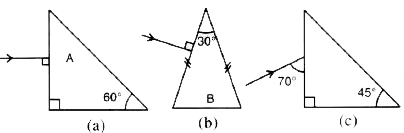
Figure below shows a light ray of green ...

Figure below shows a light ray of green colour incident on the prisms A,B and C. in each case, draw the path of the ray of light as it enters and emergest out of the prism. Mark the angle wherever necessary.

A

bend away from the normal

B

be totally reflected

C

bend toward the normal

D

do none of the above.

Text Solution

Verified by Experts

The correct Answer is:

C

The answer is simple in that we know that `N_r`=1.5 and `N_i`=1.0 , `therefore N_r/N_i ` gt 1.0 , therefore , the ray of light slows down and bend towards the normal
Promotional Banner

Similar Questions

Explore conceptually related problems

In figure, a ray of light PQ is incident normally on the hypotenuse of an isosceles right angled prism ABC. (a) complete the path of the ray PQ till it emerges from the prism. Mark in the diagram the angle wherever necessary. (b) what is the angle of deviation of the ray PQ ? (c) Name a device in which this action is used.

The diagram alongside shows a beam of light (red + blue) incident normally on an equilateral triangular prism. If the critical angle for the material of prüsm is 60^@ for the light of red colour, complete the diagram showing the path of light of each colour emerging out of the prism. Mark in the diagram the angles wherever necessary.

A beam of white light is incident normally on the surface AB of an equilateral prism ABC and emerges out of it suffering a deviation of 60^(@) . (a) Draw a diagram to show the path of beam till it emerges out of the prism. Mark the angles wherever necessary. (b) What assumption have you made while drawing the diagram ? (c) Name the phenomenon exhibited by the light beam.

A beam of white light is incident normally on the surface AB of an equilateral prism ABC and emerges out of it suffering a deviation of 60^(@) . (a) Draw a diagram to show the path of beam till it emerges out of the prism. Mark the angles wherever necessary. (b) What assumption have you made while drawing the diagram ? (c) Name the phenomenon exhibited by the light beam.

A ray of green light enters a liquid from air, as shown in figure. Angle 1 is 45^(@) and angle 2 is 30^(@) . (a) Find the refractive index of the liquid (b) Show in the diagram the path of the ray after it strikes the mirror and re-enters in air. mark in the diagram the angles wherever necessary. (c) Redraw the diagram if plane mirror becomes normal to the refracted ray inside the liquid. state the principle used.

Copy the diagram given below and complete the path of the light ray till it emerges out of the prism. The critical angle of glass is 42^(@) . In your diagram mark the angles wherever necessary.

Figure below shows two identical prisms A and B placed with their faces parallel to each other. A ray of light of single colour PQ is incident at the face of the prism A. complete the diagram to show the path of the ray till it emerges out of the prism B.

Figure shows two identical prisms P and Q placed with their faces parallel to each other. A light ray AB of yellow colour is incident at the face of the prism P. Complete the diagram to show the path of the ray till it emerges out of the prism Q.

(a) Figure shows two isosceles right angled prisms A and B and the light rays incident on the prism A. complete the diagram to show the rays emerging out of the prism B. (b) State the principle used for completing the ray diagram in part (a) above.

Figure shows the section of a semi-circular glass slab having its centre at O. three rays of light A,B and C of the same colour are incident on the slab and strike on the edge XY at the point O. the light ray B suffers refraction along OB'. (a) On the diagram, mark the critical angle by C. (b) The rays enter the slab undeviated. give reason. (c) Draw the path of rays A and C after they strike the edge XY. (d) Name the phenomenon which the rays A and C exhibit.
