Home
Class 12
PHYSICS
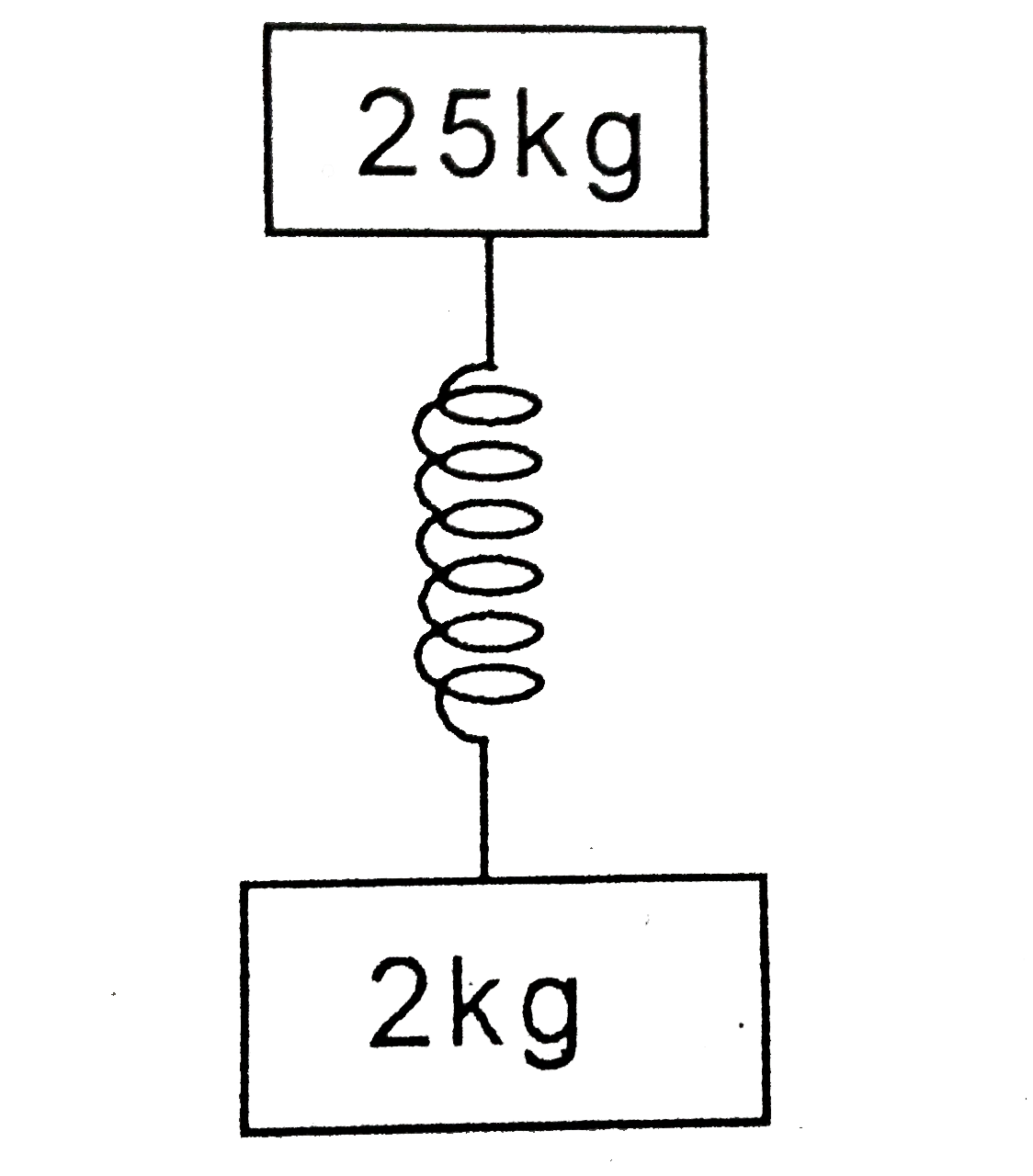
Initialy spring in its natural length no...

Initialy spring in its natural length now a block at mass 0.25 kg is released then find out maximum force by system on floor ?

A

15 N

B

20 N

C

25 N

D

30 N

Text Solution

Verified by Experts

The correct Answer is:
C


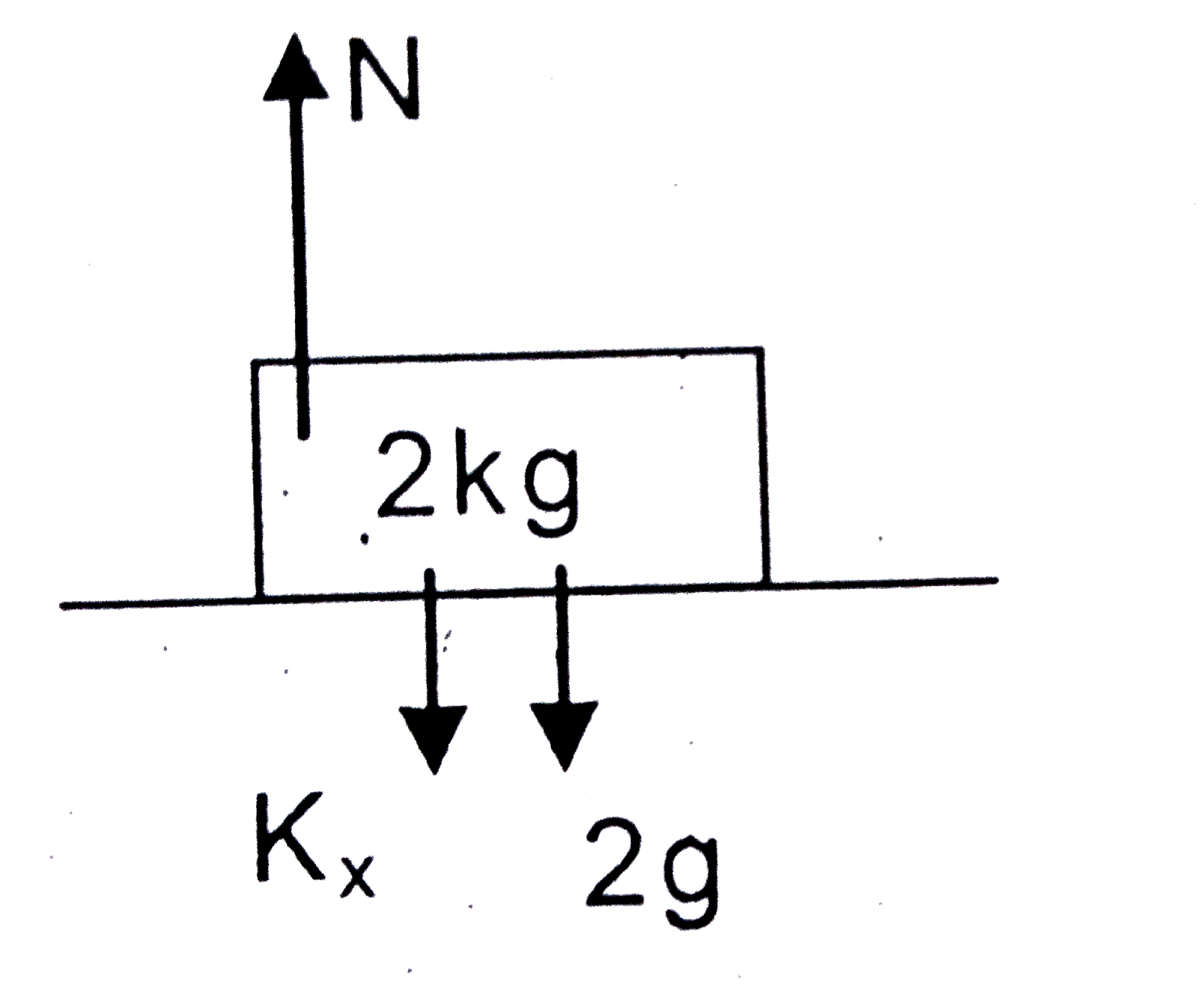
Work - energy theory on (25) kg
`(1)/(2)Kx^(2)=mgx`
`K_(x)=2mg`
`K_(x)=2xx.25xx10`
`= 5 N`
= 25 N
`N=kx+2g`
`=5+20=25N`
Promotional Banner

Similar Questions

Explore conceptually related problems

A block of mass m is attached with a spring in vertical plane as shown in the figure. If initially spring is in its natural length and the block is released from rest, then maximum extension in the spring will be

Initialy spring is in the natural length and blocks A & B are at rest. Find maximum value of constant force F that can be applied on B such that block A remains at rest. (g = 10 m//s^(2)) (given answer in Newton)

A block of mass m is attached to a spring of force constant k whose other end is fixed to a horizontal surface. Initially the spring is in its natural length and the block is released from rest. The average force acting on the surface by the spring till the instant when the block has zero acceleration for the first time is

Block A of mass m is placed on a plank B . A light support S is fixed on plank B and is attached with the block A with a spring of spring constant K . Consider that initially spring is in its natural length. If the plank B is given an acceleration a, then maximum compression in the spring is (xma)/(k) . Find the value of x (All the surface are smooth)

A block of mass m is connected to a spring (spring constant k ). Initially the block is at rest and the spring is in its natural length. Now the system is released in gravitational field and a variable force F is applied on the upper end of the spring such that the downward acceleration of the block is given as a=g-alphat , where t is time elapses and alpha=1m//s^(2) , the velocity of the point of application of the force is:

In the figure, block A is released from rest when the spring is its natural length for the block B of mass m to leave contact with the ground at some stage what should be the minimum mass of block A? .

A block of mass M is kept on a smooth surface and touches the two springs as shown in the figure but not attached to the springs. Initially springs are in their natural length. Now, the block is shifted (l_(0)//2) from the given position in such a way that it compresses a spring and released. The time - period of oscillation of mass will be

Mass m is connected with an ideal spring of natural length l whose other end is fixed on a smooth horizontal table. Initially spring is in its natural length l . Mass m is given a velocity 'v' perpendicular to the spring and released . The velocity perpendicular to the spring when its length l+x , will be

Find the maximum tension in the spring if initially spring at its natural length when block is released from rest.

A block of mass m = 2 kg is connected to a a spring of force constant k = 50 N//m . Initially the block is at rest and tlhe spring has natural length. A constant force F = 60 N is applied horizontally towards, the maximum speed of the block (in m//s ) will be (negelect friction).

