Home
Class 12
CHEMISTRY
Compounds 'A' and 'B' react according ...

Compounds 'A' and 'B' react according to the following chemical equation.
`A(g) to 2B(g) to 2C(g)`
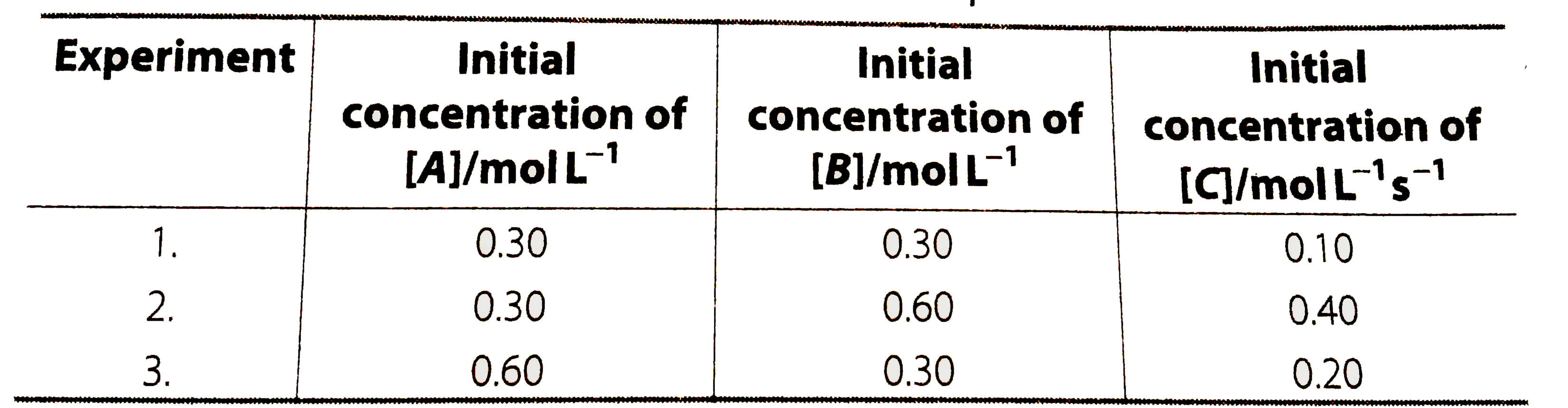
Concentration of either 'A' or 'B' were changed Keeping the concentration of one of the reactants constant and rates were measured as a function of initial concentration. Following result were obtained.
Choose the correct option for the rate equations for this reaction.

A

Rate `=k[A]^2 [B]`

B

Rate `=k[A] [B]^2`

C

Rate `=k[A] [B]`

D

Rate =`k[A]^2 [B]^@`

Text Solution

Verified by Experts

The correct Answer is:

B

From experiment 1 and 3. rate of reaction gets doubled when the concentration of A is doubled, keeping the concentration of B constant.
` therefore ` rate `prop` [A]
From experiments 1 and 2, rate of reation is quadrupled when the concentration of A is kept constant and that of B is doubled.
` therefore `rate ` prop [B]^2 " " therefore ` Overall rate of reaction`=k[A] [B]^2`
Promotional Banner

Topper's Solved these Questions

  • CHEMICAL KINETICS

    ICSE|Exercise EXERCISE (PART- I (OBJECTIVE QUESRTIONS) C. CORRECT THE FOLLOWING STATEMENTS BY CHANGING THE UNDERLINED PART OF THE STATEMENT ( DO NOT CHANGE THE WHOLE SENTENCE .)) |39 Videos
  • CHEMICAL KINETICS

    ICSE|Exercise EXERCISE (PART- I (OBJECTIVE QUESRTIONS) D. MATCH THE FOLLOWING ) |3 Videos
  • CHEMICAL KINETICS

    ICSE|Exercise EXERCISE (PART- I (OBJECTIVE QUESRTIONS)A.FILL IN THE BLANKS) |54 Videos
  • BIOMOLECULES

    ICSE|Exercise ISC EXAMINATION QUSTIONS (PART-I)(DESCRIPTIVE QUESTIONS)|21 Videos
  • CHEMISTRY IN EVERYDAY LIFE

    ICSE|Exercise EXERCISE (PART - II (DESCRIPTIVE QUESTIONS) (LONG ANSWER QUESTIONS))|19 Videos

Similar Questions

Explore conceptually related problems

Compound 'A' and B react according to the following chemical equation. A_((g)) + 2B_((g)) to 2C_((g)) Concentration of either A or B were changed keeping the concentrations of one of the reactants constant and rates were mesured as a function of initial concentration. Following results were obtained. Choose the correct option for the rate equations for this reaction. {:("Experiment","Initial concentration of"[A]//mol L^(-1),"Initial concentration of"[B]mol L^(-1),"Initial rate of formation of"[c]//mol L^(-1)s^(-1)),(1,0.30,0.30,0.10),(2,0.30,0.60,0.40),(3,0.60,0.30,0.20):}

For the reaction A + B rarr C + D , doubling the concentration of both the reactants increases the reaction rate by 8 times and doubling the initial concentration of only B ismply doubles the reaction rate. What is the rate law for the reaction ?

Rate law for the reaction A + 2B to C is found to be Rate =k[A][B] Concentration of reactant 'B' is doubled. Keeping the concentration of 'A' constant, the value of rate constant will be:

Rate law for the reaction, A + 2B to C is found to be Rate = k [A] [B] Concentration of reactant 'B' is doubled keeping the concentration of 'A' constant, the value of rate constant will be _______

A(g) + 3B(g) rarr 4C(g) Initially concentration of A is equal to that of B. The equilibrium concentrations of A and C are equal. Kc is :

In a reaction A + B to Products (i) If the initial concentration of A is doubled and B is kept constant, the rate of the reaction is doubled (ii) If the initial concentration both A and B are doubled the rate of reaction becomes eight times The rate law of the reaction is :

ICSE-CHEMICAL KINETICS-EXERCISE (PART- I (OBJECTIVE QUESRTIONS)B.COMPLE THE FOLLOWING STATEMENTS BY SELECTING THE CORRECT ALTERNATIVE FROM THE CHOICES GIVEN )
  1. Which of the following statements is incorrect about the collison theo...

    Text Solution

    |

  2. A first order reaction is 50% completed in 1.26 xx 10^(14)s. How much ...

    Text Solution

    |

  3. Compounds 'A' and 'B' react according to the following chemical eq...

    Text Solution

    |

  4. Which of the following statements is not correct ?

    Text Solution

    |

  5. The value of rate constant of a pseudo first order reaction

    Text Solution

    |

  6. Consider the reaction A to B. The concentration of both the reactan...

    Text Solution

    |

  7. The time of completion of 90% of a first order reaction is approximate...

    Text Solution

    |

  8. The rate law for the reaction 2N2 O5 to 4NO2 + O2 is

    Text Solution

    |

  9. At any stage of the reaction 3A to2B, the reaction rate +(dB )/(dt) wi...

    Text Solution

    |

  10. For the reaction system : 2NO(g) + O2(g) ------>2NO2(g),volume is sudd...

    Text Solution

    |

  11. In respect of the equation k = Ae^(-Ea //RT) in chemical kinetics, whi...

    Text Solution

    |

  12. The time taken for the completion of 3/4 of a first order reaction is

    Text Solution

    |

  13. For a reaction A+B to C + D, if concentration of A is doubled without ...

    Text Solution

    |

  14. The half-life of a reaction is halved as the initial concentration of ...

    Text Solution

    |

  15. The reaction X to Product follows first order kinetics. In 40 minutes...

    Text Solution

    |

  16. In a first order reaction, the concentration of the reactant decreases...

    Text Solution

    |

  17. The rate equation for the reaction 2A+B to C is found to be : rate = ...

    Text Solution

    |

  18. The rate of first order reaction is 1.5 xx 10^(-2) mol L^(-1) min ^(-1...

    Text Solution

    |

  19. The half-lives of 2 samples are 0.1 and 0.4 seconds. Their initial con...

    Text Solution

    |

  20. The velocity constant of a reaction at 290 K was found to be 3.2 xx 10...

    Text Solution

    |
