

Home
Class 12
CHEMISTRY
Decarboxylation....

Decarboxylation.

Text Solution

Verified by Experts

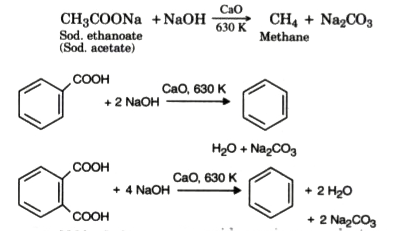
The process of removal of a molecule of `CO_(2)` from a carboxylic acid is called decarboxylation. It is usually carried out by heating a carboxylic acid or its sodium salt with soda-lime `underset("3 : 1")((NaOH+CaO))` at 630 K. For example,
`underset("(Sod. acetate)")overset("Sod. ethanoate")(CH_(3)COONa)+NaOHunderset(630K)overset(CaO)(to)underset("Methane")(CH_(4))+Na_(2)CO_(3)`

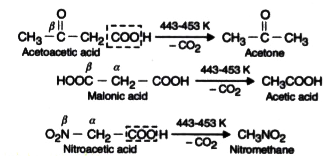
In case, a carboxylic acid carries an electron withdrawing group such as Co, COOH, `NO_(2)` etc. at `beta`-position w.r.t. the carboxylic group, decarboxylation can be readily achieved just by heating. for example,
Promotional Banner

Topper's Solved these Questions

  • SOLUTIONS

    ICSE|Exercise MULTIPLE CHOICE QUESTIONS (Assertion and Reason based questions)|10 Videos
  • SPECIMEN QUESTION PAPER

    ICSE|Exercise QUESTION|140 Videos

Similar Questions

Explore conceptually related problems

Which (------COOH) group is easaily decarboxylated on heating and why?

Which of the compounds shown below will react with diethyl malonate in the presence of methoxide ion to give a compound, which on treatment with aqueous acid and gentle heating will decarboxylate to form butanoic acid?

In CAM plants, organic acids are decarboxylated at

Which of the following compound would be expected to decarboxylates when heated:-

Assertion : Dark acidification of cytoplasm occurs in CAM plants. Reaon : Orgnaic acids are decarboxylated during night.

Assertion : Malonic acid (HOOC―CH_2―COOH) does not form cyclic anhydride on heating. Reason : It is like βketo acid, on heating it prefer to decarboxylate.

Assertion : Dark acidification of cytoplasm occurs in CAM plants. Reason : Organic acids are decarboxylated during night. (a) If both Assertion and Reason are true and the Reason is the correct explanation (b) If both Assertion and Reason are true, but the Reason is not the correct explanation of the Assertion. (c) If Assertion is true, but Reason is false. (d) If both Assertion and Reason are false.