

Home
Class 12
CHEMISTRY
Carbylamine reaction....

Carbylamine reaction.

Text Solution

Verified by Experts

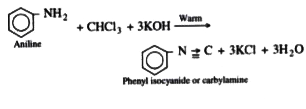
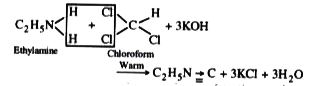
When a primary amine is warmed with chloroform and an alcoholic solution of KOH, it forms carbylamine having an extremely unpleasant smell.


This test is not given by secondary and tertiary emines. Therefore, it can be used as a test for detection of primary amines.
Promotional Banner

Topper's Solved these Questions

  • SOLUTIONS

    ICSE|Exercise MULTIPLE CHOICE QUESTIONS (Assertion and Reason based questions)|10 Videos
  • SPECIMEN QUESTION PAPER

    ICSE|Exercise QUESTION|140 Videos

Similar Questions

Explore conceptually related problems

Statement 1: Amines are less basic than alcohols. Statement-2: Secondary amines give carbylamine reactions. Statement-3: in Hofmann-bromide reaction amide is converted to amines with same number of carbon atom.

Amines are basic in nature and show many types of reactions such as substitution, Hoffmann elimination, carbylamine, acylation, diazotisation etc. X is same as

Amines are basic in nature and show many types of reactions such as substitution, Hoffmann elimination, carbylamine, acylation, diazotisation etc. What is the major alkene formed in the following Hoffmann elimination?

Amines are basic in nature and show many types of reactions such as substitution, Hoffmann elimination, carbylamine, acylation, diazotisation etc. Certain nitrogeneous compound with molecular mass 180 shows an increase in its molecular mass to 348 after treatment with acetyl chloride. The number of possible - NH_(2) groups in the molecule is...................

Distinction between pairs of compounds Aniline and N, N-dimethylaniline 1. Carbylamine test. 2. Reaction with Hinsberg's reagent.

Carbylamine test is given by........amines.

Carbylamine test is performed in alcoholic KOH by heating a mixture of:

Match the following : (i) Carbylamine - Surcose (ii) Disaccharide - Complex (iii) Cannot be prepared easily from precipitate - Obnoxious smell (iv) Sequence of elementary reactions - Irreversible colloid