

Home
Class 8
MATHS
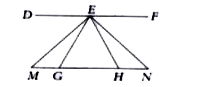
In the above figure , DF is parallel to ...


In the above figure , DF is parallel to MN . EGH is an isosceles triangle , where `EG=EHandangleGEH=50^(@)`. If EM and EN are the bisectors of the `angleDEGandangleFEH` , then
(i) Show that `angleDEM=angleFEN`.
(ii) Show that `angleGEM=angleHEN`.

Promotional Banner

Topper's Solved these Questions

  • GEOMETRY

    PEARSON IIT JEE FOUNDATION|Exercise TEST YOUR CONCEPTS (ESSAY TYPE QUESTIONS) |5 Videos
  • GEOMETRY

    PEARSON IIT JEE FOUNDATION|Exercise CONCEPT APPLICATION (Level 1)|60 Videos
  • GEOMETRY

    PEARSON IIT JEE FOUNDATION|Exercise TEST YOUR CONCEPTS ( VERY SHORT ANSWER TYPE QUESTIONS) |28 Videos
  • Formulae

    PEARSON IIT JEE FOUNDATION|Exercise Level 3|7 Videos
  • INDICES

    PEARSON IIT JEE FOUNDATION|Exercise CONCEPT APPLICATION (Level 3)|7 Videos

Similar Questions

Explore conceptually related problems

In an isosceles triangle ABC, with AB = A C , the bisectors of B and C intersect each other at O. Join A to O. Show that : (i) O B = O C (ii) AO bisects A

The figure above shows the race track in which ABCD is a square of side 21 km and MQR is an isosceles triangle. One can travel along the square at the speed of 5 kmph, along the circle at the speed of 4 kmph and along the triangle at 3 kmph. While travelling along these tracks one has to change tracks, at a point where two or three intersect each other.

DeltaABC and DeltaDBC are two isosceles triangles on the same base BC and vertices A and D are on the same side of BC (see figure). If AD is extended to intersect BC at P, show that : (i) DeltaABD cong DeltaACD (ii) DeltaABP cong DeltaACP (iii) AP bisects angleA as well as angleD (iv) AP is the perpendicular bisector of BC.

Line segment AB is parallel to another line segment CD. O is the midpoint of AD (see the given figure). Show that (i) triangleAOB = triangle DOC (ii) O is also the midpoint of BC

DeltaABC and DeltaDBC are two isosceles triangles on the same base BC and vertices A and D are on the same side of BC. If AD is extended to intersect BC at E, show that (i) DeltaABD ~=DeltaACD (ii) DeltaABE~=DeltaACE (iii) AE bisects angleA as well as angleD (iv) AE is the perpendicualr bisector of BC.

Consider two coherent sources S_(1) and S_(2) producing monochromatic waves to produce interference patten. Let the displacement of the wave produced by S_(1) be given by and the displacement by S_(2)" be" " " Y_(1) = acos omegat Y_(2) = a cos ( omegat -phi) Find out expression for the amplitude of the resultant displacement at a point and show that the intensity at that point will be I = 4a^(2) cos^(2) phi//2 Hence establish the conditions for constructive and destructive interference. (b) What is the effect on the interference friinges in Young's double slit experiment when (i) the width of the source slit is increased, (ii) the monochromatic source is replaced by a source is replaced by a source of white light ? OR (a) A ray, 'PQ' of light on the face AB of glass prism ABC (as shown in the figure) and emerges out of the face AC. Trace the path of the ray. Show that anglei + anglee= angleA+ angledelta Where delta and e denote the angle of deviation and angle of emergence respectively. Plot a graph showing the variation of the angle of deviation as a function of angle of incidence. state the condition under which angledelta is minimum. (b) Find out the relation between the refractive index (mu) of the glass prism and angleA for the case when the angle of prism (A) is equal to the angle of minimum deviation (delta_(m)) . Hence obtain the value of the refractive index for angle Ae=60^(@) .

DeltaA B C and DeltaD B C are two isosceles triangles on the same base BC and vertices A and D are on the same side of BC (see Fig. 7.39). If AD is extended to intersect BC at P, show that (i) \ DeltaA B D~=DeltaA C D (ii) DeltaA B P~=DeltaACP (iii) AP bisects ∠ A as well as ∠ D (iv) AP is the perpendicular bisector of BC

A student focussed the image of a candle flame on a white screen using a convex lens. He noted down the position of the candle, screen and the lens as under Position of candle = 12.0 cm Position of convex lens = 50.0 cm Position of the screen = 88.0 cm (i) What is the focal length of the convex lens ? (ii) Where will the image be formed if he shifts the candle towards the lens at a position of 31.0 cm . (iii) What will be the nature of the image formed if he further shifts the candle towards the lens ? (iv) Draw a ray diagram to show the formation of the image in case (iii) as said above.