Home
Class 7
CHEMISTRY
Explain the formation of the compound f...

Explain the formation of the compound formed by two elements with Z = 20 and Z = 17 .

Text Solution

Verified by Experts
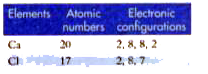

Ca loses two electrons to attain an octet configuration while Cl gains an electron to attain the same.
Hence, the formula of the compound is
`Ca^(+2) Cl^(-1)`
`CaCl_2`
Promotional Banner

Similar Questions

Explore conceptually related problems

Explain the formation of the compound in the following reaction. .

What is the formula of the compound formed when an element A (atomic number = 19) combines with an element B (atomic number =17) ?

Write the electronic configuration of two elements X and Y whose atomic numbers are 20 and 17 respectively. Write the molecular formula of the compound formed when element X reacts with element Y. Draw electron-dot structure of the product and also state the nature of the bond formed between both the elements.

Elements X,Y and Z have 4,5 and 7 valence electrons respectively, (i) Write the molecular formula of the compounds formed by these elements individually with hydrogen (ii) which of these compounds will have the highest dipolw moment ?

(a) List two limitations of Newlands' Law of Octaves. (b) Write the electronic configuration of two elements A and B whose atomic numbers are 20 and 17 respectively. Write the molecular formula of the compound formed when element A reacts with element B. State whether this compound is acidic, basic or neutral. Give reason to justify your answer.

A binary compound formed between the elements with atomic numbers 19 and 17 is expected to be

Three are three elements X,Y and Z having atomiv numbers of 6,16 and 19 respectively. Based on this information, Rakshit has been asked to answer the following questions: (a) In which group of the periodic table would you expect to find (i) element X (ii) element Y and (iii)( element Z ? (b) Which two elements will form ionic bonds ? Why? (c) What will be the formula of ionic compound formed ? (d) Which two elements will form covalent bonds? Why? (e) What will be the formula of covalent compound formed? (f) What values are displayed by Rakshit in answering the above questions?

