Home
Class 12
PHYSICS
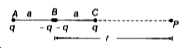
Given fgure shows a charge array known a...

Given fgure shows a charge array known as an electric quadrupole. For a point on the axis of the quadrupole, obtain the dependence of potential on r for `r//a gt gt1` and constrast your results with that due to an electric dipole and an electric monopole (i.e. a single charge).

A quadrupole is considered always a system of three charges `q,-2q` and q.

Text Solution

Verified by Experts
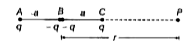
Given, `AC=2a,BP=r,AP=r+a`
and `PC=r-a`

The potential at P is V.
`:.V=` Potential at P due to A + Potential at P due to B + Potential at P due to C
`V=(1)/(4piepsi_(0))[(q)/(AP)-(2q)/(BP)+(q)/(CP)]`
`=(1)/(4piepsi_(0))*q[(1)/((r+a))-(2)/(r)+(1)/((r-a))]`
`=(q)/(4piepsilon_(0))[(r(r-a)-2(r+a)(r-a)+r(r+a))/(r(r+a)(r-a))]`
`(q)/(4piepsi_(0))[(r^(2)-ra-2r^(2)+2a^(2)+r^(2)+ra)/(r(r^(2)-a^(2)))]`
`=(q*2a^(2))/(4piepsi_(0)r(r^(2)-a^(2)))=(q*2a^(2))/(4piepsi_(0)r(r^(2)-a^(2)))=(q*2a^(2))/(4piepsi_(0)*r*r^(2)(1-(a^(2))/(r^(2))))`
According to the question,
if `(r)/(a)gt gt1`, then `altltr`.
Therefore, `V=(q*2a^(2))/(4piepsi_(0)*r^(3))rArrV prop(1)/(r^(3))`
As, we know that electric potential at a point on axial line due to an electric dipole is
`V prop(1)/(r^(2))`
In case of electric monopole, `Vprop(1)/(r)`.
Then, we conclude that for larger r, the electric potential due to a quadrupole is inversely proportional to the cube of the distance r, while due to an electric dipole, it is inversely proportional to the square of r and inversely proportional to the distance r for a monopole.
Promotional Banner

Similar Questions

Explore conceptually related problems

Two point charges +q and -2q are placed at the vertices B and C of an equilateral triangle ABC of side a as given in the figure. Obtain the expression for (i) The magnitude and (ii) the direction of the resultant electric field at the vertex A due to these two charges.

If a charge q is projected in a uniform electric field E. What would be its work done when it moves a distance r?

Two point charges +q and -q are separated by a distance d. Except at infinity, where can the electric potential due to these two point charges be zero?

