

Home
Class 11
PHYSICS
The kinetic energies of a planet in an e...

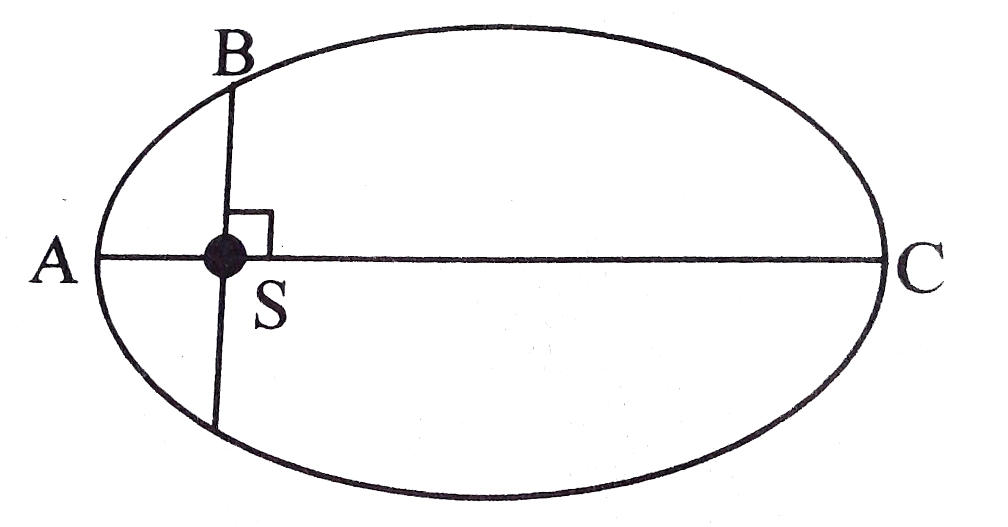
The kinetic energies of a planet in an elliptical orbit about the Sun, at positions A, B and C are `K_A`,`K_B`and `K_C`, respectively. AC is the major axis and SB is perpendicular to AC at the position of the Sun S as shown in the figure . Then

A

`K_A lt K_B lt K_C`

B

`K_A gt K_B gt K_C`

C

`K_B lt K_A lt K_C`

D

`K_B gt K_A gt K_C`

Text Solution

Verified by Experts

Promotional Banner

Topper's Solved these Questions

  • FRICTION IS SOLIDS AND LIQUIDS

    TARGET PUBLICATION|Exercise MCQ (EVALUATION TEST)|21 Videos
  • LAWS OF MOTION

    TARGET PUBLICATION|Exercise EXERCISE|281 Videos

Similar Questions

Explore conceptually related problems

The kinetic energies of a planet in an elliptical orbit about the Sun, at positions A,B and C are K_(A),K_(B) and K_(C) respectively. AC is the major axis and SB is perpendicular to AC at the position of the sun as shown in the figure. Then

Four particles of masses 0.2 kg, 0.3 kg, 0.4 kg and 0.5 kg, respectively are kept at the comers A, B, C and D of square ABCD of side 1m. Find the M.I. about an axis passing through the point A and perpendicular to the plane of the square

A planet is revolving around the sun as shown in the figure. The radius vectors joining the sun and the planet al points A and B are 90 xx 10^6 km and 60 xx 10^6 km respectively. The ratio of velocities of the planet at A and B when its velocities make 30^@ and 60^2 with major axis of the orbit is

The figure shows the elliptical orbit of a planet about the sun S. An ellipse is the curve obtained when a cone is cut by an inclined plane. It has two focal points. The sum of the distances to the two focal points from every point on the curve is constant. F_1 " and " F_2 are the two focal points of the ellipse . The shaded area CF_1D is twice the shaded area AF_1B. t_1 is the time taken by the planet to move from C to D and t_2 is the time to move from A to B Which laws do we understand from the above diagram and description?

Particle A moves along X-axis with a uniform velocity of magnitude 10 m/s. Particle B moves with uniform velocity 20 m/s. along a direction making an angle of 60^(@) with the positive direction of X-axis as shwon in the figure. The relative velocity of B with respect to that of A is

The radius of a wheel is R and its radius of gyration about an axis passing through its centre and perpendicular to its plane is K. If the wheel is rolling without slipping the ratio of its rotational kinetic energy to its translational kinetic energy is

A particle of mass m is subjected to an attractive central force of magnitude k//r^(2) , k being a constant. If at the instant when the particle is at an extreme position in its closed orbit, at a distance a from the centre of force, its speed is sqrt(k//2ma) , if the distance of other extreme position is b. Find a//b .

During SHM, a paricle has displacement x form mean position. If accreleration. Kinetic energy and potential energy are represented by a K and U respectively, the choose the appropriate graph

Light of wavelength lambda_(A) and lambda_(B) falls on two identical metal plates A and B respectively . The maximum kinetic energy of photoelectrons in K_(A) and K_(B) respectively , then which one of the following relations is true ? (lambda_(A) = 2lambda_(B))

TARGET PUBLICATION-Gravitation-Exercise
  1. If the angular momentum of a planet of mass m, moving around the Sun i...

    Text Solution

    |

  2. A planet is revolving around the sun as shown in the figure. The radiu...

    Text Solution

    |

  3. The kinetic energies of a planet in an elliptical orbit about the Sun,...

    Text Solution

    |

  4. Assume that the earth moves around the sun in a circular orbit of radi...

    Text Solution

    |

  5. Two small satellites move in circular orbits arounds the earth respect...

    Text Solution

    |

  6. A planet of mass m moves around the Sun along an elliptical path with ...

    Text Solution

    |

  7. Two astronauts are floating in gravitational free space after having l...

    Text Solution

    |

  8. Two particles of mass m(1) and m(2), approach each other due to their ...

    Text Solution

    |

  9. A spherical planet far out in space has a mass M0 and diameter D0. A p...

    Text Solution

    |

  10. Mass M is divided into two parts xm and (1 - x)m. For a given separati...

    Text Solution

    |

  11. Four particles, each of mass M and equidistant from each other, move a...

    Text Solution

    |

  12. Four identical particles of mass M are located at the corners of a squ...

    Text Solution

    |

  13. If density of the earth is doubled keeping radius constant, the new ac...

    Text Solution

    |

  14. A body weighs 700 gm-wt on the surface of the earth. How much will it ...

    Text Solution

    |

  15. A body is raised to a height 'nR' from the surface of the earth of rad...

    Text Solution

    |

  16. The value of gravitational acceleration 'g' at a height 'h' above the ...

    Text Solution

    |

  17. A body weighs 72 N on the surface of the earth What is the gravitation...

    Text Solution

    |

  18. The height at which the weight of a body becomes 1/(16), its weight on...

    Text Solution

    |

  19. The depth d at which the value of acceleration due to gravity becomes ...

    Text Solution

    |

  20. The value of acceleration due to gravity at a depth of 1600 km is equa...

    Text Solution

    |