Home
Class 11
CHEMISTRY
Why is that in the SF(4) molecule, the l...

Why is that in the `SF_(4)` molecule, the lone pair of electrons occupies an equatorial position in the overall trigonal pyramidal arrangement in preference to an axial position ?

Text Solution

Verified by Experts
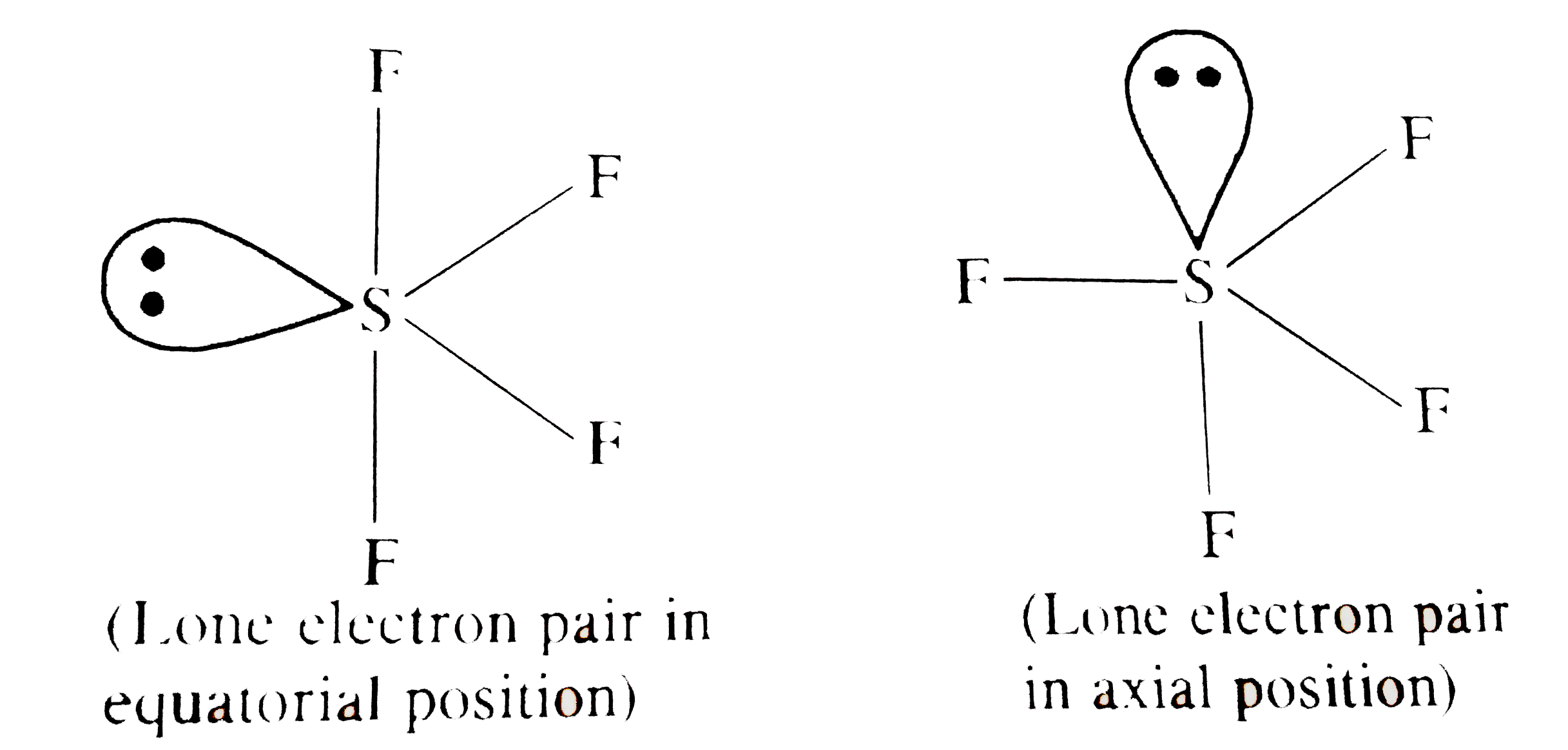

In equatorial position, the lone electron pair is experiencing repulsion from two shared pairs of electrons at right angle to it while in the axial position, it is repelled by three shared electron pairs at tight angle to it. In order to minimuse the replusion, the lone electron pair must be present in the equatorial position and not in the axial position.
Promotional Banner

Similar Questions

Explore conceptually related problems

Why is that in the SF_(4) molecule, the lone pair of electrons occupies an equatorial position in the overall trigonal bipyramidal arrangement in preferencr to an axial position ?

In BrF_(3) molecule, the lone pair occupies equatorial position minimize

In ClF_(3) , lone pair of electrons is present at equatorial position to minimize :

Valence shell electron pair repulsion theory (VSEPR) provides a method for predicting the shape of molecules, based on the electron pair electrostatic repulsion.According to VSEPR model, molecules adopt geometries in which their valence electron pairs position themselves as far from each other as possible.The VSEPR model consider double and triple bonds to have slightly greater repulsive effects than single bonds because of the repulsive effect of pi electrons.how ever, the lone pair creates the maximum repulsive effect. Which of the following does not represent the isostructural pair ?

Write the geometry of XeF_(4) and SOF_(4) and clearly indicate the position of lone pair of electrons and hybridization of the central atom.

A molecule XY_2 contains two sigma , two pi and one lone pair of electron in valence shell of X. The arrangement of lone pair as well as bond pairs is

The resonance effect is defined as 'the polarity produced in the molecule by the interaction of two pi -bonds or between a pi -bond and lone pair of electrons present on an adjacentatom.' The effect is transmitted through the chain. In positive resonance effect, the transfer of electrons is away from an atom or substituent group attached to the conjugated system. This electron displacement makes certain positions in the molecule of high electron densities. In negative resonance effect, the transfer of electrons is towards the atom or substituent group attached to the conjugated system. Which of the following intermediates is pyramidal in shape ?

The resonance effect is defined as 'the polarity produced in the molecule by the interaction of two pi -bonds or between a pi -bond and lone pair of electrons present on an adjacentatom.' The effect is transmitted through the chain. In positive resonance effect, the transfer of electrons is away from an atom or substituent group attached to the conjugated system. This electron displacement makes certain positions in the molecule of high electron densities. In negative resonance effect, the transfer of electrons is towards the atom or substituent group attached to the conjugated system. Which of the following shows +M effect ?

The resonance effect is defined as 'the polarity produced in the molecule by the interaction of two pi -bonds or between a pi -bond and lone pair of electrons present on an adjacentatom.' The effect is transmitted through the chain. In positive resonance effect, the transfer of electrons is away from an atom or substituent group attached to the conjugated system. This electron displacement makes certain positions in the molecule of high electron densities. In negative resonance effect, the transfer of electrons is towards the atom or substituent group attached to the conjugated system. Which of the following does not show resonance effect ?

The resonance effect is defined as 'the polarity produced in the molecule by the interaction of two pi -bonds or between a pi -bond and lone pair of electrons present on an adjacentatom.' The effect is transmitted through the chain. In positive resonance effect, the transfer of electrons is away from an atom or substituent group attached to the conjugated system. This electron displacement makes certain positions in the molecule of high electron densities. In negative resonance effect, the transfer of electrons is towards the atom or substituent group attached to the conjugated system. Which of the following carboxylate ions is the most stable ?

