Home
Class 11
CHEMISTRY
Assign reason for the following : (i) ...

Assign reason for the following :
(i) Ammonia is soluble in water while phosphine is not
(ii) `B_(2)` is paramagnetic while `C_(2)` is not.

Text Solution

Verified by Experts
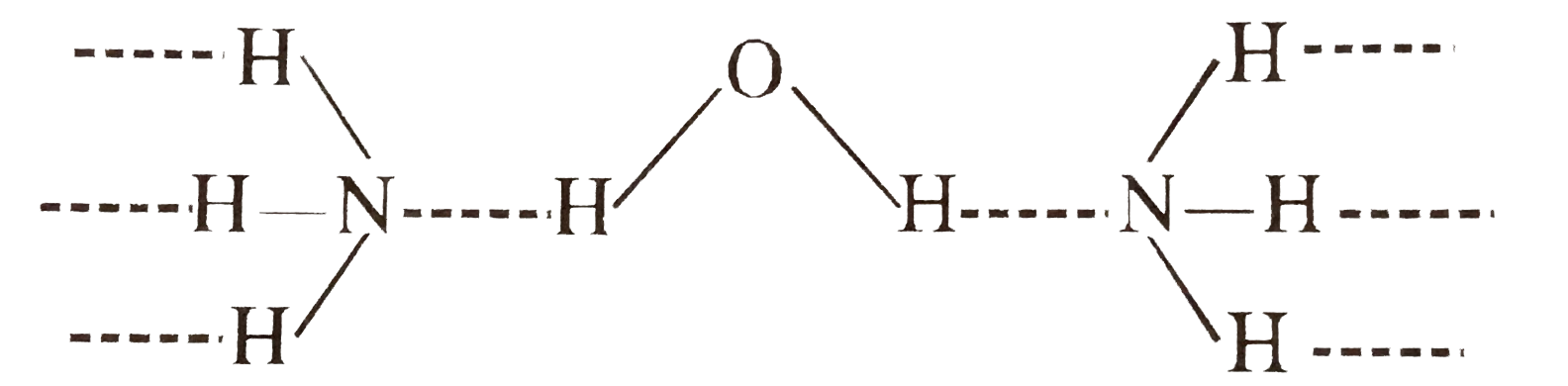
(i) Ammonia `(NH_(3))` is involved in intermolecular hydrogen bonding with the molecules of water `(H_(2)O).`

Energy relased during attraction helps in dissolving ammonia in water to from ammoniu hydroxide `(NH_(4)OH).` In phosphine `(PH_(3)),` P-H bond is almost non-polar because both P and H atoms have the same electronegativily (2.1). There is on hydrogen bonding in the molecules of phosphine and water and therefore, phosphine does not dissolce in water.
(ii) The molecular orbital electronic configuratioln both `B_(2)and C_(2)` are given :
`" "B_(2): [sigma_(1s)]^(2)[sigma_(2s)]^(2)[sigma_(2s)^(**)]^(2)[pi_(2py)]^(1)[pi_(2py)]^(1)`
`" "C_(2): [sigma_(1s)]^(2)[sigma_(2s)]^(2)[sigma_(2s)^(**)]^(2)[pi_(2py)]^(2)[pi_(2py)]^(2)`
Since `B_(2)` has two unpaired electrons, it is paramagnetic in nature. `C_(2)` is diamagnetic in nature as it has no unpaired electron present in the molecular orbitals.
Promotional Banner

Similar Questions

Explore conceptually related problems

Give reasons for the following (i) Ammonia is used for cleaning window panes.

Assign reasons for the following: Sc^(3+) ion is colourless while Cr^(3+) is coloured.

Which of the following will be readily soluble I water ?

Assign reasons for the following: Cu(I) compounds are white and diamagnetic identical ?

Assign a reason for each of the following statements : (i) Ammonia is a stronger base than phosphine. (ii) Sulphur in vapour state exhibits a paramagnetic behaviour.

Why are the lower members of alcohols soluble in water while the higher members are not?

Assign reasons for the following : (i) lonic bond is non-following: (ii) lonic bond is non-directional (iii) lonic compounds have high melting points.

Give reasons for the following : MgCl_(2) is soluble in water but insoluble in acetone, while methane is insoluble in water, but soluble in acetone.

Assign reason for each of the following : Transition elements exhibit paramagnetic behaviour .

Assign reasons for the following: (a) Zn^(2+) salts are white while Cu^(2+) salts are blue. (b) Separation of lanthanoid elements is difficult. Explain.

