Home
Class 12
CHEMISTRY
An organic compound 'A' (C(4)H(10)O) is ...

An organic compound `'A' (C_(4)H_(10)O)` is optically active. On mild oxidation, it gives a compound `'B' (C_(4)H_(8)O)` but upon vigorous oxidation, it gives another compound `'C' (C_(3)H_(6)O_(2))`. The compound `'C'` along with `'D'` are also formed from `'B'` by reacting with iodine in the presence of alkali. Deduce the structures of `'A', 'B', 'C'` and `'D'`.

Text Solution

Verified by Experts
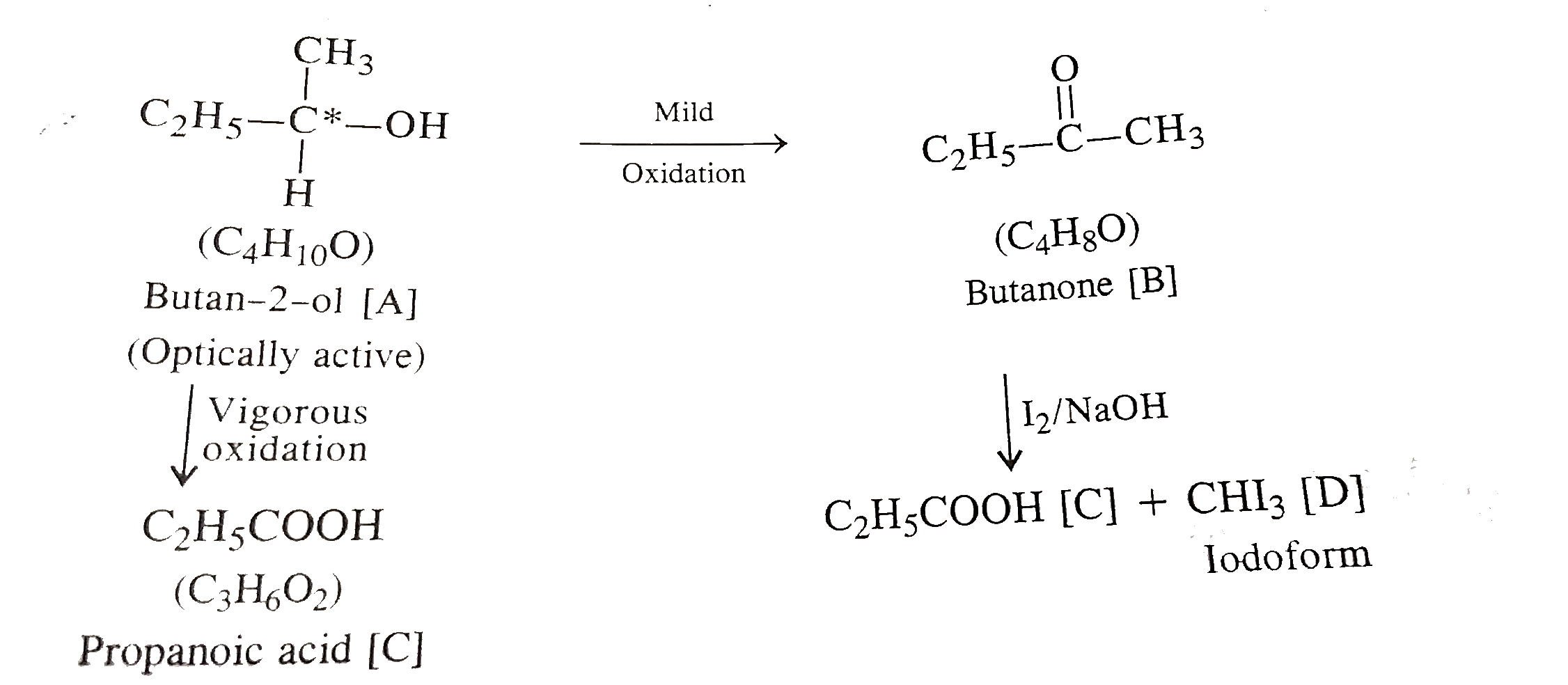
The data suggests that the compound 'A' `(C_(4)H_(10)O)` is an alcohol. Since it is optically active in nature, it is a secondary alcohol. The alcohol upon mild oxidation gives ketone `'B' (C_(4)H_(8)O)`. The compound `'A'` on vigouus oxidation forms an acid `'C' (C_(3)H_(6)O_(2))`. The acid `'C'` and a compoun D (iodoform) are formed are when 'B' is reacted with iodine and alkali `(NaOH)`. The sequenc of reactions is given ahead:
Promotional Banner

Similar Questions

Explore conceptually related problems

Compound 'A' with the formula C_(3)H_(8)O on vigorous oxidation produces an acid C_(3)H_(6)O_(2) . 'A' is

A compound 'X' (C_(2)H_(4)O) on oxidation gives 'Y' (C_(2)H_(4)O_(2)) . The compound 'X' undergoes haloform reaction. Write the structure of 'X' and 'Y'.

An organic compound E (C_5 H_8) on hydrogenation gives compound F (C_5 H_(12) ) . Compound E on ozonolysis gives formaldehyde and 2-ketopropanal. Deduce the structure of compound E.

A compound (X) with the molecular formula C_(3)H_(8)O can be oxidized to another (Y) whose molecular formula is C_(3)H_(6)O_(2) The compound (X) may be

An organic compound (A) (C_(8)H_(14)O) forms an oxime and gives a positive haloform reaction. On ozonolysis, it gives acetone and a compound (B) (C_(5)H_(8)O_(2)) . (B) forms a dioxime and on subjecting to oxidation reaction gives an acid (C ) (C_(4)H_(6)O_(4)) . On treatment with excess of ammonia and strong heating, (C ) gives a neutral compound (D) (C_(4)H_(5)O_(2)N) . (D) on distillation with zinc dust forms pyrrloe. Suggest the possible structures of (A), (B), (C ), and (D). Explain the chemical reactions involved.

An organic compound (A) , C_(4)H_(8)Cl_(2) on hydrolysis forms another compound (B) , C_(4)H_(8)O . If the compound (B) responds positively to iodo form test , then identify (A) and (B).

An organic compound X (C_(4)H_(8)O_(2)) gives positive test with NaOH and Phenopthalein. Structure of X will be:

Compound X (C_(5)H_(10)O) is a chiral alcohol. It is catalytically hydrogenated to an achiral alcohol Y (C_(5)H_(12)O) and oxidized by activated MnO_(2) to an achiral carbonyl compound Z (C_(5)H_(8)O) . Compound X is

An organic compound (A) , C_(4)H_(8)Cl_(2) on hydrolysis forms another compound (B) , C_(4)H_(8)O . If (B) does not responds to iodo form test , then identify possible structures of (A) and (B).

Compound (A)(C_(8)H_(12)) on oxidation gives an acid B(C_(4)H_(6)O_(2)) . One mole of compound (A) reacts with 3 mol of H_(2) in the presence of Pt catalyst to give octane. Identify compound (A) .

Knowledge Check

  • Compound 'A' with the formula C_(3)H_(8)O on vigorous oxidation produces an acid C_(3)H_(6)O_(2) . 'A' is

    A
    a tertiary alcohol
    B
    a secondary alcohol
    C
    a primary alcohol
    D
    not necessarily an alcohol

