Home
Class 12
CHEMISTRY
Hydrocarbon (X), C(7)H(12), on reaction ...

Hydrocarbon (X), `C_(7)H_(12)`, on reaction with boron hydride followed by treatment with `CH_(3)COOH` yields (A). On reductive ozonolysis (A) yields a mixture of two aldehydes, (B) and (C ). Of these, only (B) can undergo Cannizzaro reaction. (A) exists in two geometrical isomer, `(A-1)` and `(A-2)`, of which `(A-2)` is more stable. Gives structures of (X), (A), (B), (C ), `(A-1)`, and `(A-2)` with proper reasoning.

Text Solution

Verified by Experts
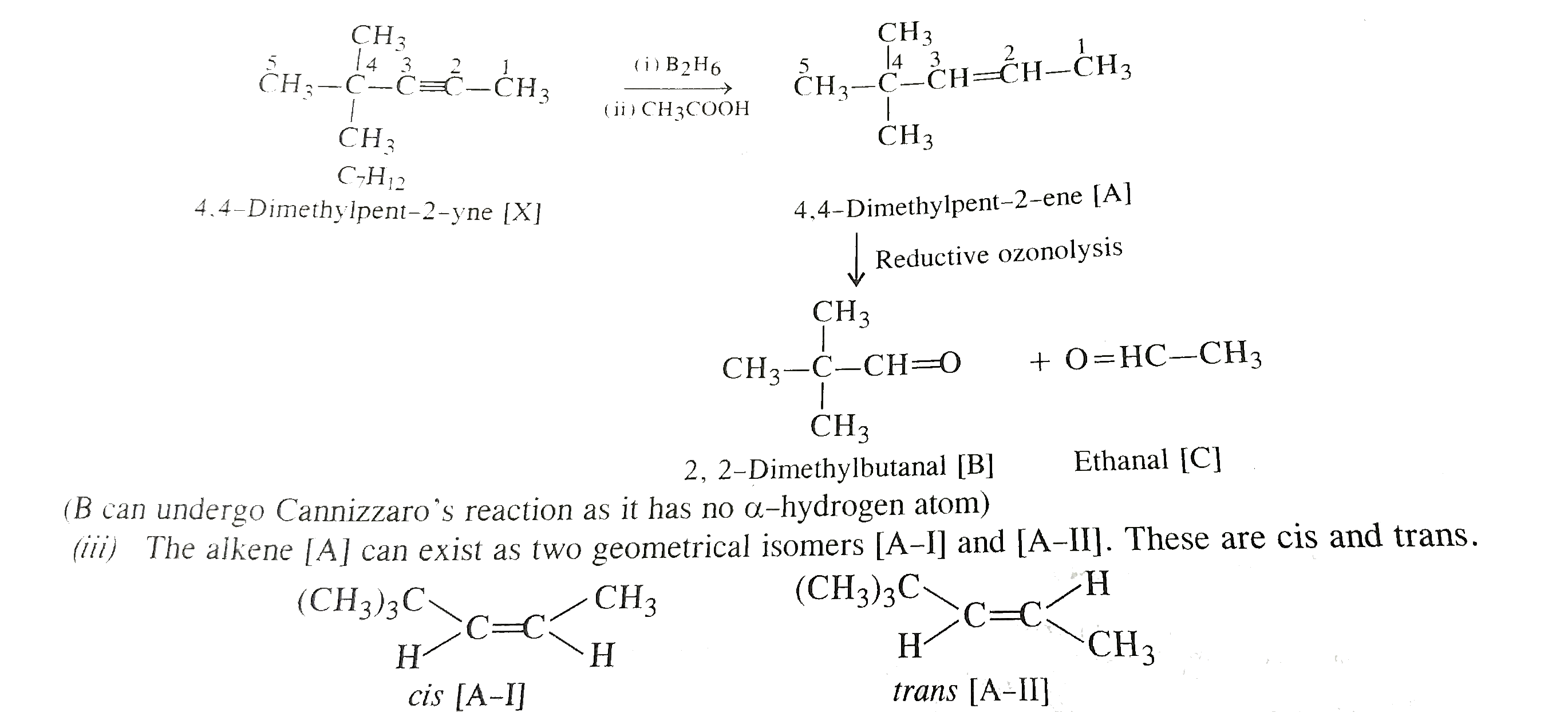
The formula of hydrocarbon `(C_(7)H_(12))` suggests that it is an alkyne `(C_(n)H_(2n-2))` which upon hydroboration gives alkene [A].
(ii) since the alkene upon reductive ozonolysis gives two aldehydes [B] and [C] out of which [B] can undergoes Cannizzaro's reactions, this means that the aldehyde [B] has no `alpha`-hydrogen atom and the CHO group is linked to teritary butyl group. Keeping these obseration in view, the hydrocarbon [X] and the related reactions are listed:
Promotional Banner

Similar Questions

Explore conceptually related problems

Two different G.R. (A) and (B) give the product (X) on reaction with ( C) and (D) respectively. Give the structures of (A), (B), ( C) and (D) .

Two isomeric compounds, (A) and (B), have the same formula, C_(11)H_(13)OCI . Both are unsaturated, yield the same compound (C) on catalytic hydrogenation, and produce 4-chloro-3-ethoxybenzoic acid on vigorous oxidation. (A) exists in geometrical isomers, (D) and (E), but not (B). Give structures of (A) to (E) with proper reasoning.

An organic compound (A) (C_(6)H_(10)O) on reaction with CH_(3)MgBr followed by acid treatment gives compound (B). The compound (B) on ozonolysis gives compound (C ), which in the presence of a base gives 1-acetyl cyclopentene (D). The compound (B) on reaction with HBr gives compound (E ). Write the structures of (A), (B), (C ), (D), and (E ). Show how (D) is formed from (C ).

An organic compound (A) of molecular formula C_(5)H_(8) when treated with Na in liquid ammonia followed by reaction with -Propyl iodide yeidls (B) C_(8)H_(12) (A) gives a ketone C_(5)H_(10)O (e) when treated with dil H_(2)SO_(4) and HgSO_(4) (B) on oxidation with alkaline KMnO_(4) gives two isomeric acids (D) and (E) C_(4)H_(8)O_(2) . Give structures of compounds (A) to (E) with proper reasoning .

An organic compound C_(6)H_(12)(X) on reduction gives C_(6)H_(14)(Y) . X on ozonolysis gives two aldehydes C_(2)H_(4)O(I) and C_(4)H_(8)O(II) . Identify the compounds X, Y and aldehydes (I) and (II).

A hydrocarbon of formula C_(10)H_(16) absorbs only one mole of H_(2) upon hydrogenation. On ozonolysis, it yields 1 , 6 -Cyclodecanedione. What is the structure of the hydrocarbon ?

An alkyne C_(7)H_(12) when reacted with alkaline KMnO_(4) followed by acidification by HCl, yielded a mixture of CH_(3)-underset(CH_(3))underset(|)(CH)-COOH & CH_(3)CH_(2)COOH . The alkyne is -

A compound 'X' on ozonolysis followed by reduction gives an aldehyde, C_(2)H_(4)O and 2-butanone. Compound 'X' is:

An acidic compound (A) (C_4 H_8 O_3) loses its optical activity on strong heating yielding (B) (C_4 H_6 O_2) which reacts readly with KMnO_4 . (B) forms a dervative ( C) with SOCl_2 which on reaction with (CH_3)_2 NH gives (D) . The compound (A) on oxidation with dilute chromic acid gives an unstable compound (E) which decarboxylates readily to give (F) (C_3 H_6 O) . The compound (F) gives a hydrocarbon (G) on treatment with amalgamated Zn and HCl . Give the structures of (A) to (G) with proper reasoning.

