Home
Class 12
CHEMISTRY
An organic compound A, C(8)H(6) on react...

An organic compound A, `C_(8)H_(6)` on reacting with dil. `H_(2)SO_(4)` and `HgSO_(4)` gives a compound 'B'-which can also be obtained from reaction of benzene with acid chloride in the presents of anh. `AlCl_(3)` Compound B when reacted with iodine and aq. NaOH yields C and a yellow compound D. Identify A to D with proper justification.

Text Solution

Verified by Experts
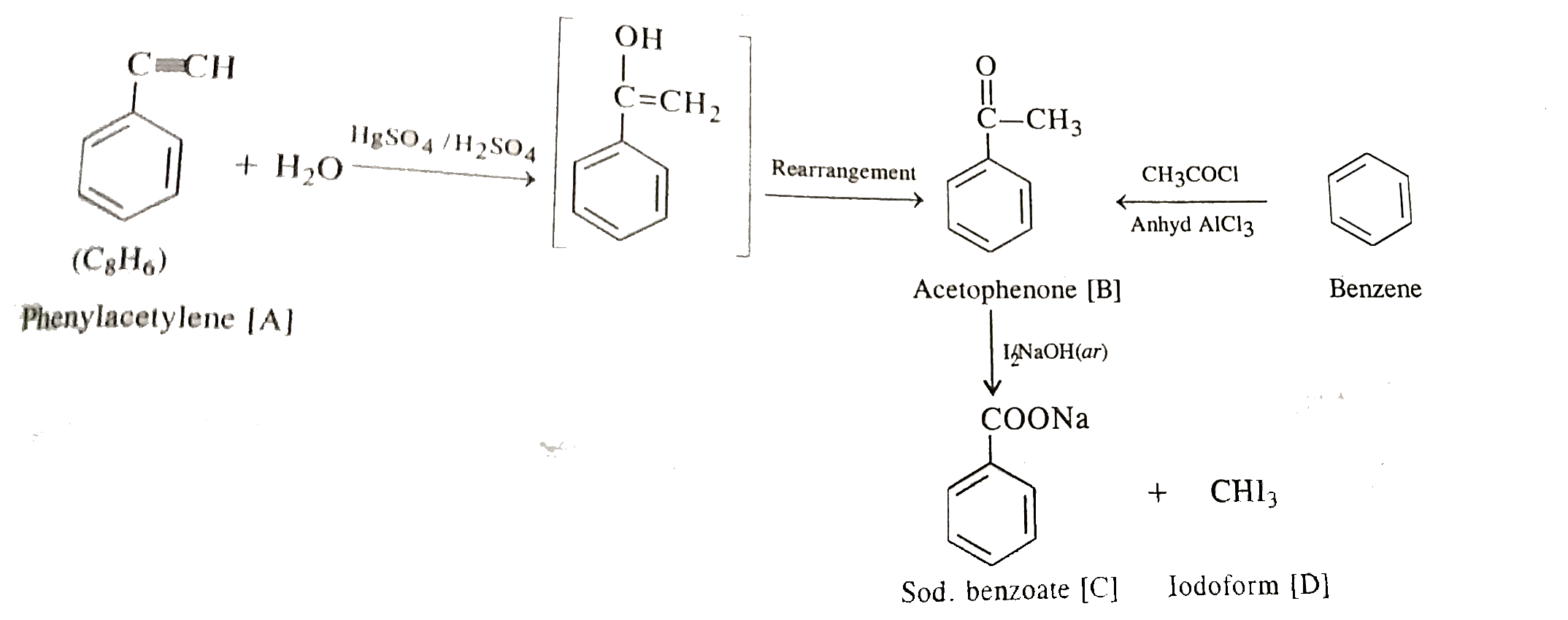
(i) As the compound [B] can be formed by reacting benzene with acid chloride in the presence of anydrous `AlCl_(3)`, It is an aromatic ketone.
(ii) Since the compound [B] gives iodofrom [D] as one of the product on reacting iodine and aquoeus `NaOH`, the compound [B] is acetophenone.
(iii) The compound [A] seems to be a derivative of acetylene since it undergoes hydration under acidic conditions to form [B] which is a ketone i.e., acetophenone.
The sequence may be shown as follows:
Promotional Banner

Similar Questions

Explore conceptually related problems

A compound 'A' when treated with HNO_(3) (in presence of H_(2)SO_(4) ) gives compound B, which is the reduced with Sn and HCl to aniline ? The compound 'A' is

An organic compound [A] with molecular formula C_(4)H_(8)O when reduced with NaBH_(4) gives compound [B] which reacts with HBr to form compound [C] (optically active) Identify A,B , C and wirte the two enantimoers of compound [C].

Compound (A) (C_(4)H_(8)O_(3)) reacts with NaHCO_(3) and evolves CO_(2)(g). (A) reacts with LAH to give a compound (B) which is a chiral. The structure of (A) is:

An organic compound A (C_(2)H_(6)O) reacts with sodium to form a compound B with the evolution of H_(2) and gives a yellow compound C on reacting with iodine and NaOH. When heated with conc. H_(2)SO_(4) at 413 K, it gives a compound D (C_(4)H_(10)O) which on reaction wiht conc. HI at 373 K gives compound E. The compound D is also obtained when B is heated with E. Idntify the compounds A,B,C,D and E write the equations for the reaction involved.

An organic compound A’ with molecular formula C_(7)H_(7)NO reacts with Br_(2) /aqKOH to give compound B’, which upon reaction with NaNO_(2) & HCl" at "O^(@) C gives C’. Compound C’ on heating with CH_(3)CH_(2)OH gives a hydrocarbon D’. Compound B’ on further reaction with Br_(2) water gives white precipitate of compound E’. Identify the compound A, B, C, D&E, also justify your answer by giving relevant chemical equations.

An organic compound (A) , C_(4)H_(8)Cl_(2) on hydrolysis forms another compound (B) , C_(4)H_(8)O . If the compound (B) responds positively to iodo form test , then identify (A) and (B).

When acetylene is passed through dil. H_(2)SO_(4) in the presence of HgSO_(4) , the compound formed is

A compound 'A' when reacts with LiAlH_4 it gives two compounds B and C along with LiCl. Compounds A, B and C respectively are

An organic compound A with molecular formula C_2 H_7 N on reaction with nitrous acid gives a compound B.B on controlled oxidation gives a compound C. C reduces Tollens' reagent to give silver mirror and D. B reacts with D in the presence of concentrated sulfuric acid to give a sweet smelling compound E. Identify A, B, C, D and E. Give the reaction of C with ammonia and name the product.

An organic compound (A) (C_(6)H_(10)O) on reaction with CH_(3)MgBr followed by acid treatment gives compound (B). The compound (B) on ozonolysis gives compound (C ), which in the presence of a base gives 1-acetyl cyclopentene (D). The compound (B) on reaction with HBr gives compound (E ). Write the structures of (A), (B), (C ), (D), and (E ). Show how (D) is formed from (C ).

