Home
Class 12
CHEMISTRY
An aldehyde (A) (C(11)H(8)O), which does...

An aldehyde (A) `(C_(11)H_(8)O)`, which does not undergo self aldol condensation, gives benzaldehyde and 2 mol of (B) on ozonolysis. Compound (B) on oxidation with silver ion gives oxalic acid. Identify the compounds (A) and (B).

Text Solution

Verified by Experts
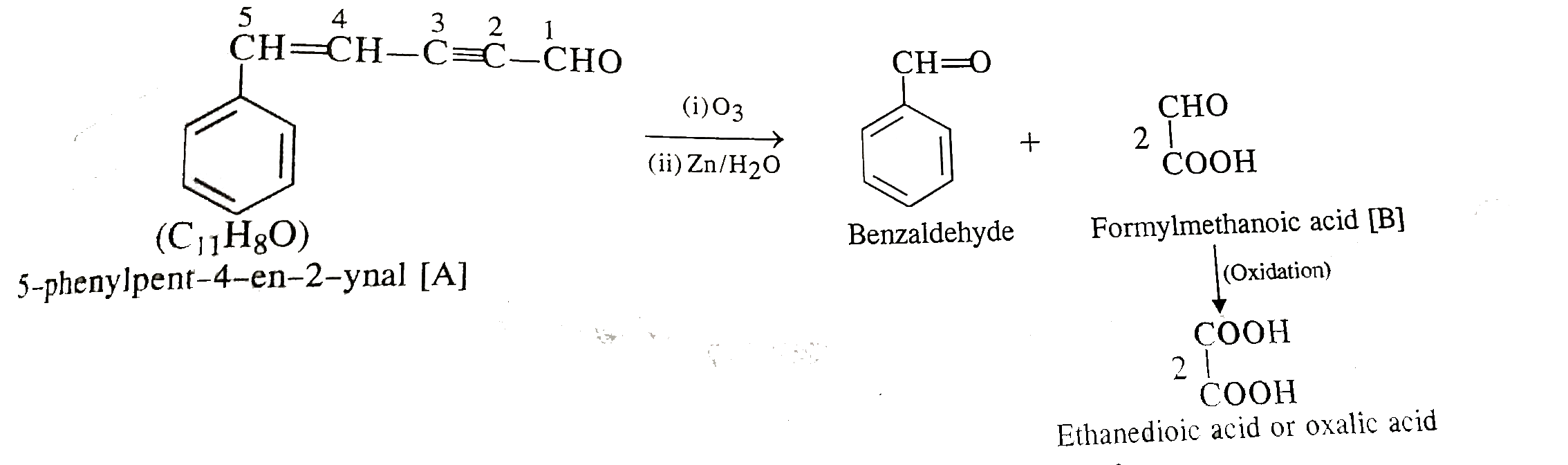
(i) As the compound 'A' `(C_(11)H_(8)O)` gives benzaldehyde as one of the products on ozonolysis, it must have a benzene nucleus or phenyl group `(C_(6)H_(5))`. The formula of the side chain is `(C_(11)H_(8)O - C_(6)H_(5)) = C_(5)H_(3)O`
(ii) Since the compound 'A' is an aldehyde therefore, the side chain may be written as `C_(4)H_(2)CHO`. Thus, the compound 'A' may be expressed as : `C_(6)H_(5)(C_(4)H_(2)CHO)`
(iii) As one mole of 'A' on ozonolysis gives two moles of 'B'. This mean that the size chain must have two unsaturated bonds and one of them must be a triple bond.
(iv) As the compound 'A' does not undergo Aldol condensation, there should no `alpha`-hydrogen atom. Keeping in view the above observations, the formula of the compound 'A' is `C_(6)H_(5)-CH=CH-C-=C-CHO`. The sequence of the reactions involved is as follows :
Promotional Banner

Similar Questions

Explore conceptually related problems

Compound (A)(C_(12)H_(16)) on oxidation with acidic KMnO_(4) solution gives acetone and . Identify compound (A) .

Which of the following compound on oxidative ozonolysis give malonic acid as only product ?

Compound (A) of molecular formula C_(9)H_(7)O_(2)Cl exists in ketoform and predominantly in enolic form (B) . On oxidation with KMnO_(4) , (A) gives m-chlorobenzoic acid. Identify (A) and (B) .

An organic compound (A) (C_(6)H_(10)O) on reaction with CH_(3)MgBr followed by acid treatment gives compound (B). The compound (B) on ozonolysis gives compound (C ), which in the presence of a base gives 1-acetyl cyclopentene (D). The compound (B) on reaction with HBr gives compound (E ). Write the structures of (A), (B), (C ), (D), and (E ). Show how (D) is formed from (C ).

Refer to Question. When the compound (B) on ozonolysis is followed by oxidation with H_(2)O_(2) , the products are :

Compound (A), C_(8)H_(6)NOBr , is optically active. Reduction of (A) gives (B) which reacts with nitrouos acid to form (C), dihydric alcohol. Benzene sulphonyl chloride reacts with (B) to give a product soluble in NaOH. Hydrolysis of (A) gives (D) which is an optically active acid. (A) does not give any precipitate with aqueous AgNO_(3) . Controlled oxidation of (A) gives monobromo benzoic acid. Compound (A) on reaction with Br_(2)//Fe gives only one compound. Identify (A), (B), (C), and (D).

A compound 'X' on ozonolysis followed by reduction gives an aldehyde, C_(2)H_(4)O and 2-butanone. Compound 'X' is:

An alkene (A)C_(16)H_(16) on ozonolysis gives only one product (B)(C_(8)H_(8)O) . Compound (B) on reaction with NH_(2)OH followed by reaction with H_(2)SO_(4), Delta gives N - methyl benzamide the compound 'A' is -

An acidic compound (A) (C_4 H_8 O_3) loses its optical activity on strong heating yielding (B) (C_4 H_6 O_2) which reacts readly with KMnO_4 . (B) forms a dervative ( C) with SOCl_2 which on reaction with (CH_3)_2 NH gives (D) . The compound (A) on oxidation with dilute chromic acid gives an unstable compound (E) which decarboxylates readily to give (F) (C_3 H_6 O) . The compound (F) gives a hydrocarbon (G) on treatment with amalgamated Zn and HCl . Give the structures of (A) to (G) with proper reasoning.

(a) Carry out the following conversions : (i) pnitrotoluene to 2-bromobenzoic acid (iii) Propanoic acid to acetic acid (b)An alkene with molecular formula C_5H_10 on ozonolysis gives a mixture of two compound B and C .Compound B gives positive Fehling test and also reacts with iodine and NaOH solution. Compound C does not give Fehling solution test but forms iodoform. Identify the compounds A, B and C.

