Home
Class 12
CHEMISTRY
Compound (X) with molecular formula C(3)...

Compound (X) with molecular formula `C_(3)H_(8)O` is treated with acidified potassium dichromate to form a product (Y) with molecular formula `C_(3)H_(6)O`. (Y) does not form a shining silver mirror on warming with ammoniacal `AgNO_(3)`. (Y) when treated with an aqueous solution of `NH_(2)CONHNH_(2).HCl` and sodium acetate, gives a product (Z). The structure of (Z) is

A

`CH_(3)CH_(2)CH = N NHCONH_(2)`

B

`CH_(3)-underset(CH_(3))underset(|)(C) = NCONHNH_(2)`

C

`CH_(3)-underset(CH_(3))underset(|)(C)= N NHCONH_(2)`

D

`CH_(3)CH_(2)CH = NCONHNH_(2)`.

Text Solution

Verified by Experts

The correct Answer is:
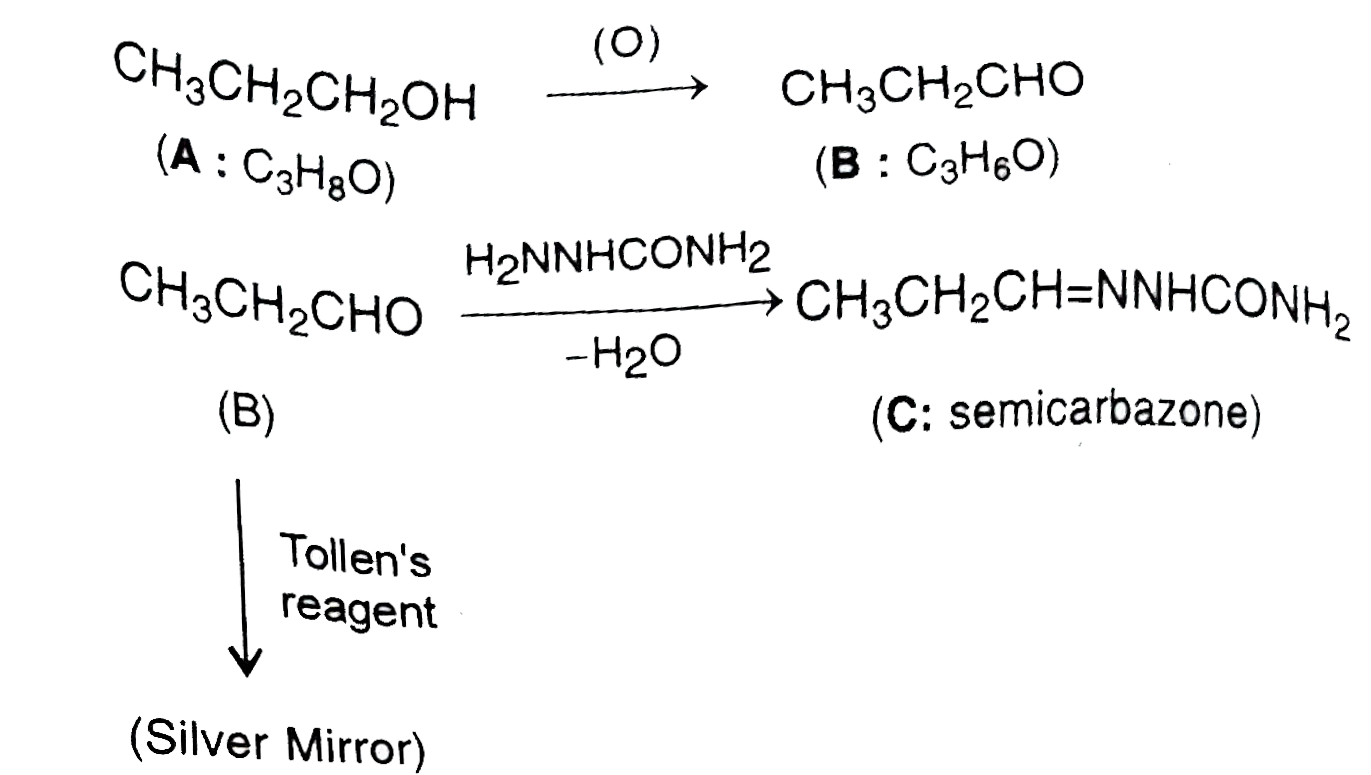
A

Compound 'A' is a primary alcohol because on oxidation, it gives an aldehydes 'B' which formate will form shining silver mirror with ammoniacal silver nitrate (Tollen's reagent). The strucutre of 'C' ca be deduced as follows :
Promotional Banner

Similar Questions

Explore conceptually related problems

A compound (X) with the molecular formula C_(3)H_(8)O can be oxidized to another (Y) whose molecular formula is C_(3)H_(6)O_(2) The compound (X) may be

A compound X with moleuclar formula C_(3)H_(8)O can be oxidized to a compoud Y with the molecular formula C_(3)H_(6)O_(2) . X is most likely to be a:

A compound with molecular formula C_(6)H_(10)O_(4) on acylation with acetic anhydride gives a compound with molecular formula C_(12)H_(18)O_(8) . How many hydroxyl groups are present in the compound?

Write all the acyclic and cyclic isomers of a compound having molecular formula C_(3)H_(6)O .

Name the type of isomerism that the compound with molecular formula C_(3)H_(6)O_(2) exhibits. Represent the isomers.

Compound X with molecular formula C_(6)H_(10)O form a semicarbazone and give negative Tollen's and lodoform tests. Upon reduction

Give the structural formula and IUPAC names of the isomers with the molecular formula C_(3)H_(8)O .

A compound X with molecular formula C_7H_8 is treated with Cl_2 in presence of FeCl_3 . Which of the following compounds are formed during the reaction?

