Home
Class 12
CHEMISTRY
Treatment of benzene with "CO"//HCl in t...

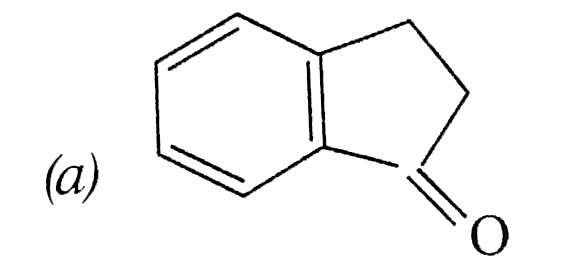
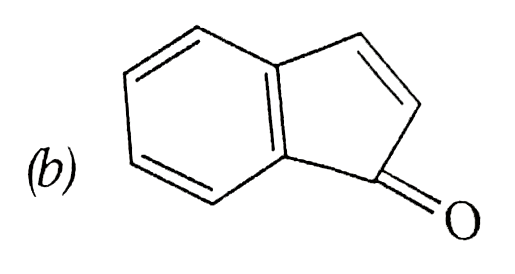
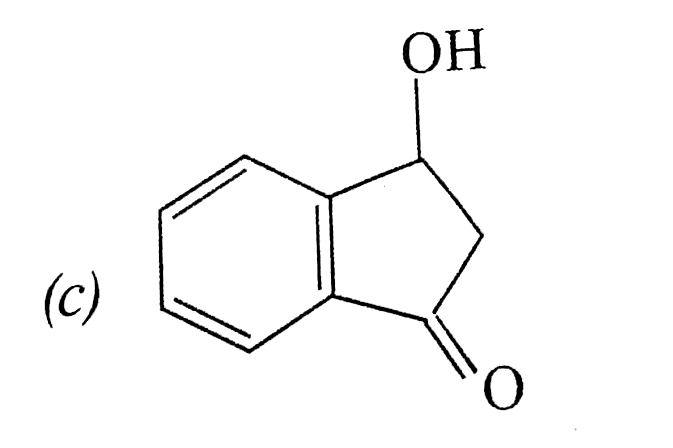
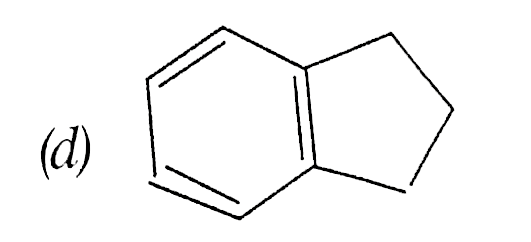
Treatment of benzene with `"CO"//HCl` in the presence of anhydrous `AlCl_(3)//CuCl` followed by reaction with `Ac_(2)"O"//NaOAc` gives a compound X. Reaction of X with `H_(2)//Pd//c` followed by treatment with `H_(3)PO_(4)` gives another compound Y. The compound Y is :

A

B

C

D

Text Solution

AI Generated Solution

The correct Answer is:

To solve the problem step by step, let's analyze the reactions and transformations involved in the synthesis of compound Y from benzene. ### Step 1: Friedel-Crafts Acylation - **Reaction**: Benzene reacts with carbon monoxide (CO) and hydrochloric acid (HCl) in the presence of anhydrous AlCl₃/CuCl. - **Mechanism**: This reaction leads to the formation of benzaldehyde (C₆H₅CHO) through the generation of an acylium ion (C₆H₅C^+=O) which then reacts with benzene. **Result**: The product formed in this step is benzaldehyde (C₆H₅CHO). ### Step 2: Reaction with Acetic Anhydride - **Reaction**: Benzaldehyde (C₆H₅CHO) is then treated with acetic anhydride (Ac₂O) in the presence of sodium acetate (NaOAc). - **Mechanism**: This reaction leads to the formation of an aromatic ketone, specifically, the product is acetophenone (C₆H₅COCH₃). **Result**: The compound X formed in this step is acetophenone (C₆H₅COCH₃). ### Step 3: Hydrogenation of Compound X - **Reaction**: Acetophenone (C₆H₅COCH₃) is then subjected to hydrogenation using hydrogen gas (H₂) in the presence of palladium on carbon (Pd/C). - **Mechanism**: This reaction reduces the carbonyl group (C=O) of acetophenone to a secondary alcohol, yielding 1-phenylethanol (C₆H₅CH(OH)CH₃). **Result**: The compound formed after this step is 1-phenylethanol (C₆H₅CH(OH)CH₃). ### Step 4: Dehydration of Alcohol - **Reaction**: The resulting alcohol (1-phenylethanol) is then treated with phosphoric acid (H₃PO₄). - **Mechanism**: This reaction leads to the dehydration of the alcohol, resulting in the formation of an alkene, specifically styrene (C₆H₅CH=CH₂). **Result**: The final compound Y formed is styrene (C₆H₅CH=CH₂). ### Final Answer The compound Y is styrene (C₆H₅CH=CH₂). ---

To solve the problem step by step, let's analyze the reactions and transformations involved in the synthesis of compound Y from benzene. ### Step 1: Friedel-Crafts Acylation - **Reaction**: Benzene reacts with carbon monoxide (CO) and hydrochloric acid (HCl) in the presence of anhydrous AlCl₃/CuCl. - **Mechanism**: This reaction leads to the formation of benzaldehyde (C₆H₅CHO) through the generation of an acylium ion (C₆H₅C^+=O) which then reacts with benzene. **Result**: The product formed in this step is benzaldehyde (C₆H₅CHO). ...
Promotional Banner

Similar Questions

Explore conceptually related problems

Treatment of benzene with CO/HCl in the presence of anhydrous "AlCl"_(3)//"CuCl" followed by reaction with Ac_(2)"O"//"NaOAc" gives compound X as the major product. Compound X upon reaction with Br_(2)//Na_(2)CO_(3) , followed by heating at 473 K with moist KOH furnishes Y as the major product. Reaction of X with H_(2)//Pd-C , followed by H_(3)PO_(4) treatment gives Z as the major product. The compound Y is

Treatment of benzene with CO/HCl in the presence of anhydrous "AlCl"_(3)//"CuCl" followed by reaction with Ac_(2)"O"//"NaOAc" gives compound X as the major product. Compound X upon reaction with Br_(2)//Na_(2)CO_(3) , followed by heating at 473 K with moist KOH furnishes Y as the major product. Reaction of X with H_(2)//Pd-C , followed by H_(3)PO_(4) treatment gives Z as the major product. The compound Z is

How many toluidines on reaction with NaNO_(2)//HCl followed by H_(3)PO_(2) treatment gives Toluene.

An organic compound (A), C_(8)H_(4) O_(3) in dry benzene in the presene of anhydorus AlCl_(3) gives compound (B) . Compound (B) on treatment with PCl_(5) followed by reaction with H_(2)//Pd (BaSO_(4)) gives compound (C) which on reaction with hydrazine gives a cyclised compound (D),(C_(14) H_(10) N_(2)) Idenyify (A),(B),(C) and (D) . Explain the formation of (D) from (C) .

An alkene (A)C_(16)H_(16) on ozonolysis gives only one product (B)(C_(8)H_(8)O) . Compound (B) on reaction with NH_(2)OH followed by reaction with H_(2)SO_(4), Delta gives N - methyl benzamide the compound 'A' is -

which of the following compounds on reaction with NaOH and H_(2)O_(2) gives yellow colour ?

The reaction of compounf P with CH_(3)MgBr (excess) in (C_(2)H_(5)_(2)O followed by addition of H_(2)O give Q the compound Q on treatment with H_(2)SO_(4) at 0^(@) C gives R. the reaaction of R with CH_(3) COCl in the presence of anhydrous AlCl_(3) in CH_(2)Cl_(2) followed by treatment with H_(2)O "produces compound S . [Et in compound P is ethyl group] The reaction, Q to R and R TO S, are

A compound 'X' on ozonolysis followed by reduction gives an aldehyde, C_(2)H_(4)O and 2-butanone. Compound 'X' is:

A symmetrical organic compound of C_(4)H_(11)N give yellow oily layer on treatment with HNO_(2) then find the structure of the compound.
