Home
Class 12
CHEMISTRY
CH(3)-CO OH overset(Br(2)//P)to(A) overs...

`CH_(3)-CO OH overset(Br_(2)//P)to(A) overset(NaCN)to(B) overset(HOH//H^(+))to(C)`
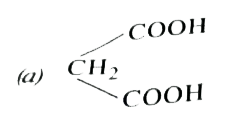
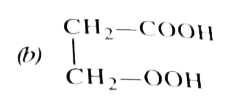
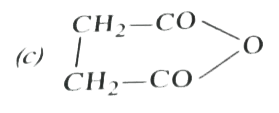
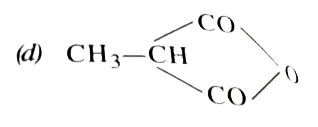
The product (C) will be

A

B

C

D

Text Solution

AI Generated Solution

The correct Answer is:

To solve the problem step by step, we will analyze the given reactions involving acetic acid (CH₃COOH) and identify the products formed at each stage. ### Step 1: Reaction of Acetic Acid with Bromine and Phosphorus The first step involves the reaction of acetic acid (CH₃COOH) with bromine (Br₂) in the presence of phosphorus (P). This is known as the Hell-Volhard-Zelinsky (HVZ) reaction, where an alpha hydrogen atom is replaced by a bromine atom. - **Reaction**: \[ \text{CH}_3\text{COOH} + \text{Br}_2/\text{P} \rightarrow \text{BrCH}_2\text{COOH} \] - **Product (A)**: The product formed is **alpha-bromoacetic acid (BrCH₂COOH)**. ### Step 2: Reaction of Alpha-Bromoacetic Acid with Sodium Cyanide In the second step, we treat the alpha-bromoacetic acid with sodium cyanide (NaCN). This reaction involves nucleophilic substitution, where the bromine atom is replaced by a cyanide group (CN). - **Reaction**: \[ \text{BrCH}_2\text{COOH} + \text{NaCN} \rightarrow \text{CH}_2\text{(CN)COOH} + \text{NaBr} \] - **Product (B)**: The product formed is **sinoacetic acid (CH₂(CN)COOH)**. ### Step 3: Hydrolysis of Sinoacetic Acid In the final step, we hydrolyze the sinoacetic acid using water (H₂O) in the presence of an acid (H⁺). This hydrolysis converts the nitrile group (CN) into a carboxylic acid (COOH). - **Reaction**: \[ \text{CH}_2\text{(CN)COOH} + \text{H}_2\text{O}/\text{H}^+ \rightarrow \text{CH}_2\text{(COOH)}_2 \] - **Product (C)**: The product formed is **malonic acid (CH₂(COOH)₂)**. ### Final Answer The product (C) will be **malonic acid (CH₂(COOH)₂)**. ---

To solve the problem step by step, we will analyze the given reactions involving acetic acid (CH₃COOH) and identify the products formed at each stage. ### Step 1: Reaction of Acetic Acid with Bromine and Phosphorus The first step involves the reaction of acetic acid (CH₃COOH) with bromine (Br₂) in the presence of phosphorus (P). This is known as the Hell-Volhard-Zelinsky (HVZ) reaction, where an alpha hydrogen atom is replaced by a bromine atom. - **Reaction**: \[ \text{CH}_3\text{COOH} + \text{Br}_2/\text{P} \rightarrow \text{BrCH}_2\text{COOH} ...
Promotional Banner

Similar Questions

Explore conceptually related problems

CH_(3) OH overset(PI_(3))(to) (A) overset(KCN)(to) (B) overset(H_(2)O//H)(to) (C ) The compound ( C ) is

The compound A , B and C in the reaction sequence CH_(3) - CH_(2) OH overset(PBr_(3))to A overset(Alc. KOH) to B overset(Br_(2))to C are given by the set :

CH_(3)-Br+NaO-underset(CH_(3))underset(|)overset(CH_(3))overset(|)C-CH_(3)to ? The product is

In the reaction sequence CH_(3)-CO-CH_(3)overset(C_(2)H_(5)OH//OH^(-))rarr(A) overset(C_(2)H_(5)OH//H^(+))rarr[X] will be

Identify the compounds A, B, C and D. CH_(3)CN overset(H_(2)O //H^(+))toA overset(NH_(3))toB overset("heat")toC overset(Br_(2)//KOH)toD

In the reaction H-C=C-H overset(NaNH_(2))to A overset(CH_(3)I)to B overset(Hg^(2+))underset(H_(3)O^(+))to C the final product 'C' is :
