Home
Class 12
CHEMISTRY
Reimer-Tiemann reaction introduces an al...

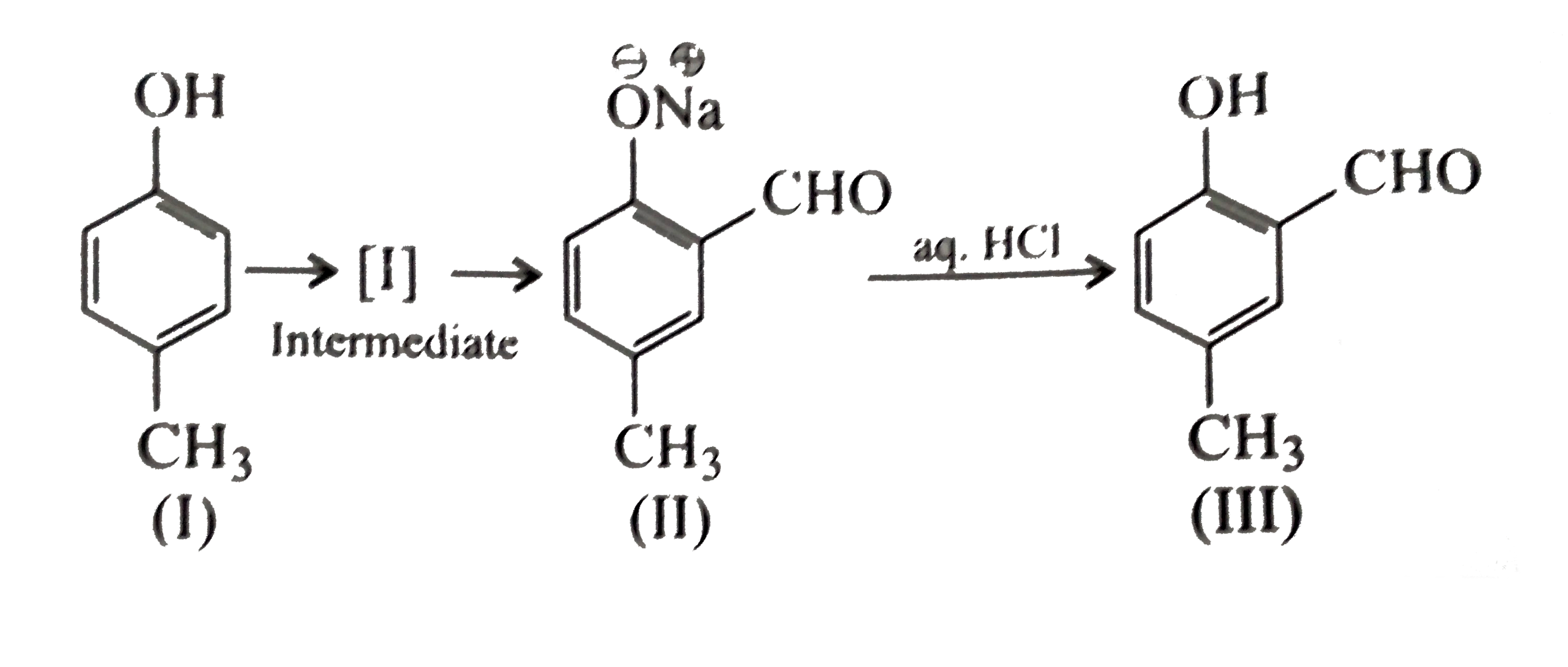
Reimer-Tiemann reaction introduces an aldehyde group on to the aromatic ring of phenol, ortho to the hydroxyl group. This reacrtion involves electrophilic aromatic subsititution. It is a general method for the synthesis of subsituted salicyladehydes as depiced below:

The electrophile in this reaction is:

A

aq. `NaOH+CH_(3)Cl`

B

aq. `NaOH+CH_(2)Cl_(2)`

C

aq. `NaOH+CHCl_(3)`

D

aq. `NaOH+C Cl_(4)`

Text Solution

Verified by Experts

The correct Answer is:

C

aq. `NaOH+CHCl_(3)`.
Promotional Banner

Similar Questions

Explore conceptually related problems

Reimer-Tiemann reaction introduces an aldehyde group on to the aromatic ring of phenol, ortho to the hydroxyl group. This reacrtion involves electrophilic aromatic subsititution. It is a general method for the synthesis of subsituted salicyladehydes as depiced below: Which one of the following reagents is used in the above reaction ?

The electrophile involved in the Reimer-Tiemann reaction is

Although chlorine is an electron withdrawing group, yet it is ortho-, para- directing in electrophilic aromatic substitution reactions. Why?

In an electrophilic aromatic substitution reaction, the nitro group is meta directing because of it?

The most deactivating group for electrophilic substitution reaction in benzene ring is

Althrough chlorine is an electron withdrawing group, yet it is ortho-para-directing in electrophilic aromatic substitution reactions. Explain why it is so ?

Identify the substitute group, that acts as ortho-para director, during electrophilic substitution in aromatic compounds.

Assertion : Aromatic aldehydes and ketones undergo electrophilic substitution reaction at metaposition. Reason : Carbonyl group activates the ring towards electrophilic substitution reactions.

The typical reaction of benzene and other aromatic compounds are electrophilic substitution. Presence of electron donating group activates the ring towards electrophilic substitution, while presence of electron withdrawing group deactivates the ring towards electrophilic substituion but at the same time activates the ring towards nucleophilic subsituion. Some groups are predominantly meta-directing and all of these are deactivating. Except halogen, most of the o- and p- directing groups are activating groups. Which of the following compound is not formed. X represents mixture of organic compounds. The mixture does not contain
