A
B
C
D
Text Solution
Verified by Experts
The correct Answer is:



Topper's Solved these Questions
Similar Questions
Explore conceptually related problems
DINESH PUBLICATION ENGLISH-FLOWER-MULTIPLE CHOICE
- Which one of the following represents an ovule where the embryo sac be...
Text Solution
|
- Which of these is an example for zygomorphic flower with inbricate aes...
Text Solution
|
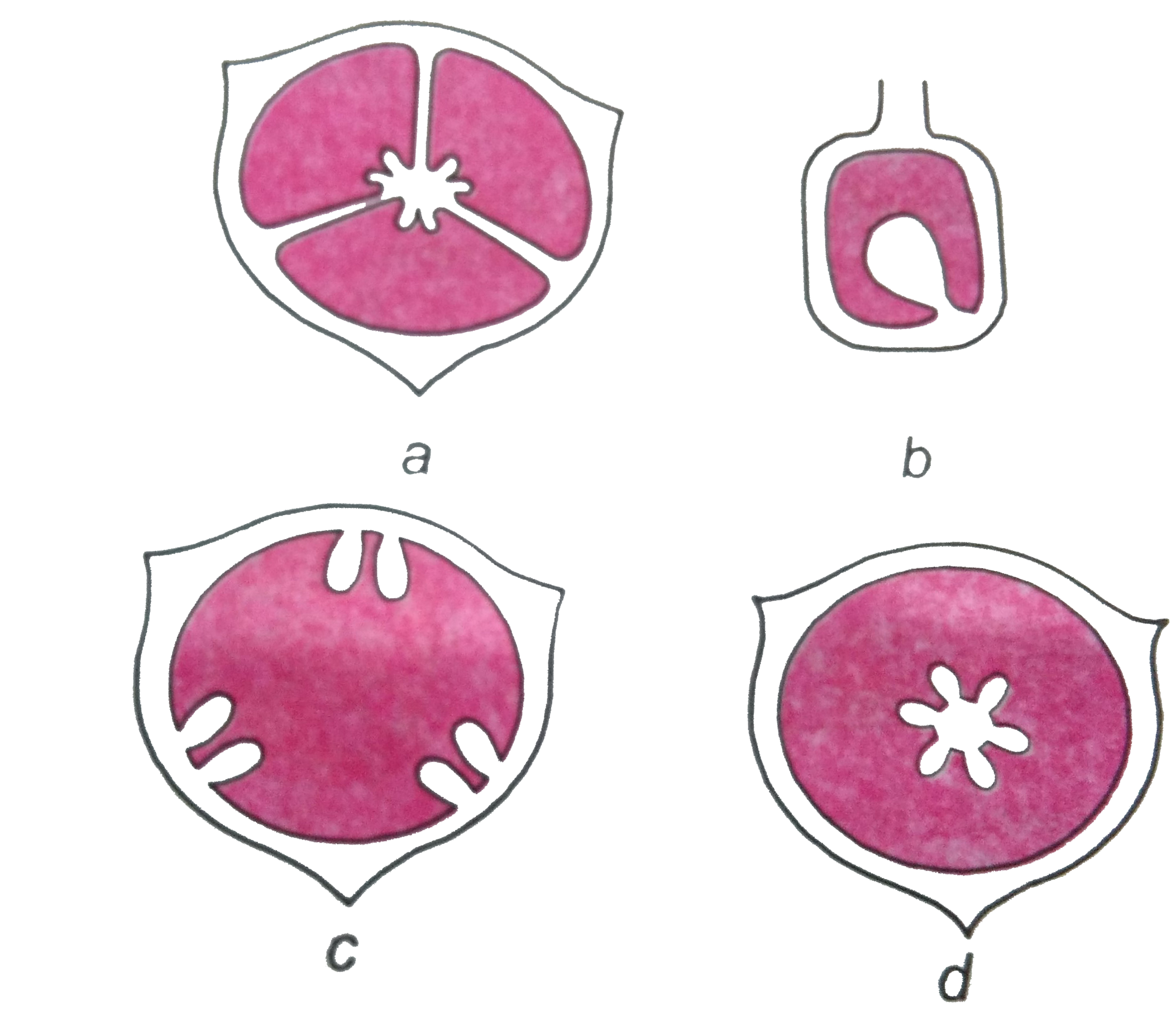
- In the diagram of types of placentation a, b, c and d represent
Text Solution
|
- Gynandrous condition means
Text Solution
|
- Feathery stigma is called
Text Solution
|
- The expression "gynoecium is apocarpous" implies that
Text Solution
|
- In a unilocular ovary with a single ovule , the placentation is
Text Solution
|
- the ovary is half inferior in:
Text Solution
|
- The technical term used for the androecium in a flower of China rose (...
Text Solution
|
- The following diagrams A, B, C, D and E show the different types of ar...
Text Solution
|
- Aestivation of petals in the flower of lady finger is correctly shown ...
Text Solution
|
- Thalamus of hypogynous ovary is
Text Solution
|
- The ovule in which the funicle, chalaza and micropyle lie in one veti...
Text Solution
|
- Cup-like structue developed from adnation of sepals, patals and stamen...
Text Solution
|
- The plant having monodelphous stamens and axile placentation is
Text Solution
|
- Match column I with column II and select the correct option from given...
Text Solution
|
- Identify the correct aestivations
Text Solution
|
- Which is correct
Text Solution
|
- Flowers are zygomorphic in
Text Solution
|
- Which one of the following diagrams represent the placentation in Dian...
Text Solution
|