Home
Class 12
CHEMISTRY
AgNO(3)(aq) was added to an aqueous KCl ...

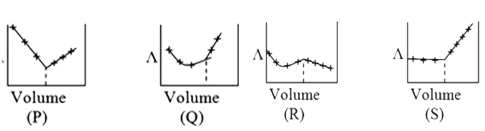
`AgNO_(3)(aq)` was added to an aqueous KCl solution gradually and the conductivity of the solution was measured. The plot of conductivity `(Lambda)` versus the value of `AgNO_(3)` is

A

P

B

Q

C

R

D

S

Text Solution

Verified by Experts

The correct Answer is:

D

`[K^(+)(aq)+Cl^(-)(aq)]+Ag^(+)(aq)+NO_(3)(aq)rarrk^(+)(aq)+NO_(3)^(-)(aq)+AgCl(g)`
Initially the conductance is due to `K^(+)` and `Cl^(-)` ions
On adding `AgNO_(3)`. Precipitate of `AgCl` is formed. Thus some `Cl^(-)` ions are replaced of `NO_(3)` ions. As both have nearly the same conductance, the conduc tance remains constant. After the end point, addition of `AgNO_(3)` will igve `Ag^(+)` and `NO_(3)^(-)` ions in the solution. hence conductance will increase rapidly.
Promotional Banner

Similar Questions

Explore conceptually related problems

AgNO_(3)(aq.) was added to an aqeous KCl solution gradually and the conductivity of the solution was measured. The plot of conductance (Lambda) versus the volume of AgNO_(3) is :

AgNO_(3)(aq) was added to an aqueous KCl solution gradually and the conductivity of the solution was measured. The plot conductivity of the solution was measured. The plot of conductance (wedge) versus the volume of AgNO_(3) is

Why does an aqueous solution of an acid conduct electricity?

A cell constant is generally found by measuring the conductivity of aqueous solution of

Aqueous solution of ammonia conducts electricity. Explian why ?

The highest electrical conductivity of the following aqueous solutions is of

The highest electrical conductivity of the following aqueous solutions is of

Aqueous hypo solution on reaction with aqueous AgNO_(3) gives :

An aqueous solution of salt gives salt precipitate with AgNO_(3) solution as well as with dilute H_(2)SO_(4) . It may be

We have taken a saturated solultion of AgBr, K_(SP) is 12 xx 10^(-4) . If 10^(-7) M of AgNO_(3) are added to 1 L of this solution, find conductivity (specific conductance) of this solution in term of 10^(-7) Sm^(-1) units. Given, lambda_((Ag^(+)))^(@) = 6 xx 10^(-3) Sm^(2) mol^(-1) , lambda_((Br^(-)))^(@) = 8 xx 10^(-3) Sm^(2) mol^(-1) , lambda_((NO_(3)^(-)))^@ = 7 xx 10^(-3) Sm^(2) mol^(-1) . Neglect the contribution of solvent.
