Home
Class 12
MATHS
Find the area bounded by the following c...

Find the area bounded by the following curve :
(i) `f(x) = sinx, g(x) = sin^(2)x, 0 le x le 2pi`
(ii) `f(x) = sinx, g(x) = sin^(4)x, 0 le x le 2pi`

Text Solution

Verified by Experts
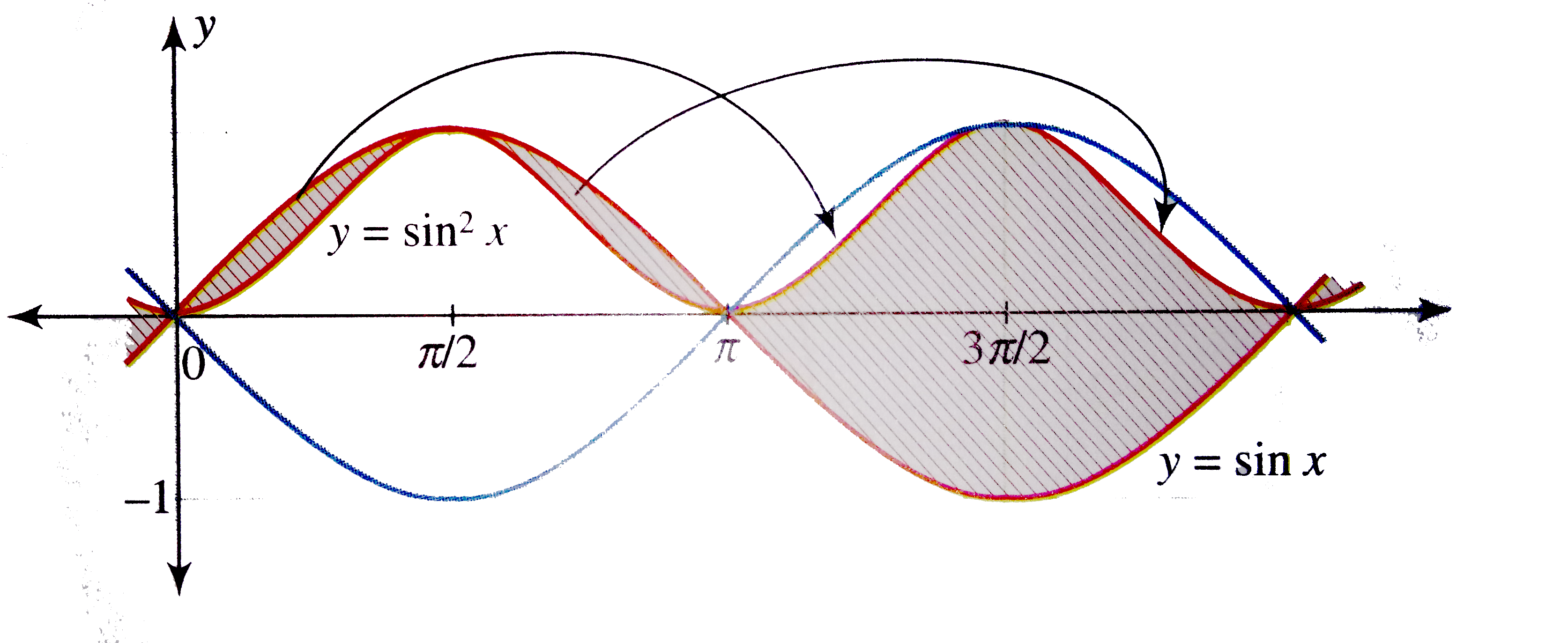

As shown in the figure, the area bounded by `y = sin x` and `y = sin^(2)x` is equal to twice the area bounded by y = sin x and the x - axis for `x in [0, pi].` Now we know that the area bounded by y = sin x and the x axis for `x in [0, pi]` is `overset(pi)underset(0)int sin x" " dx = 2 " sq. units"`
Hence the required area is 4 sq. units.
Promotional Banner

Topper's Solved these Questions

  • GRAPHS OF TRIGONOMETRIC FUNCTIONS

    CENGAGE PUBLICATION|Exercise Exercises|22 Videos
  • GRAPHS OF ELEMENTARY FUNCTIONS

    CENGAGE PUBLICATION|Exercise EXERCISES|34 Videos
  • HIGHT AND DISTANCE

    CENGAGE PUBLICATION|Exercise Archives|3 Videos

Similar Questions

Explore conceptually related problems

Solve: 16 ^(sin^(2)x) + 16^(cos^(2)x)=10 (0 le x le pi) .

Show that each of the following functions is strictly increasing phi(x) = sin x(0 le x le pi/2)

Prove that cos (sinx) > sin (cos x) for all x in 0 le x le pi//2

Find the intervals in which the function f given by f(x)=sin x + cos x(0 le x le 2 pi) is increasing

Find the intervals in which the function f given by f(x)=sin x + cos x(0 le x le 2 pi) is decreasing

Prove that each of the following functions is strictly decreasing phi(x) = sin x(pi/2 le x le pi)

Let A={x:-1 le x le 1}=B be a function f: A to B. Then find the nature of each of the following functions. (i) f(x) = |x| " (ii) " f(x)=x|x| (iii) f(x)=x^(3) " (iv) " f(x)="sin"(pi x)/(2)

dy/dx + y sec x = tan x (0le x le pi/2)

Find the range of the function f(x) = abs(x - 1) + abs(x - 2) , -1 le x le 3

CENGAGE PUBLICATION-GRAPHS OF TRIGONOMETRIC FUNCTIONS-Exercises
  1. Find the area bounded by the following curve : (i) f(x) = sinx, g(x...

    Text Solution

    |

  2. Draw the graph of y = " cosec "^(2) x - cot^(2) x. Is f(x) periodic ? ...

    Text Solution

    |

  3. Draw the graph of y = cos pix.

    Text Solution

    |

  4. Draw the graph of y = cos^(2)x.

    Text Solution

    |

  5. Find the value of x for which f(x)=sqrt(sinx-cosx) is defined, x in [0...

    Text Solution

    |

  6. Draw the graph of y = tan^(2) x.

    Text Solution

    |

  7. Draw the graph of y = sin x + cos x, x in [0, 2pi].

    Text Solution

    |

  8. Draw the graph of y = [cos x], x in [0, 2pi], where [*] represents the...

    Text Solution

    |

  9. Draw the graph of y = sin pisqrt(x).

    Text Solution

    |

  10. The number of roots of the equation xsinx=1,x in [-2pi,0)uu(0,2pi] is ...

    Text Solution

    |

  11. Evaluate : [lim(x to 0) (tan x)/(x)], where [*] represents the greates...

    Text Solution

    |

  12. For f(x) = sin x - x^(2) + 1, check weather the function is increasing...

    Text Solution

    |

  13. Draw the graph of the function f(x)=m a x{sinx ,cos2x},x in [0,2pi]. W...

    Text Solution

    |

  14. Draw the graph of [y] = sin x, x in [0,2pi] where [*] denotes the grea...

    Text Solution

    |

  15. The total number of solution of sin{x}=cos{x} (where {} denotes the fr...

    Text Solution

    |

  16. Draw the graph of f(x) = |sinx| + |cos x|, x in R.

    Text Solution

    |

  17. Find the number of solutions to cos x = (x)/(10), x gt 0.

    Text Solution

    |

  18. The number of solutions of tanx-m x=0,m >1, in (-pi/2,pi/2) is 1 (b) 2...

    Text Solution

    |

  19. Find the number of solutions to log(e) |sin x| = -x^(2) + 2x in [-(pi)...

    Text Solution

    |

  20. Solve : Cos x le - (1)/(2).

    Text Solution

    |

  21. Prove that the least positive value of x , satisfying tanx=x+1,lies i...

    Text Solution

    |

