Home
Class 12
MATHS
Let f: R to R be defined as f(x) = e^("...

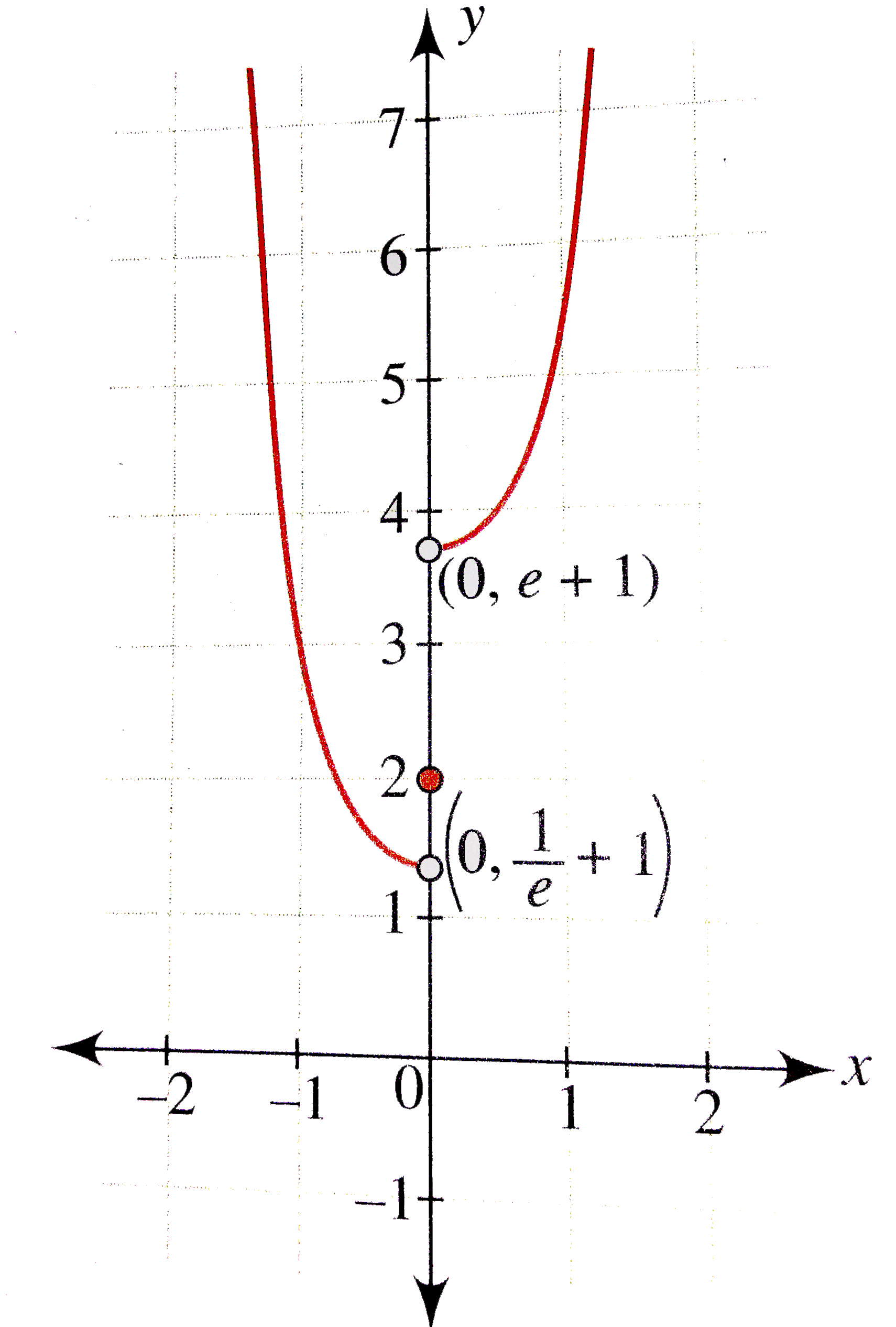
Let `f: R to R ` be defined as `f(x) = e^("sgn "x)+ e^(x^(2))`. Then find the range of the function, and also indentify the type of the function : one-one or many-one.

Text Solution

Verified by Experts
`f(x) = e^("sgn "x) + e^(x^(2))`
`" "= {{:( (1)/(e)+ e^(x^(2))",",, x lt 0),( 2"," ,, x=0 ),(e+e^(x^(2))",",, x gt 0):}`
For ` x gt 0, x^(2) gt 0, e^(x^(2)) gt1 therefore e^(x^(2)) gt 1 + e`
For `x lt 0, x^(2) gt 0, e^(x^(2)) gt 1 therefore (1)/(e) + e^(x^(2)) gt 1 + (1)/(e)`
Thus the graph of the function is as follows

From the graph, the range of the function is `(1+ (1)/(e), oo)`.
Also from the graph, the function is many-one.
Promotional Banner

Topper's Solved these Questions

  • GRAPHS OF ELEMENTARY FUNCTIONS

    CENGAGE PUBLICATION|Exercise EXERCISES|34 Videos
  • GRAPHS OF POLYNOMIAL AND RATIONAL FUNCTIONS

    CENGAGE PUBLICATION|Exercise Exercises|17 Videos
  • GRAPHS OF TRIGONOMETRIC FUNCTIONS

    CENGAGE PUBLICATION|Exercise Exercises|22 Videos

Similar Questions

Explore conceptually related problems

Let f : R to R be defined as f(x) = (x^2-x+4)/(x^2+x+4) . Then the range of the function f(x) is

Let f:RtoR be defined as f(x)=(x^(2)-x+4)/(x^(2)+x+4) . Then the range of the function f(x) is

Let f:RR to RR be defined as f(x)=(x^2-x+4)/(x^2+x+4). Then the range of the function f(x) is____

Find the range of the function f(x) = (e^x - e^-x) .

If f:R to R be defined by f(x) =2x+sinx for x in R , then check the nature of the function.

Identify the type of the function f:R to R, f(x)=e^(x^(2))+cosx.

Let f: RrarrR be defined by f(x)=(e^x-e^(-x))//2dot then find its inverse.

Find the domain and range of the function f(x)=(x^2)/(1+x^2) . Is the function one-to-one?

f(x)=x^5/5-8/3x^3+(16+c)x , then find the range of c, so that function is one-one function.

Let a function f:R to R be defined by f(x)=2x+cosx+sinx " for " x in R . Then find the nature of f(x) .

CENGAGE PUBLICATION-GRAPHS OF ELEMENTARY FUNCTIONS -EXERCISES
  1. Let f: R to R be defined as f(x) = e^("sgn "x)+ e^(x^(2)). Then find ...

    Text Solution

    |

  2. Draw the graph of y= (1)/((1//x)).

    Text Solution

    |

  3. (a) Draw the graph of f(x) = ={{:(1",",, |x| ge 1), ((1)/(n^(2)) ",",,...

    Text Solution

    |

  4. Sketch the regions which points satisfy |x+y| ge 2.

    Text Solution

    |

  5. Sketch the region satisfying |x| lt |y|.

    Text Solution

    |

  6. For a point P in the plane, let d1(P)a n dd2(P) be the distances of th...

    Text Solution

    |

  7. Draw the graph of y= (x-1)/(x-2).

    Text Solution

    |

  8. The following figure shows the graph of f(x) =ax^(2)+bx +c, then find ...

    Text Solution

    |

  9. The entire graphs of the equation y=x^2+kx-x+9 is strictly above the x...

    Text Solution

    |

  10. If x^2+2a x+a<0AAx in [1,2], the find the values of adot

    Text Solution

    |

  11. Draw the graph of f(x) = x|x|.

    Text Solution

    |

  12. Draw the graph of the function: Solve |(x^2)/(x-1)|lt=1 using the grap...

    Text Solution

    |

  13. Draw the graph of y = |x^(2) - 2x|-x.

    Text Solution

    |

  14. Draw the graph of y = {{:(2^(x)",",, x^(2)-2x le 0 ),( 1+3.5 x- x^(2),...

    Text Solution

    |

  15. Draw the graph of f(x)= |2x-1|+ |2x-3|. Find the range of the function...

    Text Solution

    |

  16. Draw the graph of f(x) =y= |x-1|+3|x-2|-5|x-4| and find the values of ...

    Text Solution

    |

  17. Find the set of real value(s) of a for which the equation |2x+3|+2x-3|...

    Text Solution

    |

  18. Draw the graph of y= 2^(((|x|+x))/(x)).

    Text Solution

    |

  19. Draw the graph of y= x ^((1)/(log(e)x)).

    Text Solution

    |

  20. Find the number of solutions to the equation x+log(e)x=0.

    Text Solution

    |

  21. draw the graph of f(x)=x+[x], [.] denotes greatest integer function.

    Text Solution

    |

