Home
Class 12
MATHS
Letf:RrarrR and g:RrarrR be respectively...

Let`f:RrarrR` and `g:RrarrR` be respectively given by `f(x)=|x|+1 and g(x)=x^2+1`. Define `h:RrarrR` by
`h(x)={(max {f(x),g(x)} if x le 0),(min {f(x),g(x)} if x gt 0):}`
The number of points at which `h(x)` is not differentiable is

Text Solution

Verified by Experts
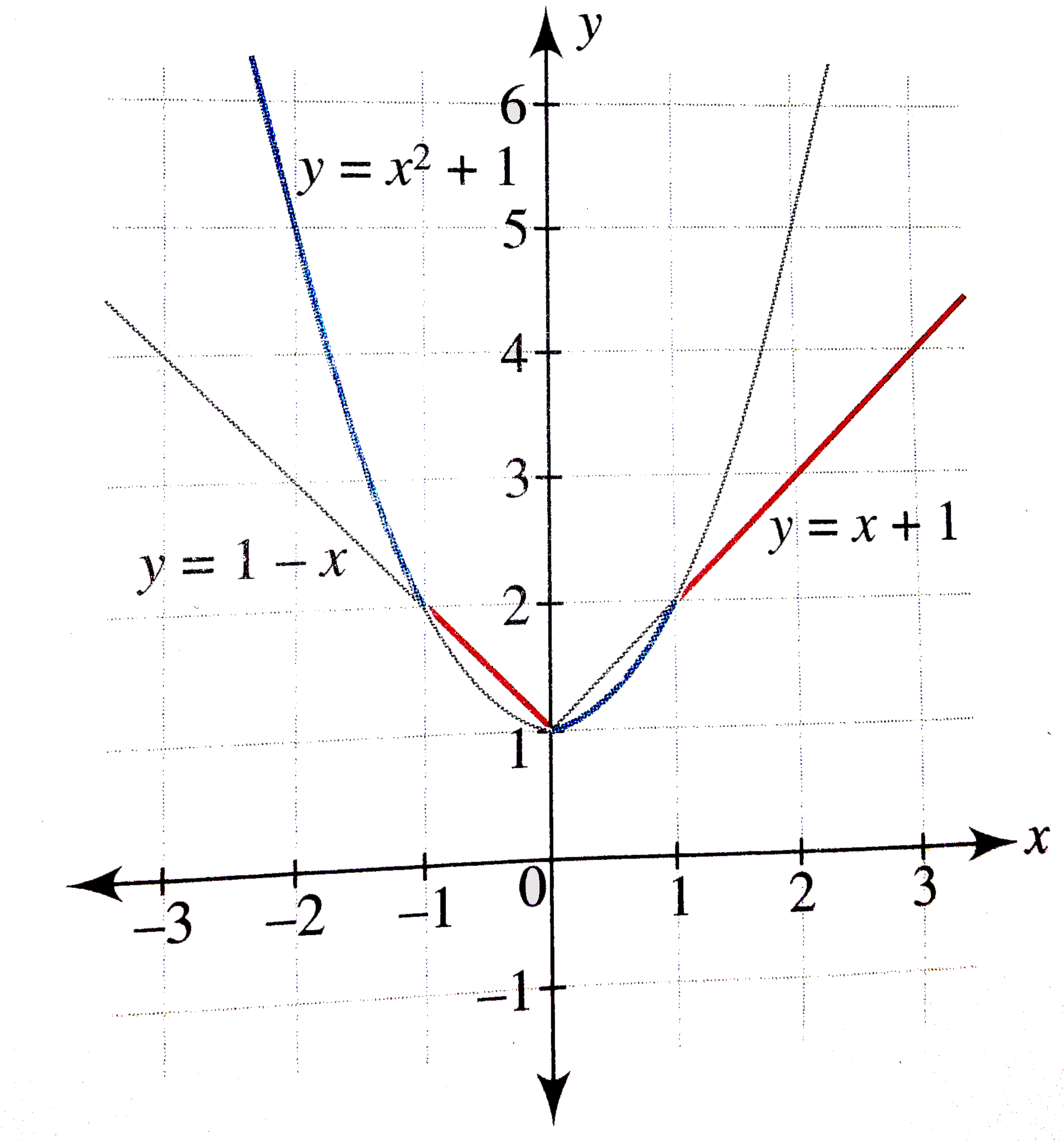
First we draw the graph, of `y= |x|+1 and y = x^(2) + 1`
`" "y = |x|+1 = {{:( x+1",",, x ge 0),( -x+1",",, xlt 0):}`
`y=x^(2)+1` is a parabola having vertex at (0, 1) and concave upwards
Thus, the graphs of both functions are as shown in the following figure.

From the graph, the required function is
`" "h(x) ={{:(x^(2)+1",",, x in (-oo, -1)), (-x+1",",, x in [-1, 0)), (x^(2)+1",",, x in [0, 1)), (x+1",",, x in [1, oo)):}`
which is non-different at `x=-1, 0 and 1`.
Promotional Banner

Topper's Solved these Questions

  • GRAPHS OF ELEMENTARY FUNCTIONS

    CENGAGE PUBLICATION|Exercise EXERCISES|34 Videos
  • GRAPHS OF POLYNOMIAL AND RATIONAL FUNCTIONS

    CENGAGE PUBLICATION|Exercise Exercises|17 Videos
  • GRAPHS OF TRIGONOMETRIC FUNCTIONS

    CENGAGE PUBLICATION|Exercise Exercises|22 Videos

Similar Questions

Explore conceptually related problems

Let f, g : R to R be defined, respectively byt f(x)=x+1, g(x)=2x-3. Find f+g, f-g and f/g .

Let g(x)=1+x-[x] and f(x)=={(-1, x lt0),(0, x=0),(1, x gt 0):} Then for all x find f(g(x))

Let f:[a,b]rarr[1,infty) be a continuous function and lt g: RrarrR be defined as g(x)={(0, "if x" lt a),(int_a^x f(t)dt, "if a"lexleb),(int_a^b f(t)dt, "if x"gtb):} Then a) g(x) is continuous but not differentiable at a b) g(x) is differentiable on R c) g(x) is continuous but nut differentiable at b d) g(x) is continuous and differentiable at either a or b but not both.

Let f(x)=x^(2) and g(x)=2x+1 be two real functions. Find (f+g) (x), (f-g) (x), (fg) (x), (f/g) (x) .

Let f:R→R: f(x)=x+1 and g:R→R: g(x)=2x−3 . Find (f−g)(x) .

Let R be the set of real numbers and the functions f:RrarrR and g:RrarrR be defined f(x)=x^2+2x-3 and g(x)=x+1 . Then the value of x for which f(g(x))=g(f(x)) is

If f(x)=sinx, g(x)=x^2 and h(x)=log x, find h[g{f(x)}].

Let f: RrarrR be defined by f(x)=(e^x-e^(-x))//2dot then find its inverse.

Let g(x)=f(x)+f(1-x) and f '' (x) gt 0 AA x in (0, 1) . Find the intervals of increase and decrease of g(x) -

Let f(x)=(1)/(1+x^(2)) and g(x) is the inverse of f(x) ,then find g(x)

CENGAGE PUBLICATION-GRAPHS OF ELEMENTARY FUNCTIONS -EXERCISES
  1. Letf:RrarrR and g:RrarrR be respectively given by f(x)=|x|+1 and g(x)=...

    Text Solution

    |

  2. Draw the graph of y= (1)/((1//x)).

    Text Solution

    |

  3. (a) Draw the graph of f(x) = ={{:(1",",, |x| ge 1), ((1)/(n^(2)) ",",,...

    Text Solution

    |

  4. Sketch the regions which points satisfy |x+y| ge 2.

    Text Solution

    |

  5. Sketch the region satisfying |x| lt |y|.

    Text Solution

    |

  6. For a point P in the plane, let d1(P)a n dd2(P) be the distances of th...

    Text Solution

    |

  7. Draw the graph of y= (x-1)/(x-2).

    Text Solution

    |

  8. The following figure shows the graph of f(x) =ax^(2)+bx +c, then find ...

    Text Solution

    |

  9. The entire graphs of the equation y=x^2+kx-x+9 is strictly above the x...

    Text Solution

    |

  10. If x^2+2a x+a<0AAx in [1,2], the find the values of adot

    Text Solution

    |

  11. Draw the graph of f(x) = x|x|.

    Text Solution

    |

  12. Draw the graph of the function: Solve |(x^2)/(x-1)|lt=1 using the grap...

    Text Solution

    |

  13. Draw the graph of y = |x^(2) - 2x|-x.

    Text Solution

    |

  14. Draw the graph of y = {{:(2^(x)",",, x^(2)-2x le 0 ),( 1+3.5 x- x^(2),...

    Text Solution

    |

  15. Draw the graph of f(x)= |2x-1|+ |2x-3|. Find the range of the function...

    Text Solution

    |

  16. Draw the graph of f(x) =y= |x-1|+3|x-2|-5|x-4| and find the values of ...

    Text Solution

    |

  17. Find the set of real value(s) of a for which the equation |2x+3|+2x-3|...

    Text Solution

    |

  18. Draw the graph of y= 2^(((|x|+x))/(x)).

    Text Solution

    |

  19. Draw the graph of y= x ^((1)/(log(e)x)).

    Text Solution

    |

  20. Find the number of solutions to the equation x+log(e)x=0.

    Text Solution

    |

  21. draw the graph of f(x)=x+[x], [.] denotes greatest integer function.

    Text Solution

    |

