Home
Class 12
MATHS
Discuss the continuity of f(x)=(lim)(n->...

Discuss the continuity of `f(x)=(lim)_(n->oo)(x^(2n)-1)/(x^(2n)+1)`

Text Solution

Verified by Experts
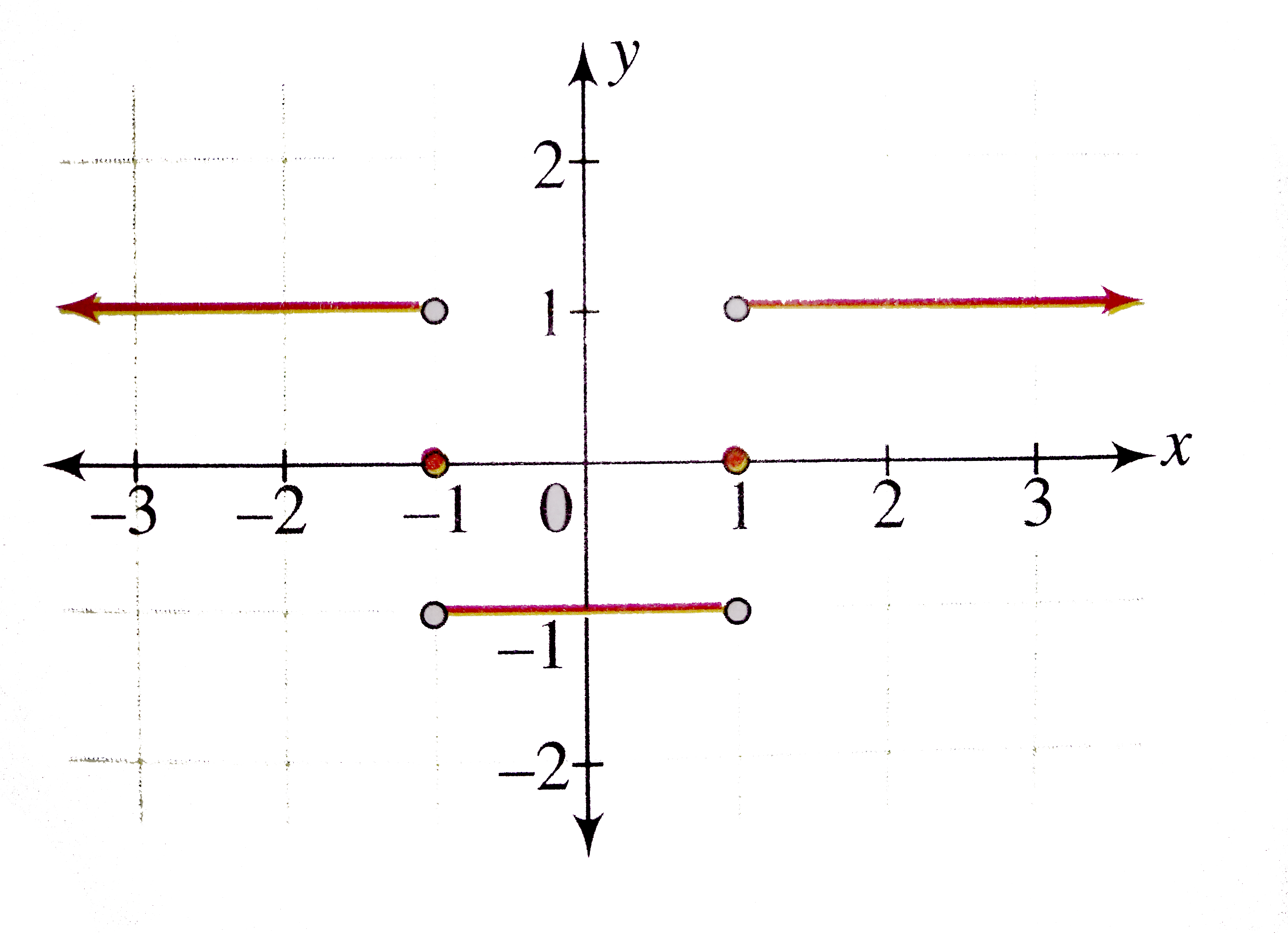
`f(x) =underset(ntooo) (lim) ((x^(2))^(n)-1)/((x^(2))^(n)+1)`
`" "=underset(n to oo) (lim) (1-(1)/((x^(2))^(n)))/(1+(1)/((x^(2))^(n)))`
`" "={{:(-1",",,0le x^(2)lt1),(0",",,x^(2) =1),(1",",, x^(2) gt 1):}`
`" "={{:(1",",,xlt-1),(0",",,x=-1),(-1",",,-1 lt xlt 1), (0",",,x=1), (1",",,x gt 1):}`
Clearly, the above function is same as `g(x)= "sgn"(x^(2) -1)`.
Promotional Banner

Topper's Solved these Questions

  • GRAPHS OF ELEMENTARY FUNCTIONS

    CENGAGE PUBLICATION|Exercise EXERCISES|34 Videos
  • GRAPHS OF POLYNOMIAL AND RATIONAL FUNCTIONS

    CENGAGE PUBLICATION|Exercise Exercises|17 Videos
  • GRAPHS OF TRIGONOMETRIC FUNCTIONS

    CENGAGE PUBLICATION|Exercise Exercises|22 Videos

Similar Questions

Explore conceptually related problems

Discuss the continuity of f(x)=("lim")_(n->oo)cos^(2n)xdot

Let f(x)=lim_(ntooo) (x)/(x^(2n)+1). Then f has

Find the values of a if f(x)=("lim")_(n rarr oo)(a x^(2n)+2)/(x^(2n)+a+1) is continuous at x=1.

Discuss the continuity of the function, f(x)=lim_(nrarrinfty)(log(2+x)-x^(2n)sinx)/(1+x^(2n)) at x=1

Discuss the continuity of f(x) where f(x)=lim_(nrarrinfty)("sin" (pix)/2)^(2n)

If f(x)=(x+1)/(x-1)a n dg(x)=1/(x-2),t h e n discuss the continuity of f(x),g(x),a n dfog(x)dot

lim_(n->oo)((n^2-n+1)/(n^2-n-1))^(n(n-1)) is

A function f: RvecR is defined as f(x)=(lim)_(nvecoo)(a x^2+b x+c+e^(n x))/(1+c.e^(n x)) is continuous on R then find the values of a,b,c.

Let for all xgt0,f(x)=lim_(nto oo)n(x^((1)/(n))-1) , then

The value of ("lim")_(n->oo)[(n+1)^2 3-(n-1)^2 3] is_____

CENGAGE PUBLICATION-GRAPHS OF ELEMENTARY FUNCTIONS -EXERCISES
  1. Draw the graph of f(x) =y= |x-1|+3|x-2|-5|x-4| and find the values of ...

    Text Solution

    |

  2. Find the set of real value(s) of a for which the equation |2x+3|+2x-3|...

    Text Solution

    |

  3. Draw the graph of y= 2^(((|x|+x))/(x)).

    Text Solution

    |

  4. Draw the graph of y= x ^((1)/(log(e)x)).

    Text Solution

    |

  5. Find the number of solutions to the equation x+log(e)x=0.

    Text Solution

    |

  6. draw the graph of f(x)=x+[x], [.] denotes greatest integer function.

    Text Solution

    |

  7. Given f(x) is a periodic function with period 2 and it is defined as ...

    Text Solution

    |

  8. Draw the region of relation [x][y]= 6, x, y ge 0. Here [*] denotes the...

    Text Solution

    |

  9. lim(xrarrc)f(x) does not exist for wher [.] represent greatest integ...

    Text Solution

    |

  10. Let f(x) = ([x]+1)/({x}+1) for f: [0, (5)/(2) ) to ((1)/(2) , 3], whe...

    Text Solution

    |

  11. Draw the graph of y= 2^({x}), where {*} represents the fractional part...

    Text Solution

    |

  12. The area of the region containing the points (x , y) satisfying 4lt=x^...

    Text Solution

    |

  13. Draw the graph of y= -sqrt(x^(2)+2)

    Text Solution

    |

  14. Draw the graph of y=|x|^(1/2) for -1lt=x<1.

    Text Solution

    |

  15. Draw the graph of f(x) = "sgn"(log(0.5) x).

    Text Solution

    |

  16. The graph of y=f(x) is as shown in the following figure. Draw the grap...

    Text Solution

    |

  17. Discuss the continuity of f(x)=(lim)(n->oo)(x^(2n)-1)/(x^(2n)+1)

    Text Solution

    |

  18. An even periodic function f:R to R with period 4 is such that f(x)=...

    Text Solution

    |

  19. The function f(x) = "max"{(1-x), (1+x), 2}, x in (-oo, oo) is

    Text Solution

    |

  20. If f (x) = min { 1, x^2 , x^3} then

    Text Solution

    |

