Home
Class 12
MATHS
Line segment AB of fixed length c slides...

Line segment AB of fixed length c slides between coordinate axes such that its ends A and B lie on the axes. If O is origin and rectangle OAPB is completed, then show that the locus of the foot of the perpendicular drawn from P to AB is `x^((2)/(3)) + y^((2)/(3)) = c^((2)/(3)).`

Text Solution

Verified by Experts
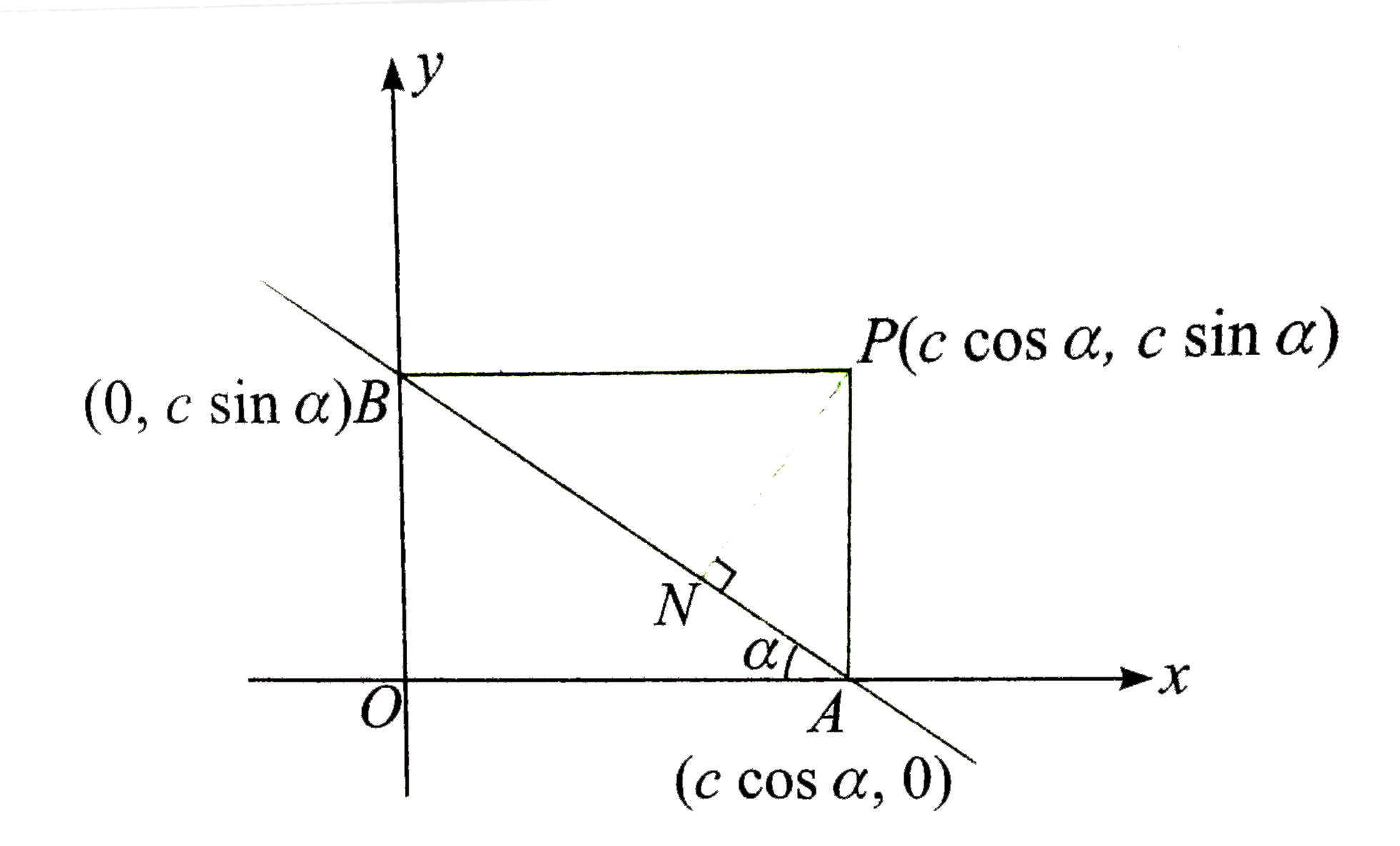

As shown in the figure, is on x-axis and B is on y-axis.
AB=c (given)
Given that OAPB is a rectangle.
Let `angle BAO = alpha`
`therefore OA = c "cos " alpha and OB= " c sin "alpha`
`therefore P-= (c "cos " alpha,c "sin " alpha)`
Equation of AB is
` (x)/(c " cos " alpha) + (y)/(c "sin " alpha) = 1`
` or x "sin " alpha + y "cos"alpha = c " sin"alpha "cos" alpha " "(1)`
Equation of PN (perpendicular from P to AB) is
`y-c sin alpha = cot a (x-c cos alpha)`
`rArr x cos alpha - y sin alpha = c(cos^(2) alpha -sin^(2) alpha) " "(2)`
N is point of intersection of (1) and (2).
Solving (1) and (2), we get
`x = c cos^(3) alpha, y = c sin^(3) alpha`
`therefore cos alpha = ((x)/(c))^(1//3), sin alpha = ((y)/(c))^(1//3)`
Squaring and adding, we get
`((x)/(c))^(2//3) + ((y)/(c))^(2//3) = 1`
` or x^(2//3) + y^(2//3) = c^(2//3), "which is the required locus"`
Promotional Banner

Topper's Solved these Questions

  • STRAIGHT LINES

    CENGAGE PUBLICATION|Exercise EXAMPLE|12 Videos
  • STRAIGHT LINES

    CENGAGE PUBLICATION|Exercise CONCEPT APPLICATION EXERCISE 2.1|23 Videos
  • STRAIGHT LINE

    CENGAGE PUBLICATION|Exercise Multiple Correct Answers Type|8 Videos
  • THEORY OF EQUATIONS

    CENGAGE PUBLICATION|Exercise JEE ADVANCED (Numerical Value Type )|1 Videos

Similar Questions

Explore conceptually related problems

The circle A and B of a line segment of constant length c unit slides upon the fixex rectangular axes OX and OY. If P be a point on the plane such that OAPB is a rectangle, then show that locus of the foot of the perpendicular drawn from P to AB is x^(2//3)+ y^(2//3)=c^(2//3) .

The straight line through a fixed point (2,3) intersects the coordinate axes at distinct point P and Q. If O is the origin and the rectangle OPRQ is completed then the locus of R is

The locus of the foot of perpendicular drawn from the centre of the ellipse x^(2)+3y^(2)=6 on any tangent to it is-

A variable line makes intercepts on the co-ordinate axes , the sum of whose squares is constant and equal to k^2 . Show that the locus of the foot of the perpendicular from the origin to this line is (x^2+ y^2)^2 (x^(-2)+ y^(-2))=k^2 .

Find the foot of perpendicular drawn from the point (2, 2) to the line 3x - 4y + 5 = 0

Find the coordinates of the foot of the perpendicular drawn from the point (2,-5) on the straight line x=y+1.

A rod of length k slides in a vertical plane, its ends touching the coordinate axes. Prove that the locus of the foot of the perpendicular from the origin to the rod is (x^2+y^2)^3=k^2x^2y^2dot

The locus of foot of the perpendiculars drawn from the vertex on a variable tangent to the parabola y^2 = 4ax is

The coordinates of the foot of the perpendicular drawn from the point A(2, 4, -1) on the line (x+5)/(1)=(y+3)/(4)=(z-6)/(-9) are -

A plane passes through a fixed point (a ,b ,c)dot Show that the locus of the foot of the perpendicular to it from the origin is the sphere x^2+y^2+z^2-a x-b y-c z=0.

