Home
Class 12
MATHS
Let the sides of a parallelogram be U=a,...

Let the sides of a parallelogram be U=a, U=b,V=a' and V=b', where U=lx+my+n, V=l'x+m'y+n'. Show that the equation of the diagonal through the point of intersection of
`U=a, V=a' and U=b, V=b' " is given by " |{:(U,V,1),(a,a',1),(b,b',1):}| =0.`

Text Solution

Verified by Experts
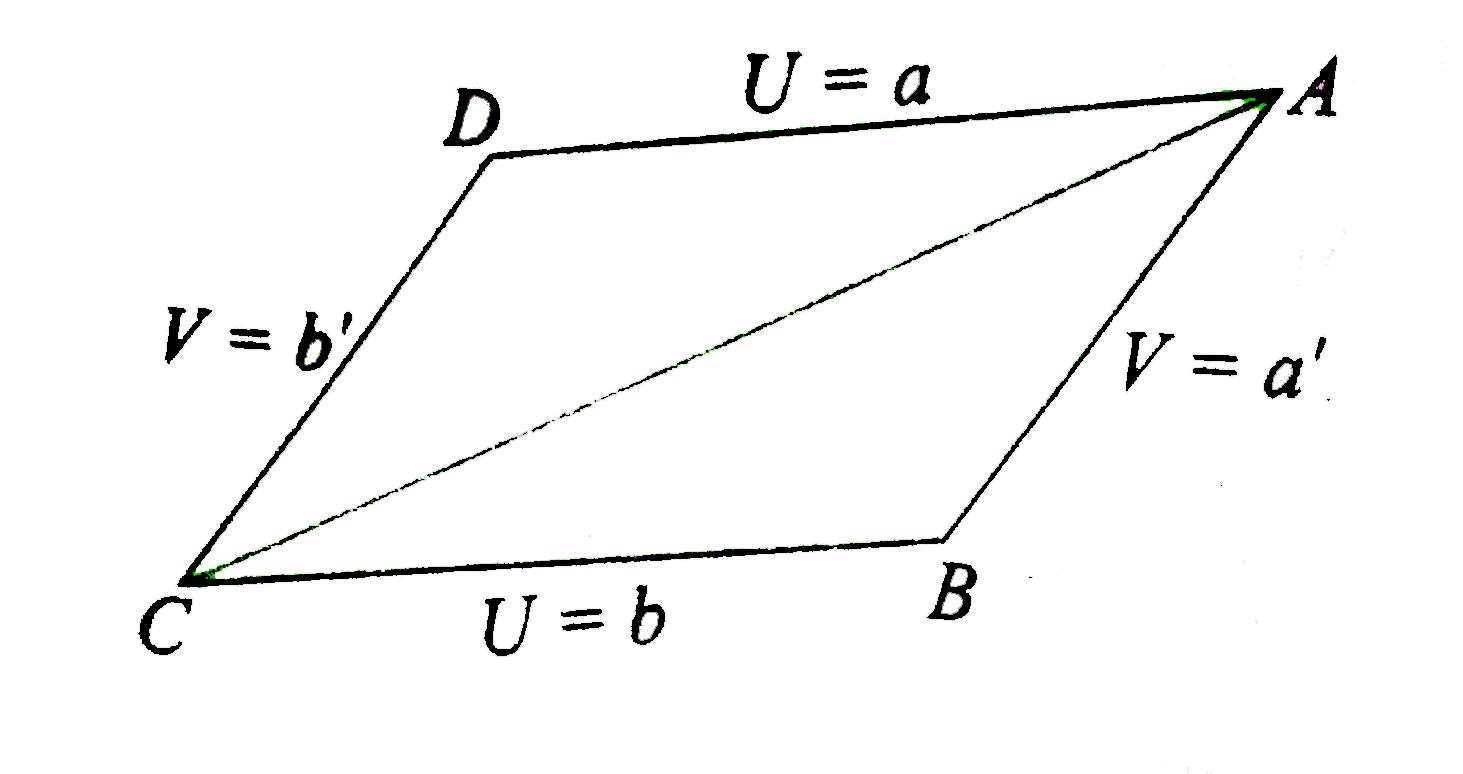
Parallelogram is formed by lines U=a, U=b, V=a' and V=b', where U=lx+my+n, V=l'x+m'y+n'

Let the required diagonal be AC.
Since one end A of the diagonal AC passes through the point of intersection of lines U-a=0 and V-a'=0, its equation is given by
`(U-a)+lambda(V-a')=0 " " (1)`
But the other end C of the same diagonal passes through the point of intersection of lines U-b=0 and V-b' = 0.
So, its equation is given by
`(U-b)+mu(V-b') = 0 " " (2)`
Equation (1) and (2) represents the same straight lines.
`therefore 1=(lambda)/(mu) = (a+lambdaa')/(b+mub')`
`rArr lambda=mu = -((a-b)/(a'-b'))`
Putting the value of `lambda` in (1), we get
`(U-a)-((a-b)/(a'-b'))(V-a')=0`
`" or " |{:(U,V,1),(a,a',1),(b,b',1):}| =0`
This is the required equation of diagonal.
Promotional Banner

Topper's Solved these Questions

  • STRAIGHT LINES

    CENGAGE PUBLICATION|Exercise EXAMPLE|12 Videos
  • STRAIGHT LINES

    CENGAGE PUBLICATION|Exercise CONCEPT APPLICATION EXERCISE 2.1|23 Videos
  • STRAIGHT LINE

    CENGAGE PUBLICATION|Exercise Multiple Correct Answers Type|8 Videos
  • THEORY OF EQUATIONS

    CENGAGE PUBLICATION|Exercise JEE ADVANCED (Numerical Value Type )|1 Videos

Similar Questions

Explore conceptually related problems

Show that the equation v^(2) = u^(2)+2 as is dimensionally homogeneous.

If u is proportional to v then

Show that at constant volume Delta U=q_v

Let A = { a, e, i, o, u } and B = { a, i, u } . Show that A ∪ B = A

Find the points points of discontinuity of y=1/(u^2+u-2) where u=1/(x-1)

A particle starting from a point A and moving with a positive constant acceleration along a straight line reaches another point B is time T. Suppose that the initial velocity of the particle is u gt0 and P is the midpoint of the line AB. If the velocity of the particle at point P is v_(1) and if the velocity at time (T)/(2) is v_(2) , then -

For a concave mirror, prove that 1/u+1/v=1/f , where u, v and f have their usual meanings.

Find the particular solution of v(dv)/(dx)=n^(2)x , given v=u when x=a

