Home
Class 12
MATHS
A diagonal of rhombus A B C D is member ...

A diagonal of rhombus `A B C D` is member of both the families of lines `(x+y-1)+lambda(2x+3y-2)=0` and `(x-y+2)+ lamda(2x-3y+5)=0` and rhombus is (3, 2). If the area of the rhombus is `12sqrt(5)` sq. units, then find the remaining vertices of the rhombus.

Text Solution

Verified by Experts
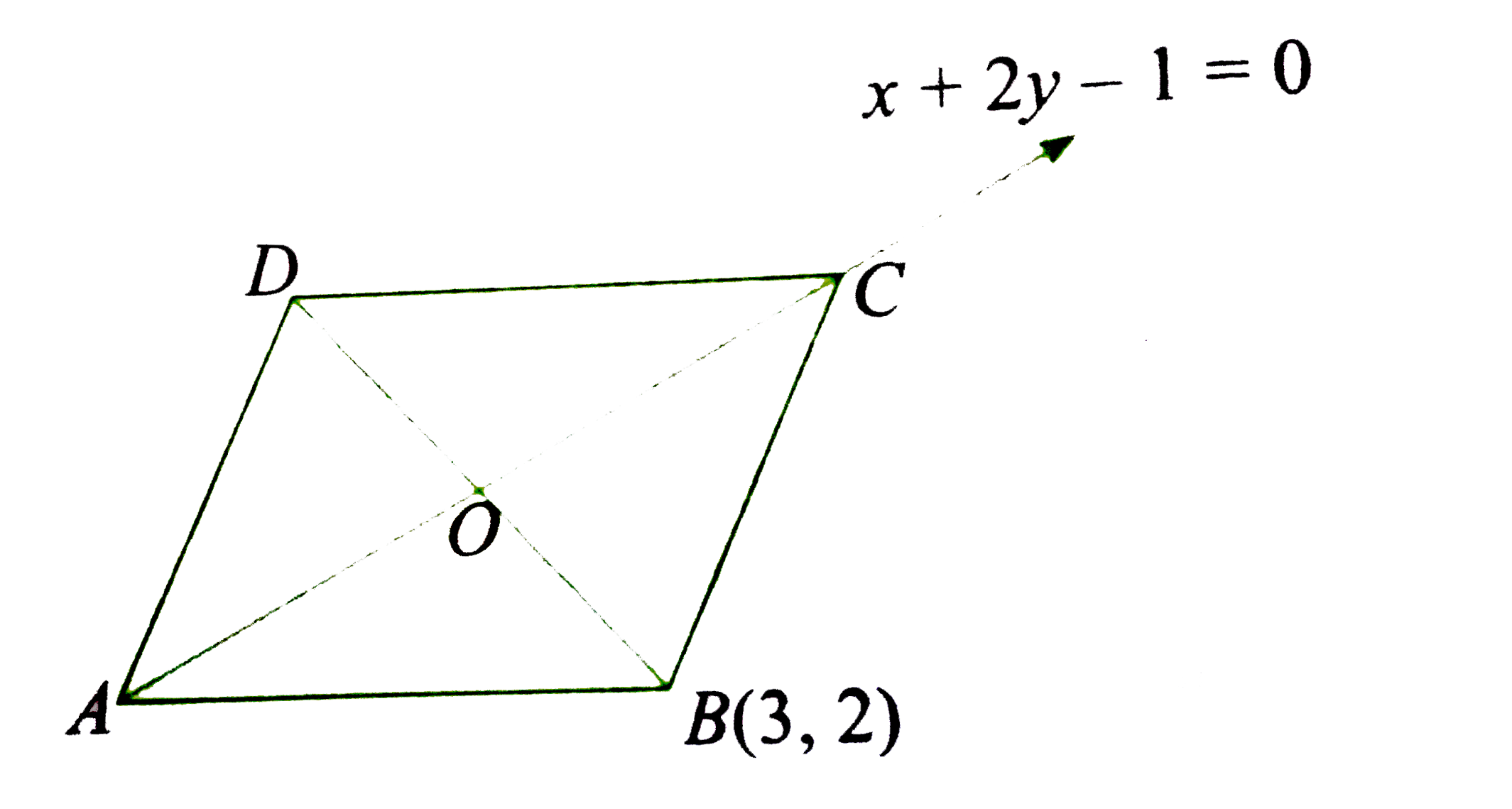

Since diagonal is member of both the given families of line, it will pass through the points (1,0) and (-1,1) which are points where given family of lines are concurrent.
So, equation of diagonal AC is x+2y-1=0.
Clearly, point (3,2) does not satisfy this diagonal.
`therefore "Let" B -= (3,2).`
Diagonal BD is perpendicular to AC.
So, equation of diagonal BD is 2x-y-4=0.
Point of intersection of diagonal AC and BD is O `((9)/(5), (-2)/(5)).`
Since O is midpoint of BD, D `-=((3)/(5),-(14)/(5)).`
`"Now", OD = (6)/(sqrt(5)). So, BD = (12)/(sqrt(5))=d_(1)`
`"Area of rhombus " =(1)/(2)d_(1) xx d_(2) = 12sqrt(5) " " ("where " d_(2) " is length of diagonal AC")`
`therefore d_(2) = 10 " units"`
This is the length of diagonal AC.
Slope of AC `=-(1)/(2) = "tan" theta, "where" theta` is inclination of AC with x-axis.
Since OA=OC=5, using parametic from of straight line, we have
`A,C -= ((9)/(5)+-5"cos" theta, -(2)/(5) +- 5 "sin" theta)`
`-= ((9)/(5)+-5(-(2)/(sqrt(5))), -(2)/(5) +- 5 ((1)/(sqrt(5))))`
`-= ((9)/(5)-2sqrt(5), -(2)/(5) + sqrt(5)), ((9)/(5)+2sqrt(5), -(2)/(5) - sqrt(5))`
Promotional Banner

Topper's Solved these Questions

  • STRAIGHT LINES

    CENGAGE PUBLICATION|Exercise CONCEPT APPLICATION EXERCISE 2.1|23 Videos
  • STRAIGHT LINES

    CENGAGE PUBLICATION|Exercise CONCEPT APPLICATION EXERCISE 2.2|4 Videos
  • STRAIGHT LINES

    CENGAGE PUBLICATION|Exercise ARCHIVES (NUMERICAL VALUE TYPE)|1 Videos
  • STRAIGHT LINE

    CENGAGE PUBLICATION|Exercise Multiple Correct Answers Type|8 Videos
  • THEORY OF EQUATIONS

    CENGAGE PUBLICATION|Exercise JEE ADVANCED (Numerical Value Type )|1 Videos

Similar Questions

Explore conceptually related problems

Consider the family of lines (x+y-1)+lambda(2x+3y-5)=0 and (3x+2y-4)+ mu(x+2y-6)=0 , equation of a straight line that belongs to both the families is

Consider the family of lines 5x+3y-2+lambda_(1)(3x-y-4)=0 " and " x-y+1+lambda_(2)(2x-y-2)=0 . Find the equation of a straight line that belongs to both the families.

Two sides of a rhombus lyin in the first quadrant are given by 3x-4y=0 and 12x-5y=0 . If the length of the longer diagonal is 12 units, find the equationsof the other two sides of the rhombus.

If the two sides of rhombus are x+2y+2=0 and 2x+y-3=0, then find the slope of the longer diagonal.

Two sides of a rhombus lying in the first quadrant are given by 3x-4y=0a n d12 x-5y=0 . If the length of the longer diagonal is 12, then find the equations of the other two sides of the rhombus.

If the lines 2x-3y-5=0 and 3x-4y=7 are diameters of a circle of area 154 sq. units, then the equation of the circle is

The equation of straight line belonging to both the families of lines (x-y+1)+lambda_1(2x-y-2)=0 and (5x+3y-2)+lambda_2(3x-y-4)=0 where lambda_1, lambda_2 are arbitrary numbers is (A) 5x -2y -7=0 (B) 2x+ 5y - 7= 0 (C) 5x + 2y -7 =0 (D) 2x- 5y- 7= 0

The diagonals A C and B D of a rhombus intersect at (5,6)dot If A=(-3,2), then find the equation of diagonal B Ddot

The straight line x+y+1+ lambda (2x-y-1)=0 is bot to 2x+3y-8=0, find the value of lambda .

