Home
Class 12
MATHS
theta1 and theta2 are the inclination of...

`theta_1 and theta_2` are the inclination of lines `L_1 and L_2` with the x-axis. If `L_1 and L_2` pass through `P(x_1,y_1)`, then the equation of one of the angle bisector of these lines is

A

`(x-x_(1))/("cos"((theta_(1)+theta_(2))/(2))) = (y-y_(1))/("sin"((theta_(1)+theta_(2))/(2)))`

B

`(x-x_(1))/("-sin"((theta_(1)-theta_(2))/(2))) = (y-y_(1))/("cos"((theta_(1)-theta_(2))/(2)))`

C

`(x-x_(1))/("sin"((theta_(1)+theta_(2))/(2))) = (y-y_(1))/("cos"((theta_(1)+theta_(2))/(2)))`

D

`(x-x_(1))/("-sin"((theta_(1)+theta_(2))/(2))) = (y-y_(1))/("cos"((theta_(1)+theta_(2))/(2)))`

Text Solution

Verified by Experts

The correct Answer is:
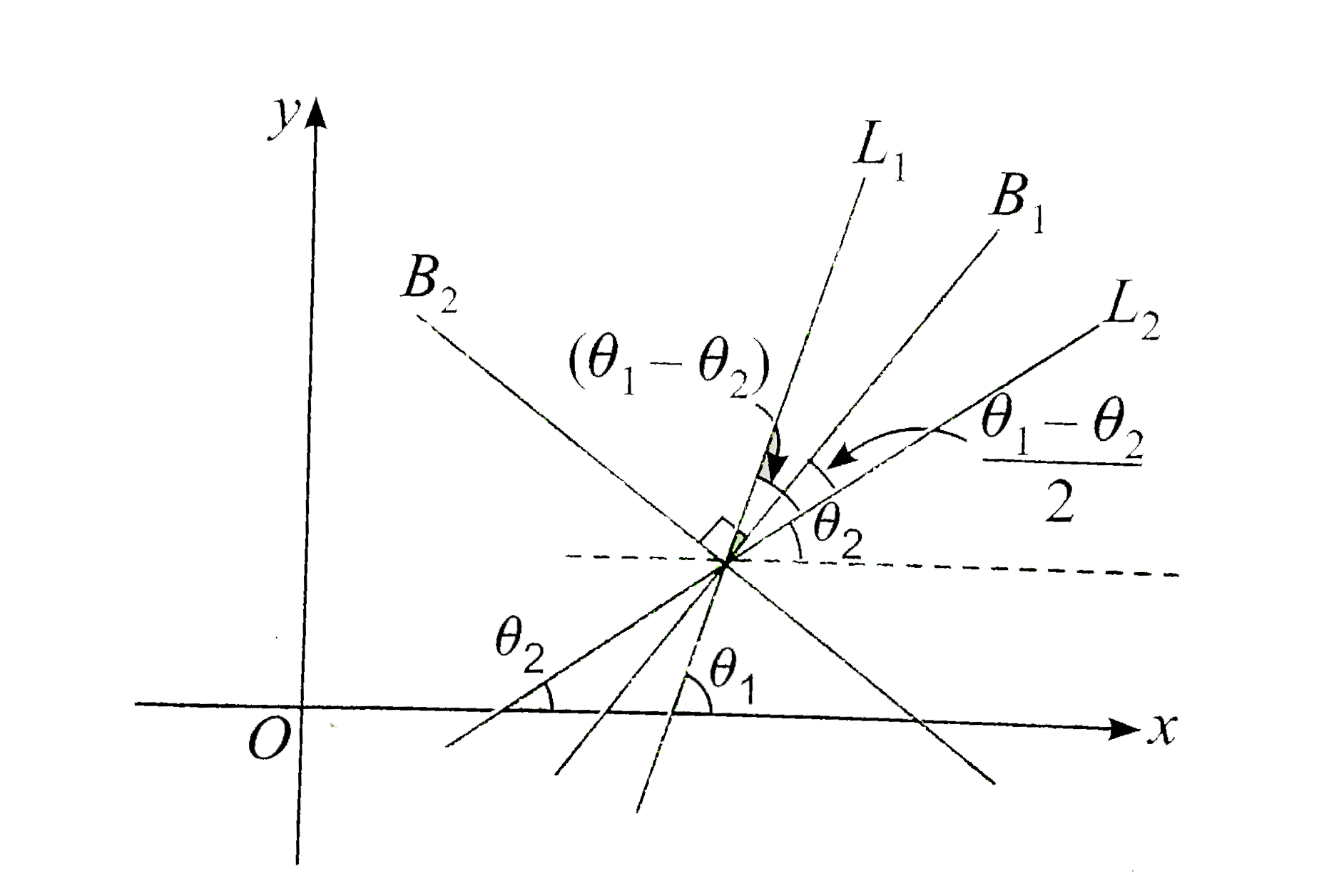
A, D


From the figure, angle bisectors `B_(1) " and " B_(2)` have inclinations of
`(theta_(1) + theta_(2))/(2) " and " ((pi)/(2) + (theta_(1) + theta_(2))/(2))` with the x-axis.
Therefore, equations of angle bisectors are
`(x-x_(1))/("cos"((theta_(1) + theta_(2))/(2))) = (y-y_(1))/("sin"((theta_(1) + theta_(2))/(2)))`
`"and " (x-x_(1))/("cos"((pi)/(2)+(theta_(1) + theta_(2))/(2))) = (y-y_(1))/("sin"((pi)/(2)+(theta_(1) + theta_(2))/(2)))`
`"or " (x-x_(1))/("-sin"((theta_(1) + theta_(2))/(2))) = (y-y_(1))/("cos"((theta_(1) + theta_(2))/(2)))`
Promotional Banner

Topper's Solved these Questions

  • STRAIGHT LINES

    CENGAGE PUBLICATION|Exercise EXERCISE (LINKED COMPREHENSION TYPE)|27 Videos
  • STRAIGHT LINES

    CENGAGE PUBLICATION|Exercise EXERCISE (MATRIX MATCH TYPE)|8 Videos
  • STRAIGHT LINES

    CENGAGE PUBLICATION|Exercise EXERCISE (SINGLE CORRECT ANSWER TYPE)|82 Videos
  • STRAIGHT LINE

    CENGAGE PUBLICATION|Exercise Multiple Correct Answers Type|8 Videos
  • THEORY OF EQUATIONS

    CENGAGE PUBLICATION|Exercise JEE ADVANCED (Numerical Value Type )|1 Videos

Similar Questions

Explore conceptually related problems

The equations of bisectors of two lines L_1 & L_2 are 2x-16y-5=0 and 64x+ 8y+35=0 . lf the line L_1 passes through (-11, 4) , the equation of acute angle bisector of L_1 & L_2 is:

If theta is the angle between the lines given by the equation 6x^2+5x y-4y^2+7x+13 y-3=0 , then find the equation of the line passing through the point of intersection of these lines and making an angle theta with the positive x-axis.

Let a given line L_1 intersect the X and Y axes at P and Q respectively. Let another line L_2 perpendicular to L_1 cut the X and Y-axes at Rand S, respectively. Show that the locus of the point of intersection of the line PS and QR is a circle passing through the origin

P_1 and P_2 are planes passing through origin L_1 and L_2 are two lines on P_1 and P_2, respectively, such that their intersection is the origin. Show that there exist points A ,B and C , whose permutation A^(prime),B^(prime)a n dC^(prime), respectively, can be chosen such that i) A is on L_1,B on P_1 but not on L_1 and C not on P_1; ii) A ' is on L_2,B ' on P_2 but not on L_2 and C ' not on P_2dot

A straight lines L through the point ( 3, 2) is inclined at an angle 60^@ to the line sqrt3x +y =1 . If L also intersects the x-axis, then the equation of L is

Consider three planes P_1 : x-y + z = 1 , P_2 : x + y-z=-1 and P_3 : x-3y + 3z = 2 Let L_1, L_2 and L_3 be the lines of intersection of the planes P_2 and P_3 , P_3 and P_1 and P_1 and P_2 respectively. Statement 1: At least two of the lines L_1, L_2 and L_3 are non-parallel . Statement 2:The three planes do not have a common point

Find the equation of a plane passing through (1, 1, 1) and parallel to the lines L_1 and L_2 direction ratios (1, 0,-1) and (1,-1, 0) respectively. Find the volume of the tetrahedron formed by origin and the points where this plane intersects the coordinate axes.

If l_(1), m_(1), n_(1) and l_(2), m_(2), n_(2) are direction cosines of two mutually perpendicular straight lines, then prove that the direction cosines of the straight line which is perpendicular to both the given lines are pm (m_(1)n_(2)-m_(2)n_(1)), pm (n_(1)l_(2)-n_(2)l_(1)), pm (l_(1)m_(2)-l_(2)m_(1))

CENGAGE PUBLICATION-STRAIGHT LINES-EXERCISE (MULTIPLE CORRECT ANSWERS TYPE)
  1. The straight line 3x+4y-12=0 meets the coordinate axes at Aa n dB . An...

    Text Solution

    |

  2. The equation of the lines passing through the point (1,0) and at a dis...

    Text Solution

    |

  3. The sides of a triangle are the straight lines x+y=1,7y=x , and sqrt(3...

    Text Solution

    |

  4. If the straight line a x+c y=2b , where a , b , c >0, makes a triangle...

    Text Solution

    |

  5. Consider the equation y-y1=m(x-x1) . If ma n dx1 are fixed and differe...

    Text Solution

    |

  6. Equation(s) of the straight line(s), inclined at 30^0 to the x-axis su...

    Text Solution

    |

  7. The lines x+y-1=0,(m-1)x+(m^2-7)y-5=0, and (m-2)x+(2m-5)y=0 are ...

    Text Solution

    |

  8. The equation of a straight line passing through the point (2, 3) and ...

    Text Solution

    |

  9. Find the equation of a straight line on which the perpendicular from ...

    Text Solution

    |

  10. A line is drawn perpendicular to line y=5x , meeting the coordinate ax...

    Text Solution

    |

  11. If x-2y+4=0a n d2x+y-5=0 are the sides of an isosceles triangle having...

    Text Solution

    |

  12. Find the value of a for which the lines 2x+y-1=0, a x+3y-3=0, 3x...

    Text Solution

    |

  13. The lines px +qy+r=0, qx + ry + p =0,rx + py+q=0, are concurrant then

    Text Solution

    |

  14. theta1 and theta2 are the inclination of lines L1 and L2 with the x-ax...

    Text Solution

    |

  15. Consider the lines L(1) -=3x-4y+2=0 " and " L(2)-=3y-4x-5=0. Now, choo...

    Text Solution

    |

  16. The sides of a rhombus are parallel to the lines x+y-1=0 and 7x-y-5=0....

    Text Solution

    |

  17. Two straight lines u=0a n dv=0 pass through the origin and the angle b...

    Text Solution

    |

  18. Let u=a x+b y+a ^3sqrt(b)=0,v=b x-a y+b^3sqrt(a)=0,a ,b in R , be two...

    Text Solution

    |

  19. Two sides of a triangle are parallel to the coordinate axes. If the ...

    Text Solution

    |

  20. A line which makes an acute angle theta with the positive direction of...

    Text Solution

    |

