Home
Class 12
MATHS
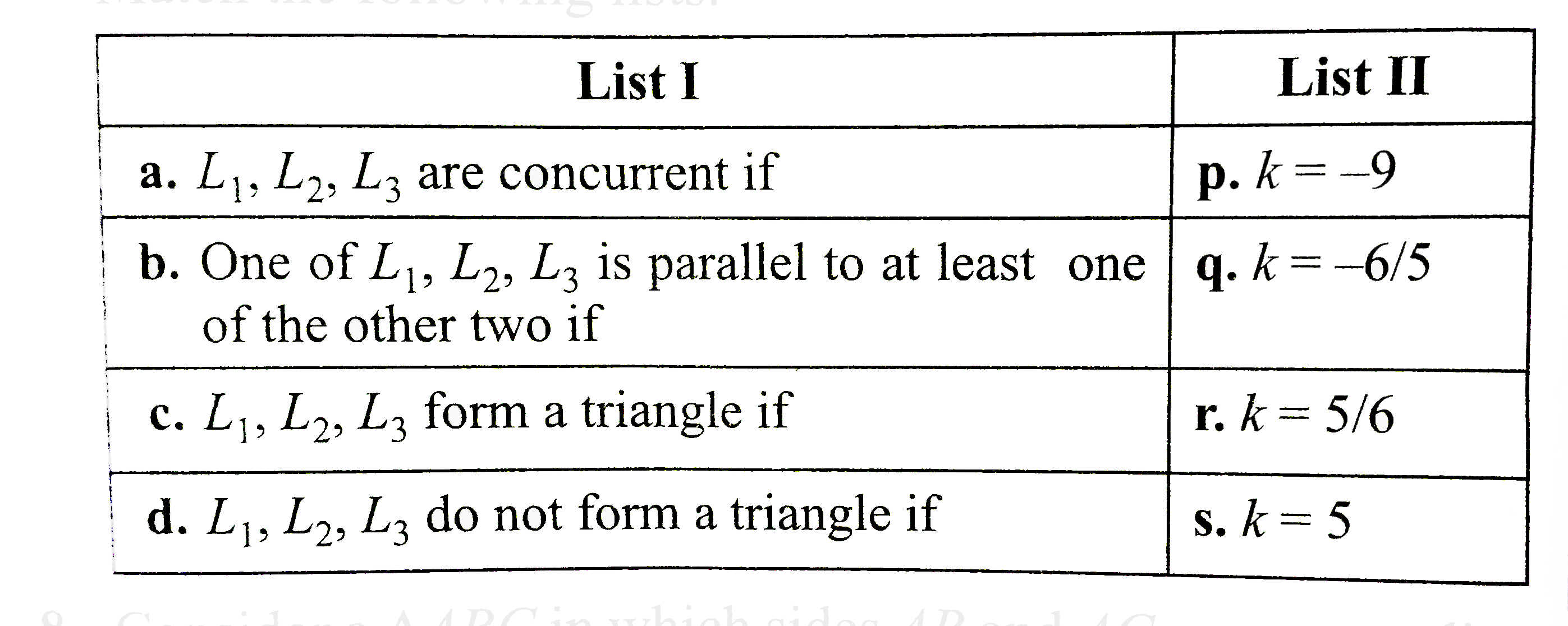
Consider the lines given by L(1):x+3y-...

Consider the lines given by
`L_(1):x+3y-5=0`
`L_(2):3x-ky-1=0`
`L_(3):5x+2y-12=0`
Match the following lists.

Text Solution

Verified by Experts

The correct Answer is:

`a to s;" b" to p,q; " c" to r; " d" to p,q,s`

Given lines are
`L_(1): x+3y-5 = 0`
`L_(2): 3x-ky-1 = 0`
`L_(3): 5x+2y-12 = 0`
`L_(1) " and " L_(3)` intersect at (2, 1)
`therefore L_(1), L_(2), L_(3)` are concurrent if
6-k-1 = 0 or k=5
`"For " L_(1), L_(2)` to be parallel
`(1)/(3) = (3)/(-k) rArr k = -9`
`"For " L_(2), L_(3)` to be parallel
`(3)/(5) = (-k)/(2) rArr k = (-6)/(5)`
Thus, for k = 5, lines are concurrent and for `k = -9, (-6)/(5),` at least two lines are parallelk. So, for these values of k, lines will not form triangle.
Obviously, for `k ne 5, -9, (-6)/(5),` lines form triangle.
Promotional Banner

Topper's Solved these Questions

  • STRAIGHT LINES

    CENGAGE PUBLICATION|Exercise EXERCISE (NUMERICAL VALUE TYPE)|13 Videos
  • STRAIGHT LINES

    CENGAGE PUBLICATION|Exercise ARCHIVES (JEE MAIN)|9 Videos
  • STRAIGHT LINES

    CENGAGE PUBLICATION|Exercise EXERCISE (LINKED COMPREHENSION TYPE)|27 Videos
  • STRAIGHT LINE

    CENGAGE PUBLICATION|Exercise Multiple Correct Answers Type|8 Videos
  • THEORY OF EQUATIONS

    CENGAGE PUBLICATION|Exercise JEE ADVANCED (Numerical Value Type )|1 Videos

Similar Questions

Explore conceptually related problems

Consider the lines given by L_1: x+3y-5=0 L_2:3x-k y-1=0 L_3:5x+2y-12=0 Column I|Column II L_1,L_2,L_3 are concurrent if|p. k=-9 One of L_1,L_2,L_3 is parallel to at least one of the other two if|q. k=-6/5 L_1,L_2,L_3 form a triangle if|r. k=5/6 L_1,L_2,L_3 do not form a triangle if|s. k=5

Consider three lines as follows. L_1:5x-y+4=0 L_2:3x-y+5=0 L_3: x+y+8=0 If these lines enclose a triangle A B C and the sum of the squares of the tangent to the interior angles can be expressed in the form p/q , where p and q are relatively prime numbers, then the value of p+q is

Consider the lines L_(1) -=3x-4y+2=0 " and " L_(2)-=3y-4x-5=0. Now, choose the correct statement(s).

Consider the line L 1 : x 1 y 2 z 1 312 +++ ==, L2 : x2y2z3 123

Consider the line L 1 : x 1 y 2 z 1 312 +++ ==, L2 : x2y2z3 123

Consider the family of lines (x+y-1)+lambda(2x+3y-5)=0 and (3x+2y-4)+ mu(x+2y-6)=0 , equation of a straight line that belongs to both the families is

Let L_1 be a straight line passing through the origin and L_2 be the straight line x+y=1 . If the intercepts made by the circle x^2+y^2-x+3y=0 on L_1 and L_2 are equal then which of the following equations can represent L_1 ?

Consider the family of lines 5x+3y-2+lambda_(1)(3x-y-4)=0 " and " x-y+1+lambda_(2)(2x-y-2)=0 . Find the equation of a straight line that belongs to both the families.

Consider the line L 1 : x +1/3 = y+ 2/1= z +1/2 L2 : x-2/1= y+2/2= z-3/3 The unit vector perpendicular to both L 1 and L 2 lines is

Consider two lines L_1a n dL_2 given by x-y=0 and x+y=0 , respectively, and a moving point P(x , y)dot Let d(P , L_1),i=1,2, represents the distance of point P from the line L_idot If point P moves in a certain region R in such a way that 2lt=d(P , L_1)+d(P , L_2)lt=4 , find the area of region Rdot
