Home
Class 12
MATHS
For a given point A(0,0), ABCD is a rhom...

For a given point A(0,0), ABCD is a rhombus of side 10 units where slope of AB is `4/3`and slope of AD is `3/4`. The sum of abscissa and ordinate of point C (where C lies in first quadrant) is

Text Solution

Verified by Experts

The correct Answer is:
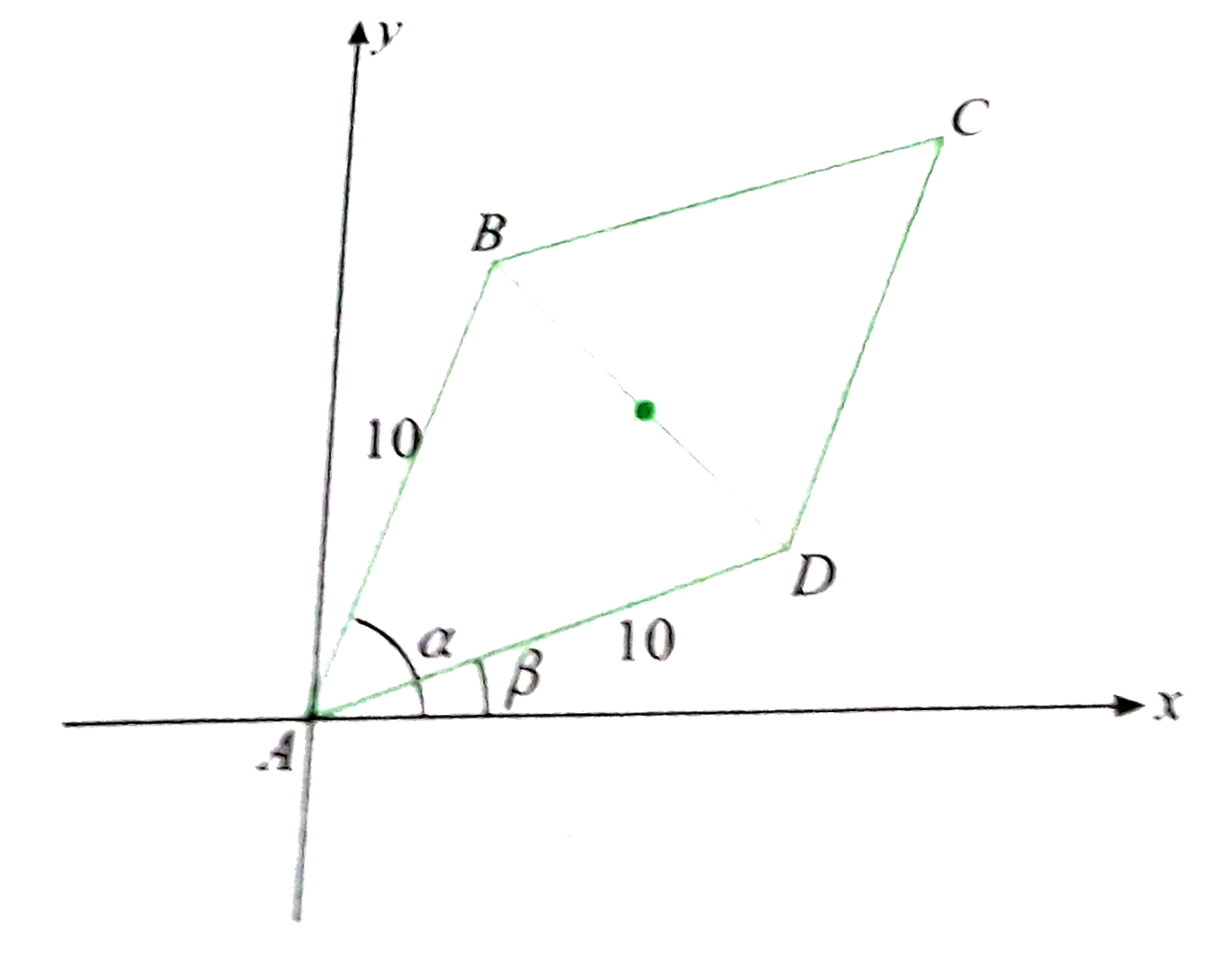
`B(6,8),C(14,14),D(8,6)`


In the figure,`tan alpha=(4)/(3)`
`therefore` Coordinates of point B
`-=(10cosalpha,10sinalpha)`
`-=(10xx(3)/(5),10xx(4)/(5))-=(6,8)`
Also, `tanbeta=(3)/(4)`
`therefore` coordinates of Point D
`-=(10cosbeta,10sinbeta)`
`-=(10xx(4)/(5),10xx(3)/(5))-=(8,6)`
Diagonals of rhombus bisect. So, midpoint of BD is `(7,7)` which is midpoint of AC. therefore, coordinates of C are `(14,14)`.
Promotional Banner

Topper's Solved these Questions

  • COORDINATE SYSYEM

    CENGAGE PUBLICATION|Exercise Concept applications 1.5|5 Videos
  • COORDINATE SYSYEM

    CENGAGE PUBLICATION|Exercise Concept applications 1.6|9 Videos
  • COORDINATE SYSYEM

    CENGAGE PUBLICATION|Exercise Concept applications 1.3|10 Videos
  • COORDINATE SYSTEM

    CENGAGE PUBLICATION|Exercise Multiple Correct Answers Type|2 Videos
  • CROSS PRODUCTS

    CENGAGE PUBLICATION|Exercise DPP 2.2|13 Videos

Similar Questions

Explore conceptually related problems

The distance between the point on x axis and (3, 2, —4) is m unit.Find the co-ordinate of that point which lies on x axis

A rectangular billiard table has vertices at P(0,0),Q(0,7),R(10 ,7), and S(10 ,0)dot A small billiard ball starts at M(3,4) , moves in a straight line to the top of the table, bounces to the right side of the table, and then comes to rest at N(7,1) . The y- coordinate of the point where it hits the right side is 3.7 (b) 3.8 (c) 3.9 (d) 4

A point P moves such that sum of the slopes of the normals drawn from it to the hyperbola xy=16 is equal to the sum of ordinates of feet of normals. The locus of P is a curve C

At any point (x,y) of a curve, the slope of the tangent is twice the slope of the line segment joining the point of contact to the point(-4, -3).Find the equation of the curve given that it passes through (-2, 1).

Find the equation of a curve passing through the point (0,1).If the slope of the tangent to the curve at any point (x,y) is equal to the sum of the x coordinate(abscissa) and the product of the x coordinate and y coordinate (ordinate) of that point.

A curve passes through the point (5,3) and the product of its slope and ordinate at any point (x,y) is equal to its abscissa. Find the equation of the curve.

The slope of the normal to the parabola 3y^(2)+4y+2=x at a point it is 8. find the coordinates of the points.

Let A,B and C be three distinct points on y^(2) = 8x such that normals at these points are concurrent at P. The slope of AB is 2 and abscissa of centroid of Delta ABC is (4)/(3) . Which of the following is (are) correct? (a) Area of DeltaABC is 8 sq. units (b) Coordinates of P -= (6,0) (c) Angle between normals are 45^(@),45^(@),90^(@) (d) Angle between normals are 30^(@),30^(@),60^(@)

A ray emerging from the point (5, 0) is incident on the hyperbola 9x^2-16 y^2=144 at the point P with abscissa 8. Find the equation of the reflected ray after the first reflection if point P lies in the first quadrant.

The slope of the tangent line to the curve x^(3)-x^(2)-2x+y-4=0 at some point on it is. 1. Find the coordinates of such point or points.

