

Home
Class 12
MATHS
The graph of the derivative f'(x) is giv...

The graph of the derivative f'(x) is given in the following figure.
(a) Find the interval in which f is increasing or decreasing.
(b) Find the values of x for which f has local maximum or minimum.
(c) Find the intervals in which f is concave upward or downward.
(c) Find the point of inflection.

Text Solution

Verified by Experts

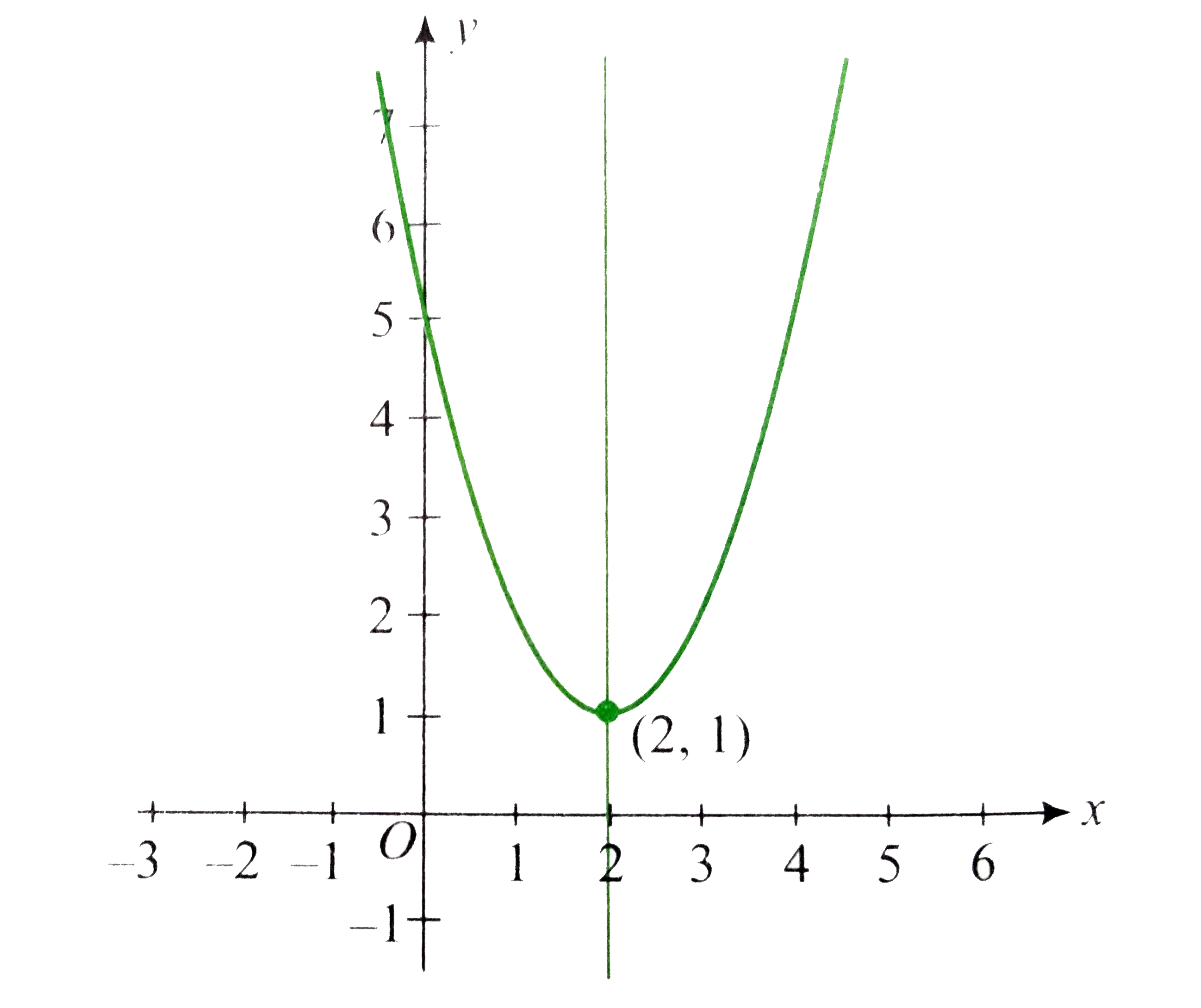
We have `f:R to [1,oo),f(x)=x^(2)-4x+5`
or `f(x) =(x-2)^ (2)+1.`
Graph of the function is as shown in the following figure.

Clearly f(x) is many-one function.
However, in the interval `(-oo,2] or [2,oo), f(x)` is one-one.
For ` f:(-oo,2] to [1,oo),y=(x-2)^(2) +1`
` :. (x-2)^(2)=y-1`
` implies x-2=sqrt(y-1)`
`implies x=2-sqrt(y-1)`
Thus `f^(-1):[1,oo) to (-oo,2],f^(-1)(x)=2-sqrt(x-1)`
For `f:[2,oo) to [1,oo),y=(x-2)^(2)+1`
`implies x=2 +sqrt(y-1)`
Thus ` f^(-1):[1,oo) to [2,oo),f^(-1)(x)=sqrt(x-1)+2`
Promotional Banner

Topper's Solved these Questions

  • PROPERTIES AND SOLUTIONS OF TRIANGLE

    CENGAGE PUBLICATION|Exercise Archives (Numerical Value Type)|3 Videos
  • SCALER TRIPLE PRODUCTS

    CENGAGE PUBLICATION|Exercise DPP 2.3|11 Videos

Similar Questions

Explore conceptually related problems

The graph of the derivative f'(x) is given in the following figure. (b) Find the values of x for which f has local maximum or minimum. (c) Find the intervals in which f is concave upward or downward. (d) Find the point of inflection.

Find the intervals in which f(x)=x^2+2x-5 is increasing or decreasing.

Find the intervals in which f(x)=(x+2) e^(-x) is decreasing

Find the intervals in which f(x)=(x+2) e^(-x) is increasing

Find the interval in which f(x)=2x^3+3x^2-12x+1 is increasing.

Find the interval in which f(x)= 4x^3+3x^2+2x+1 is increasing.

Find the interval in which the function f(x)=x^x(x>0) is decreasing.

Find the intervals in which the function f(x)=3/x+x/3 is decreasing

Find the intervals in which the following functions are increasing or decreasing f(x)=3x^2-4x

The graph of the second derivation f''(x) is given in the following figure. State the x - coordinate of the point of inflection of f. Given reasons for your answer.

CENGAGE PUBLICATION-RELATIONS AND FUNCTIONS-All Questions
  1. If f and g are one-one functions, then (a)f+g is one one (b)fg is one ...

    Text Solution

    |

  2. Which of the following function/functions has/have point of inflection...

    Text Solution

    |

  3. The graph of the derivative f'(x) is given in the following figure. ...

    Text Solution

    |

  4. Let A=R-{3}, B=R-{1} and f: A rarr B defined by f(x)=(x-2)/(x-3). Is '...

    Text Solution

    |

  5. Let f: RrarrR be defined by f(x)=(e^x-e^(-x))//2dot then find its inve...

    Text Solution

    |

  6. Find the inverse of f(x)={(x ,, x<1),(x^2 ,, 1lt=xlt=4), (8sqrt(x) ,,...

    Text Solution

    |

  7. Find the inverse of the function f: [-1,1] to [-1,1],f(x) =x^(2) xx s...

    Text Solution

    |

  8. Find the inverse of the function f:[-(pi)/(2)-"tan"^(1)(3)/(2),(pi)/...

    Text Solution

    |

  9. If f(x)=3x-2a n d(gof)^(-1)(x)=x-2, then find the function g(x)dot

    Text Solution

    |

  10. Let f(x)=x+f(x-1) for AAx in R. If f(0)=1,f i n d \ f(100).

    Text Solution

    |

  11. The function f(x) is defined for all real x. If f(a+b)=f(ab) AA a " a...

    Text Solution

    |

  12. Let a function f(x)s a t i sfi e sf(x)+f(2x)+f(2-x)+f(1+x)=AAx in Rdo...

    Text Solution

    |

  13. Let f be a function satisfying of xdot Then f(x y)=(f(x))/y for all po...

    Text Solution

    |

  14. If f(x) is a polynomial function satisfying f(x)dotf(1/x)=f(x)+f(1/x) ...

    Text Solution

    |

  15. Let f(x)=(9^x)/(9^x+3) . Show f(x)+f(1-x)=1 and, hence, evaluate. f(1/...

    Text Solution

    |

  16. Consider a real-valued function f(x) satisfying 2f(x y)=(f(x))^y+(f(y)...

    Text Solution

    |

  17. Let f be a real-valued function such that f(x)+2f((2002)/x)=3xdot Then...

    Text Solution

    |

  18. If f: R->R is an odd function such that f(1+x)=1+f(x)and x^2f(1/x)...

    Text Solution

    |

  19. Let f: R^+vecR be a function which satisfies f(x)dotf(y)=f(x y)+2(1/x+...

    Text Solution

    |

  20. A continuous function f(x)onR->R satisfies the relation f(x)+f(2x+y)+5...

    Text Solution

    |